
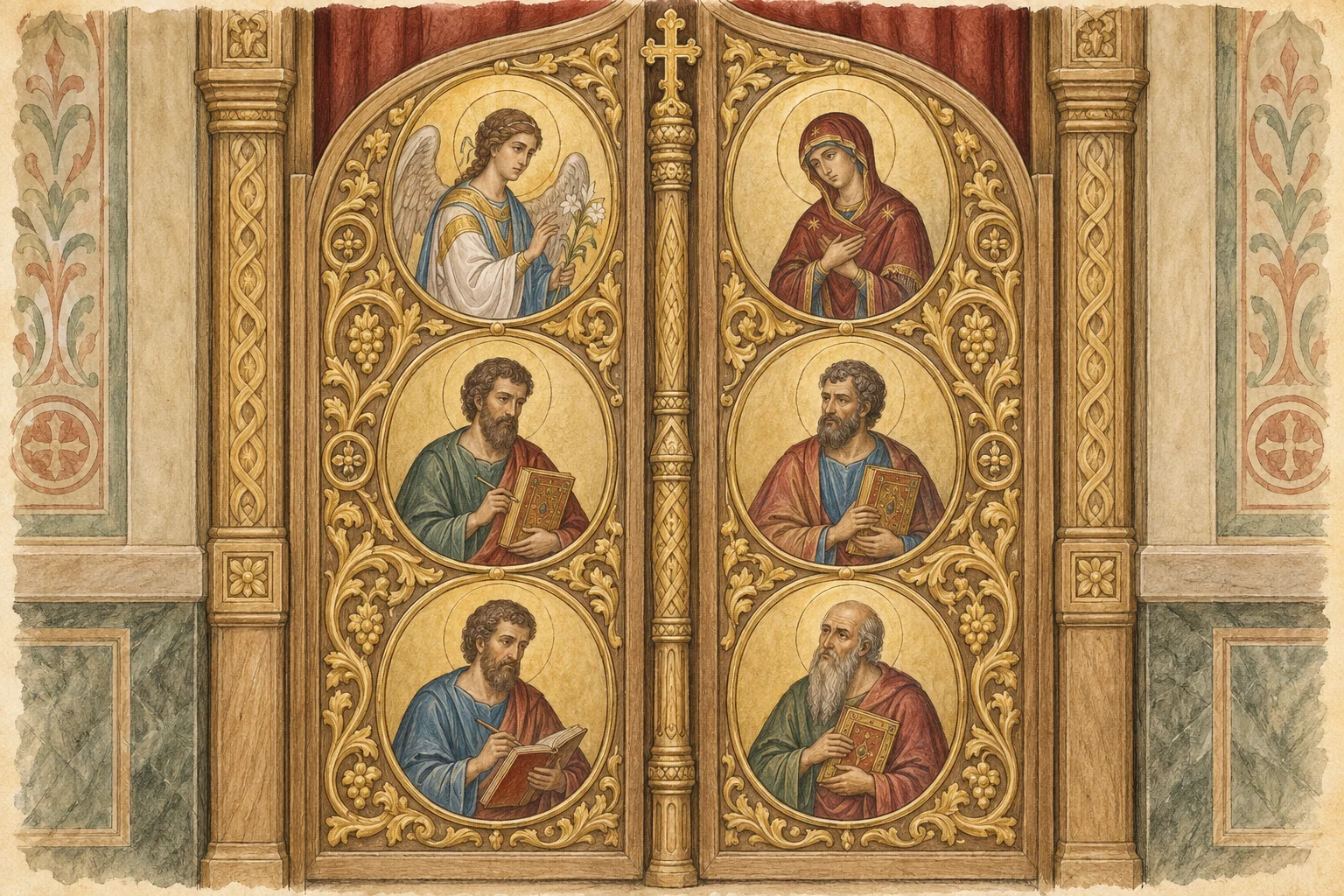
The Royal Doors stand at the centre of the icon screen and lead toward the altar table. They open and close at particular points in worship. This does not mean that some people gain access to God's help while others lose it. Their movements belong to the language of the service, marking entrances, proclamations, and the bringing out of the Holy Gifts.
What Happens at the Open Doors
The clergy use the central doors for actions appointed by the service. At the Liturgy a worshipper may recognize the entrance with the Gospel, the Great Entrance, and the bringing out of the chalice for Communion. These are helpful landmarks, but every opening is not a signal to move forward. Each action has accompanying words and its own place.
When the chalice is brought out and the invitation is given, those prepared for Communion approach. If you are new to church, ask about participation beforehand. Open doors do not invite visitors to enter the sanctuary independently, approach the altar table, or take photographs inside.
Why They Close
Liturgical explanations may connect closing the doors with the hiddenness of the mystery or with events in salvation history. Such interpretations can be helpful without becoming the only possible explanation of every movement. Each action also has its history and its practical place within the service.
Closed doors do not sever the congregation's prayer from the priest's prayer. Participation is not only visual: people hear the proclamations, respond in prayer, and stand before God together. You do not need to find a gap or change position repeatedly to maintain an uninterrupted view of the altar.
Why Parishes Differ
Orthodox traditions differ in their use of the doors and curtain. Local custom, episcopal celebrations, and ecclesiastical directions affect the practice. A difference observed in another parish is not by itself proof of an error. Ask the priest calmly after the service if you would like to understand a particular arrangement.
Bright Week is distinguished by open doors expressing Paschal joy. Even here, the general meaning should be distinguished from the exact rubrics concerning when the doors close. Their position is not a measure of how much grace is available, nor a way of identifying an especially effective moment for a personal request.
Finding Your Bearings
Listen as well as watch: notice whether the congregation is hearing a reading, offering a petition, singing a hymn, or being invited to Communion. The movements will gradually form an intelligible sequence. Begin with two landmarks, perhaps the Gospel entrance and the appearance of the chalice, instead of trying to memorize all the rubrics immediately.
Follow parish rules about photographs and do not block the clergy's path for a better view. When a child asks why a door is closed, explain that different parts of worship have their own order. There is no need to threaten punishment for an accidental glance. Respect for the sanctuary grows through a clear explanation of boundaries, not fear of moving doors.
The curtain behind the doors and the doors themselves are distinct, even if a visitor perceives them as one barrier. Clarify whether your question concerns opened doors, a drawn curtain, or movement through a side door. This avoids apparent contradictions between descriptions and observations. Prayer still does not require continuously monitoring every movement.
Boundaries and welcome
Respecting the sanctuary boundary does not mean being an unwelcome guest in church. Different parts of the building have purposes, just as different participants have responsibilities in worship. A visitor need not pass through every doorway to participate fully. If you are asked to help with a task involving an unfamiliar route, clarify with the person responsible exactly where to go. Do not infer permission merely because you previously saw someone else there.
With a child, agree on a clear boundary beforehand: we stay here and leave room for those serving to pass. This explanation is more helpful than describing a dangerous place they must never approach. If a child steps in the wrong direction, stop them calmly and return to your place. There is no need for a loud confrontation beside the doors, or to connect an accidental mistake with some future misfortune.
Reading explanations of the service
Older and newer guides can offer different symbolic readings of an action. Not every difference amounts to a disagreement about faith. One author may highlight a particular aspect of worship while another describes its practical ordering. Separate three questions: what happens, what this form of the service prescribes, and what interpretation the writer offers. Confusing them can turn a symbolic explanation into an alleged rule for every parish and period of history.
Observing a whole episode
Instead of recording every opening, choose a connected episode: the appearance of the Gospel, its reading, and the assembly's response. Notice that the book is not simply displayed; its word is proclaimed and received in prayer. On another visit, explore the preparation for Communion. Following a whole action is more informative than a photograph of one second without sound or context. Open doors in an image do not by themselves identify which part of a service is taking place.
If your height, the crowd, or a visual impairment prevents a clear view, do not treat that as exclusion from prayer. Choose a safe place where audible landmarks are accessible. There is no need to compete for an uninterrupted view of the centre. The congregation is not an audience whose participation depends on obtaining the best seat in front of a stage. Listening and responding remain meaningful when you cannot see every action.