
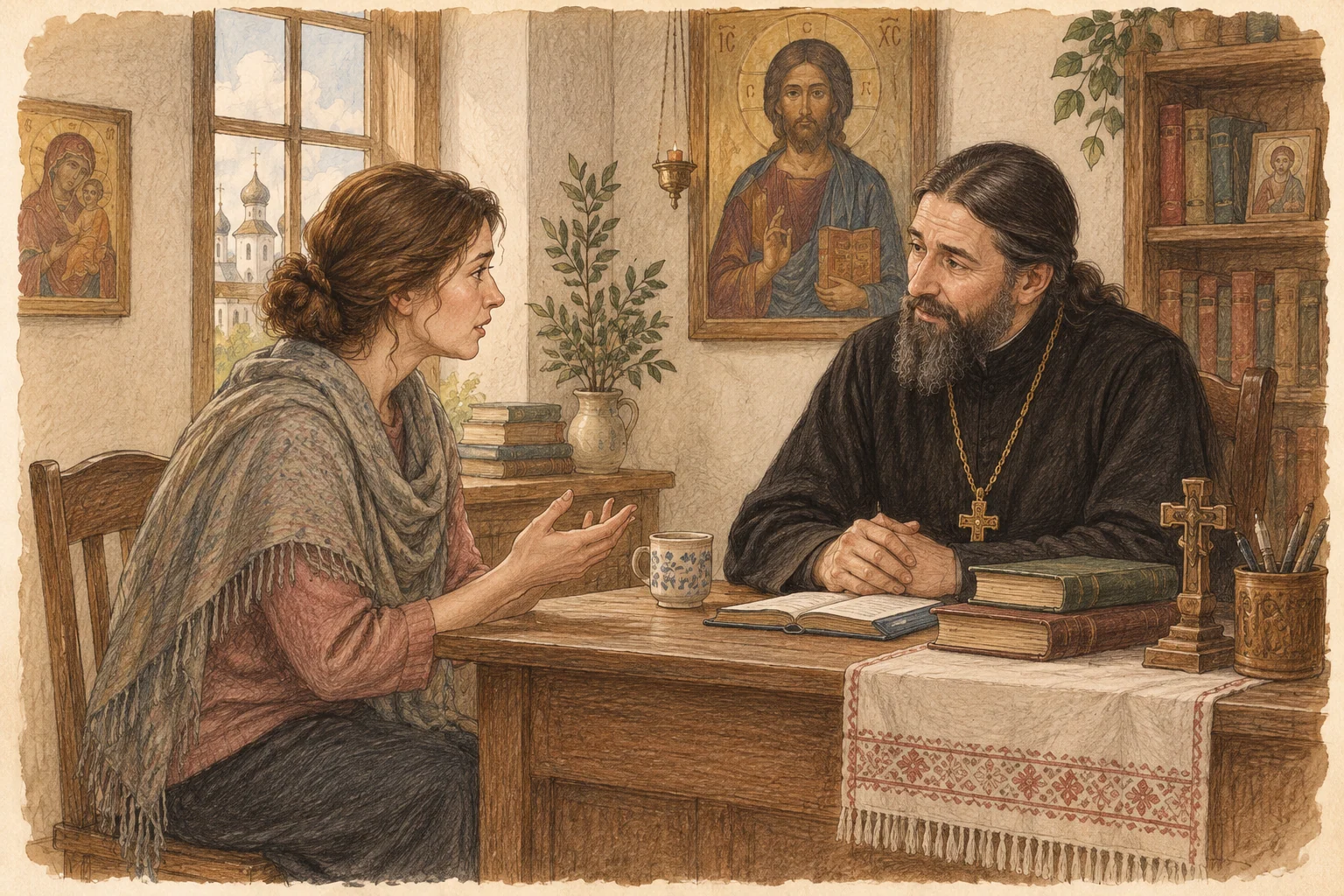
The expression church divorce is often used for several different matters: separation, civil divorce, the Church's consideration of a crowned marriage, and the possibility of another church wedding. These should not be confused. In the Russian Orthodox Church, there is no automatic ceremony that simply removes the crowns on request and cancels a shared history.
What the Church Considers
The document On the Canonical Aspects of Church Marriage describes recognition that a marriage has lost canonical force. Diocesan authority considers the matter; civil divorce does not replace its decision. Permission for a later church wedding is not automatic either. Grounds and circumstances are assessed through ecclesiastical procedures, not an online test or an intermediary's promise.
You do not need a perfect technical description before seeking help. At an initial conversation, you can simply explain that the marriage has broken down, a church wedding took place, and you need to understand your continuing church life. You need not begin by demanding a particular certificate. The first need may be support, confession, and a calm explanation of the next step.
Where to Ask and What to Prepare
Start with a parish priest and the official contacts of your diocese. Ask who receives enquiries, how to arrange a meeting, where documents should go, and which information is actually required. Do not send identity documents, medical information, or intimate details to strangers promising a faster outcome. Verify contact details independently on the diocese's official website.
A short chronology can help: civil marriage, church wedding, separation, civil divorce, and whether there are children. Note separately which information or documents you lack. This is a tool for clear conversation, not a universal mandatory checklist. Confirm the required documents, submission process, and timescale locally. Promising every reader an identical procedure would be misleading.
Truthfulness Without a Public Trial
Describe facts while distinguishing direct knowledge from assumptions about motives. Do not invent a more convenient reason or hide circumstances to obtain a predetermined answer. Equally, you need not discuss intimate details in a parish chat or with acquaintances. Share the personal history with those genuinely responsible for considering it, in an appropriately private setting.
If there are threats or danger to children, say so plainly and ask about safe arrangements for further communication. Church consideration does not replace emergency protection, healthcare, or advice on civil matters. Do not postpone necessary safety measures while waiting for a church document. Property and parental responsibilities require separate competent advice rather than general legal assurances from an article.
Life After the Breakdown of a Family
Divorce does not make someone unnecessary to the Church. Discuss participation in the sacraments and personal spiritual questions with a priest rather than applying automatic labels to every divorced person. Where you bear responsibility, acknowledge it and repair what is possible. Accepting your responsibility does not mean agreeing with every allegation by a former spouse or surrendering protection.
Do not rush to make another marriage the sole purpose of the conversation. Children need stability, reliable care, and freedom from pressure to choose sides. Adults may need time, trusted support, and professional assistance. An ecclesiastical decision addresses a particular matter; rebuilding life also involves daily commitments and gradually recovering the capacity for trust. No article can replace individual canonical consideration.
Distinguish an Enquiry From Winning an Argument
In a short account, separate an event, its consequences, and your interpretation. For example: shared life ended at a certain time; present contact concerns the children; the other spouse's intentions are not known. This is clearer than a long catalogue of judgements about their personality. If you cannot remember a date, identify it as approximate. If a document leaves something unclear, ask which information should be clarified instead of completing the story with assumptions.
Do not use an approach to the diocese as a threat during an argument. Its purpose is not to make a former spouse agree with you on every matter. Do not involve children in gathering allegations or ask them to carry messages between adults. Even when the circumstances need serious consideration, children should not hear intimate details simply because an adult needs an audience. Keep the ecclesiastical enquiry distinct from the continuing work of responsible parenting.
What to Clarify After the First Response
Note who will consider the matter next, how you will be contacted, and whether further action is required from you. If the wording is unclear, ask what it means for your particular enquiry. An initial pastoral conversation, acceptance of documents, and a final decision are not necessarily the same thing. Do not tell relatives about an outcome you merely anticipate or arrange another church wedding on the basis of someone else's apparently similar experience.
Keep correspondence and copies somewhere private, especially where they contain information about children or health. In a developing relationship, you can honestly explain that the church question remains unresolved without showing another person's private documents to prove your account. The waiting period can be used to establish a more stable daily life rather than continually checking which former spouse has attracted more support from others. Practical steadiness matters independently of how quickly an administrative response arrives.