
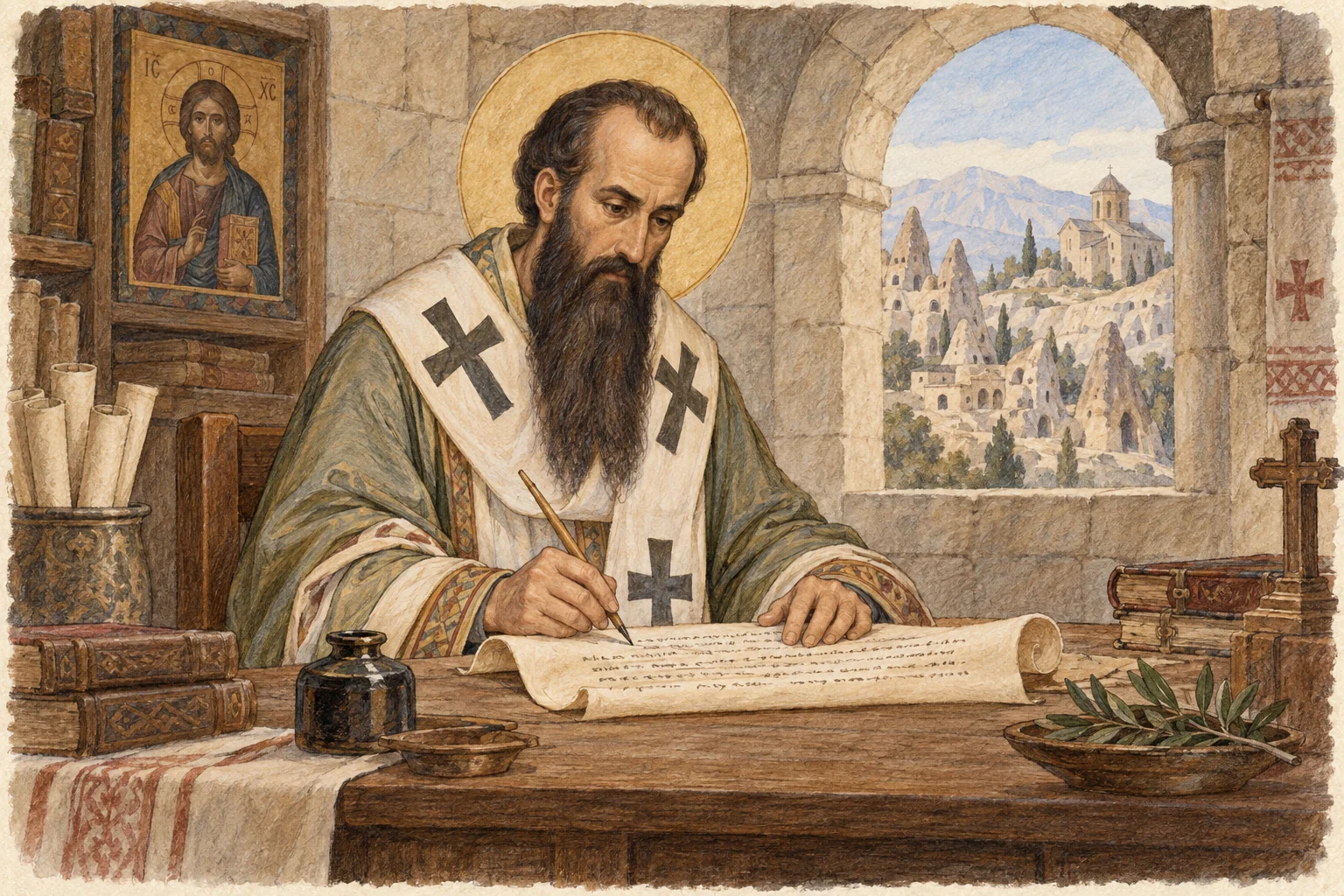
Basil the Great is one of the fourth-century Fathers of the Church. His name is connected with theology, monastic organization, preaching and organized care for people in need. These were not unrelated interests: his understanding of faith shaped his treatment of people, while practical care did not remove the need to speak clearly about God.
Education and episcopal ministry
Basil came from a Christian family in Cappadocia, received a substantial education and formed a close friendship with Gregory the Theologian. He became bishop of Caesarea in 370. His ministry took place amid intense doctrinal disputes and pressure from imperial authority. He died in 379.
Education and ascetic life are not presented as opposites in his biography. Reading, reasoning and distinguishing the meanings of words served ecclesiastical responsibility. Basil is therefore a useful companion for someone afraid that questions or study undermine faith. A question is not itself unbelief; honesty and willingness to listen matter in how it is asked.
Reading about the Holy Spirit
In On the Holy Spirit, Basil discusses the Church's glorification of the Spirit and the Spirit's work of sanctification. Beginners may find it demanding because many passages answer specific controversies of the ancient world. Read a short section with commentary rather than trying to master the entire book in an evening.
List unfamiliar terms and investigate their theological meaning. The Holy Spirit should not be reduced to an impersonal energy or a pleasant feeling. Equally, ancient formulations should not be removed from their argumentative context and treated as ready-made answers to every current question. Careful reading needs patience, not merely a collection of striking quotations.
Community and practical care
Basil's legacy includes guidance for monastic life and concern for poor and sick people. His ministry is associated with a charitable complex near Caesarea known as the Basileias. This represents not just personal generosity but the organization of sustained assistance.
For a parish today, that raises practical questions. Who is responsible for assistance? Can a person rely on it more than once? Is the recipient's dignity protected? An impulse of kindness matters, but someone with a long-term need may require predictable support. Good intentions do not remove responsibility for careful handling of donations and people's private information.
Commemoration and a reader's path
Basil's principal feast falls on January 1 in the church calendar, corresponding to civil January 14 in Russian Old Calendar practice during the twentieth and twenty-first centuries. He is also commemorated with Gregory the Theologian and John Chrysostom at the feast of the Three Hierarchs on January 30/February 12. The features of the Liturgy bearing his name deserve a separate explanation.
Begin with a short biography and one manageable text. Afterwards, ask what has changed in your understanding of prayer, shared work or another person's need. You need not accept the first paraphrase you find: check the work's title and context. Calling Basil “the Great” invites a serious encounter with a teacher of the Church; it does not abolish thoughtful reading or authenticate every saying circulated under his name.
When reading in a group, distinguish the author's words from participants' explanations. Begin with a shared question about one paragraph rather than a competition in theological vocabulary. Someone who needs more time to understand is not obstructing the session. Reading together can reveal difficulties that a quick individual reading might otherwise miss.
More Than a Solitary Thinker
The Life of Basil gives an important place to his sister Macrina and her influence on his spiritual formation. His brother is known as Saint Gregory of Nyssa. Gregory of Nyssa should not be confused with Basil's friend Gregory the Theologian: similar names can make a first encounter with this period confusing. A small note of family relationships and friendships helps keep subsequent reading clear.
This changes the picture of a theologian working alone to produce finished formulas. Basil learned, talked with others, received support, and answered people. A reading group today can likewise make room for different questions. Someone without specialist training may notice what experienced readers have stopped explaining. Clear language does not diminish a complex argument; it makes discussion more honest and allows other participants to understand what is actually being claimed.
From Good Intentions to Organised Assistance
Reflecting on the Basileias helps distinguish a single response from an arrangement people can depend upon. If a parish collects groceries, filling boxes is only a beginning. Who receives them, how are they delivered, who checks the contents, and can an older recipient carry the parcel? What happens after the collection ends? These are not petty administrative distractions from mercy. They determine whether the intended help reaches someone in a useful form.
Start with a limited undertaking, such as providing necessary supplies to one household regularly for an agreed period. Identify a contact person without promising indefinite support that cannot be funded. The recipient's consent and privacy matter alongside accountability to donors. This is not a reconstruction of daily operations in the ancient Basileias, which a short article cannot fully establish. It is a contemporary question prompted by the scale and practical character of Basil's ministry.