
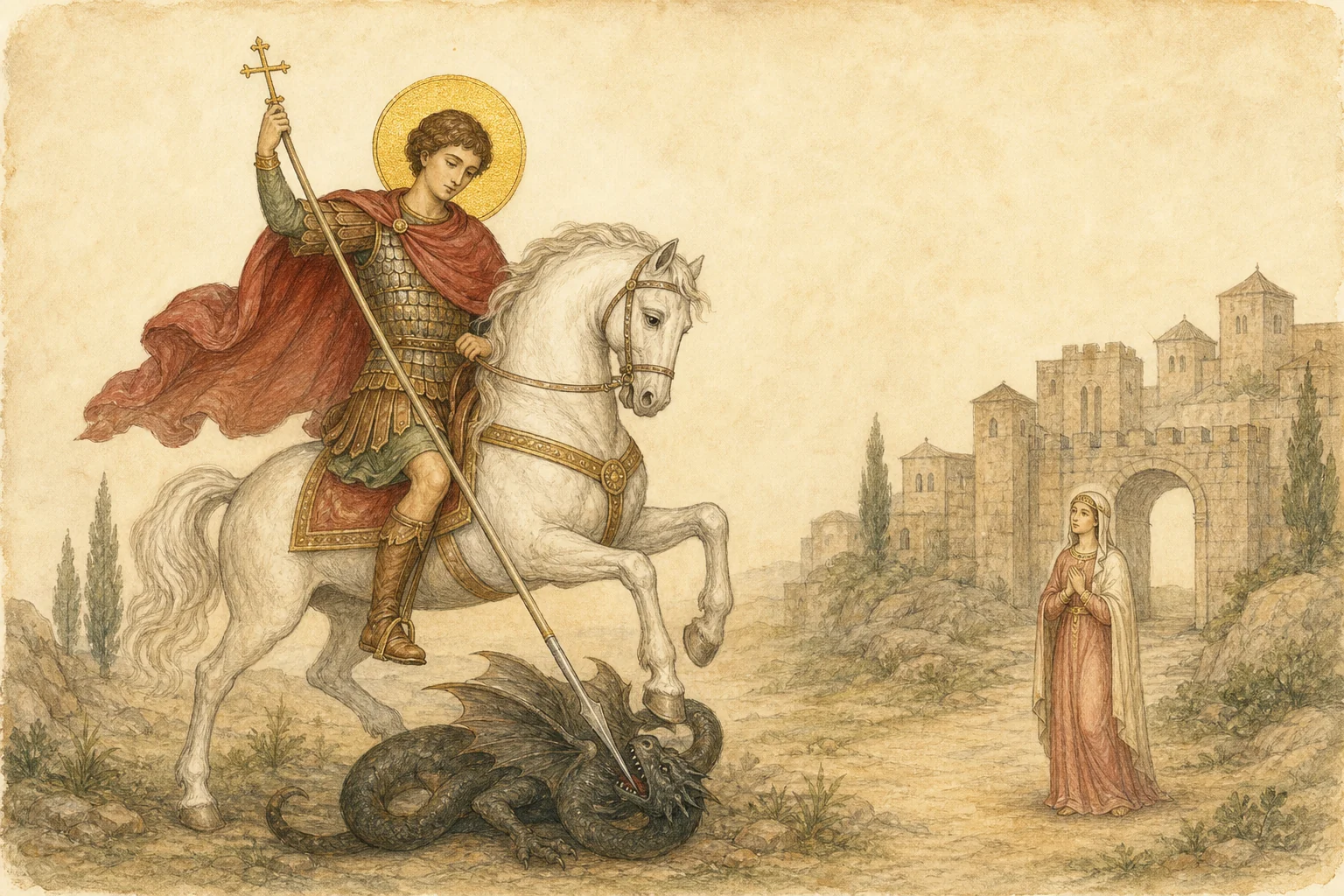
Great Martyr George the Victory-Bearer is an early Christian saint who chose fidelity to Christ over rank, safety, and life itself. The Church remembers him not primarily as the hero of a successful battle but as a martyr: a person who overcame fear, coercion, and violence through faithful witness.
His principal feast in the Russian Orthodox Church falls on May 6 in the civil calendar. For our parish this is the patronal feast because the church in Krasavitsa is dedicated to Saint George.
Who Saint George was
Church tradition places George at the end of the third and beginning of the fourth century, during the reign of Emperor Diocletian and a severe persecution of Christians. He came from a Christian family and served in the Roman military, yet publicly confessed Christ when obedience to the state demanded apostasy.
The ancient core of his life concerns courage before persecutors and death for the faith. Details in later recensions vary, so a responsible account should not pretend to offer a modern documentary biography where the sources do not permit certainty.
Why he is called a Great Martyr
The title Great Martyr is given to saints whose suffering for Christ was exceptionally severe and whose witness received broad ecclesial veneration. “Great” does not describe earthly rank or make one saint more valuable to God than another; it marks the scale of the confession remembered by the Church.
Christian martyrdom is not a search for pain and does not despise life. It is fidelity when a person is forced to call falsehood truth and to abandon Christ for survival.
What Victory-Bearer means
George's victory is first spiritual. His persecutors could take his earthly life, but they could not compel him to renounce Christ, hate other people, or approve evil.
The saint is therefore not a charm that guarantees military success. His image teaches that Christian victory begins with fidelity, self-command, and protection of the vulnerable rather than a desire to dominate.
When Saint George is commemorated
The principal feast is May 6, corresponding to April 23 in the old calendar. The Church calendar also contains other commemorations connected with churches, miracles, and sacred objects associated with the martyr.
If you wish to attend the patronal feast at our church, consult the current service schedule. The time of worship and parish events can change from one year to another.
What is known about his martyrdom
Hagiographic tradition places George's suffering during the Diocletian persecution. He openly identified himself as a Christian, endured torture, and was beheaded. The Church's central concern is not the physiology of pain but a freedom that imperial power could not erase.
Detailed accounts of torture in later texts should not become entertainment or a way to frighten children. They testify that the saint's faith was not a temporary opinion that vanished under threat.
The dragon story: history or tradition?
The dragon miracle is one of the best-known scenes associated with George, but its surviving literary and visual witnesses are much later than the martyr. The Orthodox Encyclopedia identifies early surviving images from around the eleventh century and manuscripts of the developed story from the twelfth and thirteenth centuries.
It is therefore honest to call this a church tradition and symbolic narrative rather than an eyewitness news report. That distinction does not remove the spiritual meaning of the icon.
What the dragon means in the icon
The dragon represents evil, idolatry, fear, and a destructive power that constantly demands new victims. George strikes it to free a person, not to celebrate cruelty; the rescued maiden and the city often appear in the composition.
The spear points to determined resistance against sin. A Christian must never label a neighbor, a nation, or someone with a different opinion “the dragon” in order to justify hatred.
Why George is shown as a soldier
Military clothing recalls George's earthly service and makes his choice visible: the weapons of the empire did not become his highest loyalty. He placed career and security beneath conscience before God.
The Church prays for those in military service and honors courage, but Saint George must not become a sign of hatred. Christian prayer seeks preservation of the soul, peace, justice, and mercy toward defenseless people.
Why he is widely venerated in Russia
Veneration of George came to Rus with Byzantine Christianity. Princes bore his name, churches were dedicated to him, and the horseman image entered civic and state symbolism.
Historical popularity does not make the saint the property of one state. Orthodox Christians in many countries honor the Great Martyr, and his ecclesial memory is broader than any political period.
What people ask Saint George to pray for
Christians ask for courage to keep the faith, protection from evil, help in danger, peace, justice, and strength for people carrying serious responsibility. Prayer to a saint means asking him to pray to God with and for us.
George does not replace Christ and does not execute requests through a formula. No responsible pastor can promise that a number of candles, a pilgrimage, or a special object guarantees a chosen outcome.
May one pray for a service member?
Yes. One may ask for the preservation of life and conscience, wisdom for leaders, an end to hostility, and a safe return home. Such prayer should not desire the death of other human beings.
When a family lives with constant anxiety, prayer can be joined to human care: conversation, support for children, medical help, and qualified psychological assistance when needed.
Patron of our parish church
The church in Krasavitsa bears the name of Great Martyr George. On his feast, the community gives special thanks for its patron and remembers that dedication creates a calling to imitate the saint; it is more than a label on a building.
The parish page tells the history of the church. A relic of the Great Martyr is also venerated here; our separate guide explains what holy relics mean and how to approach them without superstition.
Preparing for the patronal feast
Check the schedule, arrive near the beginning, and do not make the day a contest in external actions. If you plan to receive Confession and Communion, ask about parish practice in advance and prepare without panic.
A patronal feast may include a procession, a parish meal, or a community gathering, but the actual program is announced locally. An old news post should never be treated as this year's timetable.
How to venerate an icon of George
Make the sign of the cross, bow according to your ability, pray briefly, and, when customary and safe, kiss the edge or the depicted hand rather than the face. Do not hold up a line or correct strangers.
If you are ill, concerned about infection, or unable to bend, standing before the icon and praying is sufficient. Our practical guide explains how to venerate icons without anxiety.
How to tell a child about the saint
Begin with his choice rather than graphic torture: George refused to betray Christ and did not answer hatred with hatred. The dragon image can be explained as the victory of goodness, fidelity, and protection over fear.
Never promise that the saint will make a child invulnerable. Ask where quiet courage is needed today: admitting a mistake, defending someone bullied, refusing to join cruelty, or telling the truth gently.
George as a baptismal patron
A person named George may have the Great Martyr as his patron, but the calendar includes other saints with the same name. The patron is identified through Baptism and family-parish tradition, not merely by an automatic nearest-date search.
Our guide to name days, baptism anniversaries, and birthdays explains these distinctions.
An icon is not an amulet
An image of Saint George should not be treated as an amulet for a car, a business, or dangerous work. A blessed icon calls a person to prayer and faithful life; it does not replace a seat belt, professional standards, or personal responsibility.
Do not rank icons by the price of a cover or rarity of materials. Honor passes to the saint depicted, while prayer reaches God with a request for the saint's intercession.
Veneration versus superstition
Veneration leads to thanksgiving, repentance, and imitation of the saint. Superstition promises an automatic result, advertises the “strongest” icon, and frightens people with punishment for an accidental mistake in gesture.
If advice requires a secret ritual, a large payment, or guarantees victory over a particular person, it is not sound Orthodox pastoral care.
A short prayer in one's own words
You may say: “Holy Great Martyr George, pray that I may keep the faith, refuse to return evil for evil, and fulfill my duty with courage.” A simple request can stand beside the prayers given by the Church.
Prayer does not need to feel emotionally intense. Honesty, attention, and a willingness to take the next right step matter more.
Frequently asked questions
Is Saint George's feast always May 6?
May 6 is his principal commemoration in the Russian Orthodox Church's civil calendar. Other commemorations also appear in the liturgical calendar.
Did a literal dragon exist?
The developed story belongs to later church tradition. The icon principally reveals spiritual victory over evil and the liberation of the vulnerable.
May I ask the saint for victory in battle?
Pray for preservation of life and conscience, peace, justice, and an end to evil, not for hatred or suffering inflicted on others.
Must I kiss the icon?
No. A bow and attentive prayer are sufficient when health or another serious reason makes kissing inappropriate.
Why is our church named for George?
It was consecrated in honor of the Great Martyr, and his feast is the patronal celebration of the parish community.
The central message
George is the Victory-Bearer not because weapons made him stronger than everyone else, but because violence could not make him betray Christ. Martyrdom, rather than imaginary invulnerability, is the center of his life.
Honor him by asking for courage, peace, and fidelity, joining the Church's worship, and learning to defend the vulnerable without hatred. Then the familiar horseman is no talisman; he becomes an honest question addressed to our conscience.