
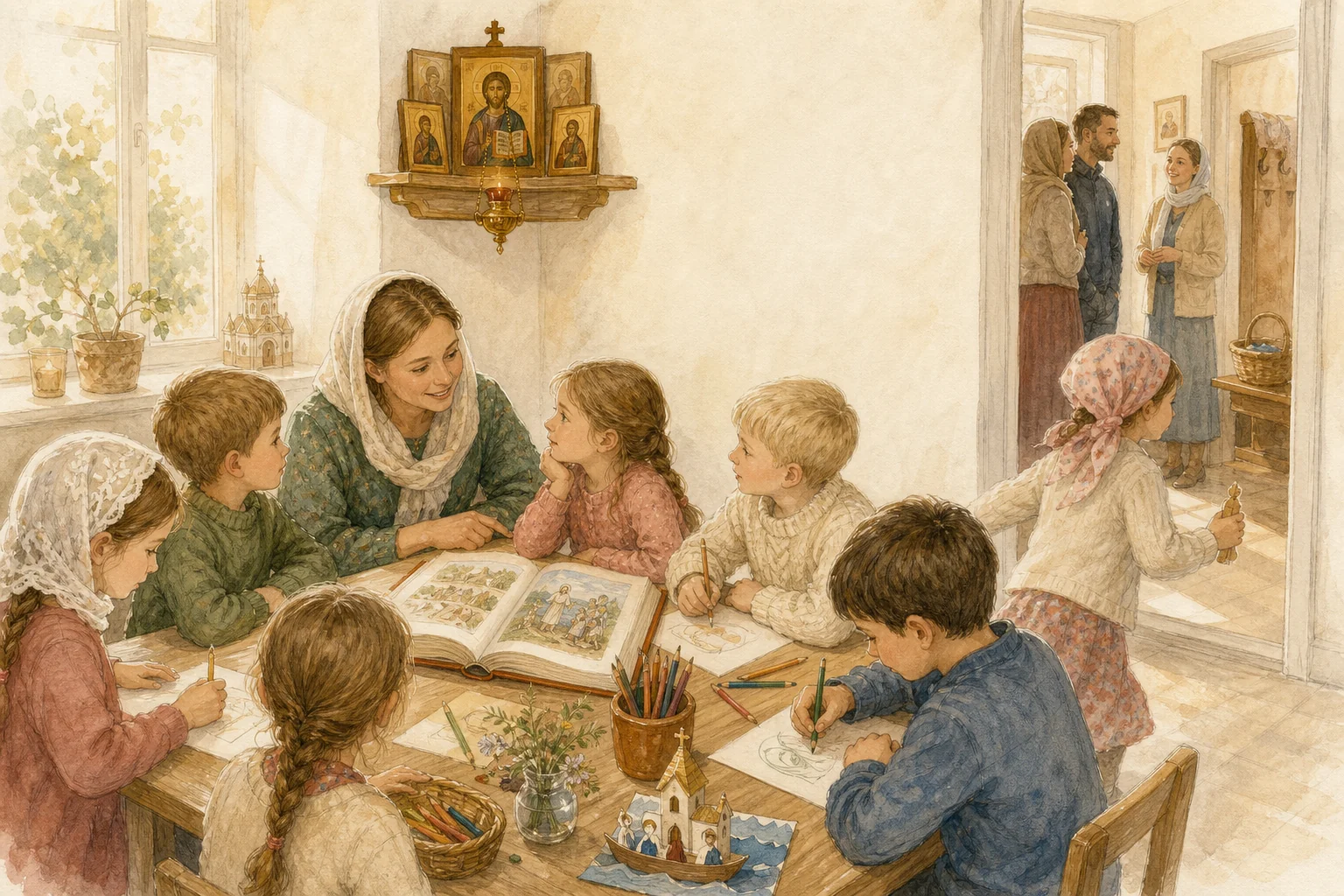
A parish Sunday school helps children encounter Scripture, Orthodox faith, and community life through lessons, conversation, interactive activities, and play. It does not replace ordinary education, family responsibility, or participation in worship; it offers a gentle space where faith can become understandable at the child's age.
Saint George Church in Krasavitsa has a Sunday school. Exact age groups, enrollment periods, and meeting times must be confirmed with the parish because they may change; this article deliberately avoids inventing permanent hours.
Why Sunday school exists
A child hears unfamiliar words and sees actions in church whose meaning is not immediately clear. During a lesson, questions can be asked, a Gospel account explored, a feast connected with daily life, and prayer learned without fear of making a mistake.
The school also creates a circle where children meet beyond a brief moment in worship and learn friendship, play, service, and participation in parish life.
What our parish has confirmed
The parish states that the school serves the spiritual and moral formation of children. Its program includes lessons, Scripture reading, interactive activities, and games.
An attentive and accessible approach to each child and the formation of a living community are explicit aims. See the school's place in parish life on the Community page.
What a class may look like
A meeting can combine a short common prayer, a story or reading, questions, creative work, movement, and play. Changing activities is particularly important for younger children.
The actual duration, materials, and division by age depend on the current group. Ask the teacher rather than promising a child the format used by another parish.
What children learn
Topics commonly include the Gospel, feasts, sacraments, prayer, saints, and Christian relationships. The goal is not to accumulate encyclopedia facts but to connect knowledge with life.
A healthy lesson leaves room for questions and the honest words “I do not know yet.” Faith does not require a teacher to invent a quick answer to a difficult subject.
School or activity club?
The word school points to systematic learning, yet parish education is ordinarily gentler than general education. A program and assignments may exist, but a child must not be graded as a “bad Christian” for an error.
Ask whether there is homework, participation in performances, and an attendance expectation. A family should understand the commitment before enrolling.
What ages are accepted?
Sunday schools serve different ages, but this specific question must be put to our parish. The word children on a page does not establish a lower and upper boundary.
State the child's age, experience of church, and relevant needs. The teacher can say whether a suitable group is currently available.
Must a child be baptized?
The parish determines enrollment practice. A family just encountering Orthodoxy or preparing for Baptism may describe the situation honestly and ask whether participation is possible.
Do not conceal the facts or baptize a child merely to gain formal access to a club. Baptism is a free ecclesial sacrament requiring its own preparation.
Must parents already belong to the parish?
This also needs local confirmation. Even when no strict requirement exists, family participation matters: a child cannot easily connect a lesson with life when adults dismiss everything learned.
A parent need not already understand theology. A willingness to respect the class, ask questions, and sometimes attend worship offers honest support.
Does school replace the Liturgy?
No. Sunday school helps children understand church life but is not an alternative to common prayer and the sacraments. At the same time, many hours of worship plus class may be too much for a particular child without a break.
The family and teacher seek a realistic rhythm together. Current worship times appear in the service schedule.
May a family visit first?
Ask whether a trial visit, open lesson, or conversation with the teacher is possible. A child can see the room, people, and routine before beginning regular attendance.
Do not promise that the child will immediately be left without a parent. A younger or anxious child may need gradual introduction according to parish practice.
Questions before enrollment
Ask about the age group, dates, duration, fee or donation, required materials, absence policy, and how cancellation is communicated.
Also learn who leads the group, whether parents may observe, and how photographs, video, snacks, outdoor time, and release of the child are handled.
Child safeguarding
A parent may ask who is responsible for the children, how many adults are present, and how arrival, departure, toilets, first aid, and emergencies are managed.
Clarify rules for private adult-child communication, photography, and trips. A spiritual setting does not remove ordinary requirements for safety and transparency.
Allergies and medical needs
Tell responsible adults in advance about allergies, asthma, diabetes, epilepsy, prescribed medicines, and an emergency plan. Never send medication secretly without informing the person responsible.
Ask whether food is served and what it contains. Prayer for health does not replace medical information or readiness to call for help.
Disability and neurodiversity
Discuss physical access, the need for a quiet place, a visual schedule, movement breaks, an aide, or a different communication method. Not every difference requires a separate group, but each requires conversation.
A child with autism, ADHD, hearing impairment, or motor disability is not spiritually disobedient. Together assess the accommodations the parish can genuinely provide.
When a child is shy
Do not demand a public answer or immediate performance at a feast. Agree that the child may first observe, draw nearby, or sit close to the exit.
Ask the teacher to introduce the child simply and give one small, clear task. Belonging grows through repeated safe meetings.
When difficult questions arise
A question about death, injustice, violence in a biblical text, or doubt must not be mocked. A teacher may admit the difficulty and return with a prepared response.
Parents may learn how a subject was explained, but should not demand surveillance of every thought or a report about a child's private Confession.
What Sunday school must never do
It must not humiliate, threaten hell for an ordinary mistake, use corporal punishment, require secrets from parents, or declare a teacher incapable of error.
If a child reports frightening touch, threats, or a secret, listen calmly, secure safety, and inform responsible authorities. A possible crime must be reported to the appropriate services.
Parent participation
A family may help with materials, feast preparation, supervised outings, or ordinary volunteering when the parish offers this and defines responsibility.
Helping does not grant authority over other people's children without rules. Follow the teacher's direction and never publish photographs of another child without consent.
Supporting the lesson at home
Instead of asking “What grade did you get?” ask, “What was interesting or difficult?” Read one short Gospel passage, locate a feast on the calendar, or repeat a craft without turning it into a test.
A brief family prayer with children can connect the lesson with daily life when it stays calm and achievable.
When a child does not want to continue
Discover the reason: fatigue, conflict, boredom, fear of answering, noise, a topic that is too difficult, or a broader refusal to enter church. Do not label everything laziness before listening.
A different group, a pause, or a shorter format may help. Our guide to responding without coercion offers a practical plan.
How to contact our parish
Use the information on the Contact page. State the child's age, the hoped-for starting period, church experience, and important needs.
Ask for current conditions rather than relying only on an older announcement. Enrollment and meeting times can change during the year.
Frequently asked questions
Does class meet every Sunday?
Obtain the current calendar from the parish; holidays, breaks, and group composition may affect it.
Is there a fee?
Confirm current terms before enrollment; this article does not claim a price the parish has not published.
May a parent remain?
Ask the teacher. It may be possible for introduction or adaptation, but the group's practice determines the answer.
Must a child already know prayers?
A beginner should not be expected to arrive with complete knowledge; gradual learning is part of the school's purpose.
How do we enroll?
Contact the parish, give the child's age, and request current information about the nearest suitable group.
The central message
A parish Sunday school is a place of learning, community, and gradual encounter with Orthodox tradition. Its value lies not in the number of memorized answers but in joining Scripture, prayer, play, kindness, and a safe community.
Begin with a conversation and an introductory visit. Explain your child's needs, ask about the program and safeguarding, and preserve the right to learn gradually; then the school can support the whole family.