
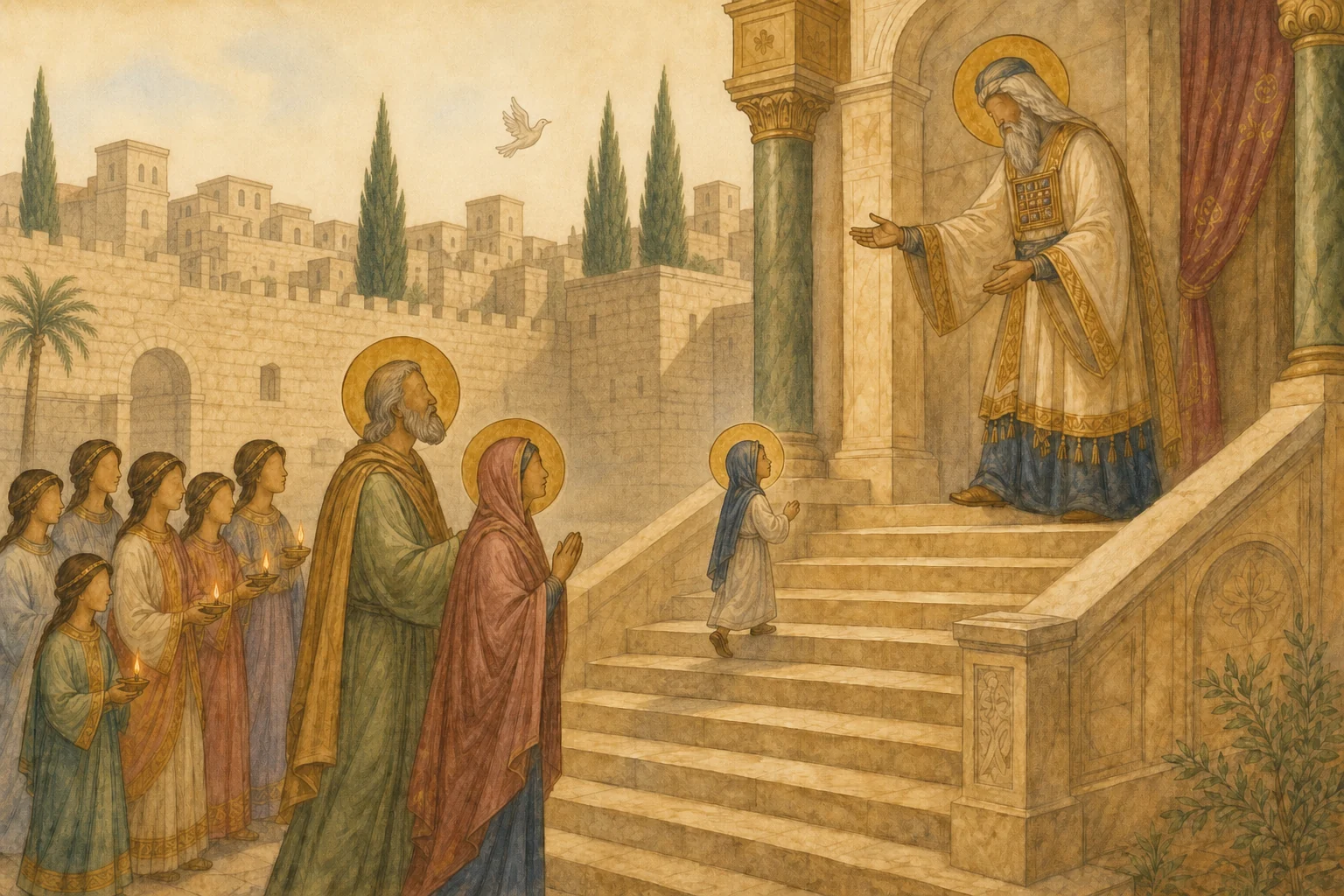
The Entrance of the Mother of God into the Temple is one of the Twelve Great Feasts, celebrated on December 4 in the civil calendar used by the Russian Orthodox Church. It remembers how righteous Joachim and Anna brought the young Mary to the Temple in Jerusalem and dedicated her to God.
The event is known through Church Tradition rather than the canonical Gospels. The feast speaks of Mary's preparation for her future vocation and of the approaching Nativity of Christ. It does not justify forcing a child into religion, and a promise made by parents never erases the freedom of a daughter or son.
When the Entrance is celebrated
The Russian Orthodox Church keeps the feast on November 21 according to the Julian calendar, corresponding to December 4 in the modern civil calendar. It is a fixed date and always falls during the Nativity Fast.
The Entrance belongs to the Twelve Great Feasts. Its place in the annual cycle is shown in our guide to the church year and its principal feasts.
Is the event described in the Bible?
The canonical Gospels do not describe Mary's childhood or her entrance into the Temple of Jerusalem. The account is preserved in Church Tradition, ancient writings, liturgical poetry, and iconography.
It is therefore inaccurate to claim that every detail was written by the Apostles. The Church receives the tradition through worship while still distinguishing it from the direct text of Holy Scripture.
What Church Tradition relates
Righteous Joachim and Anna had remained childless for many years and promised to dedicate a child to God. When Mary was about three years old, they brought her to the Temple accompanied by maidens carrying lamps.
The young Mary ascends the high steps herself, and the high priest receives her. In the festal account this is not a scene of parents abandoning their daughter but a joyful offering of life to God.
Who were Joachim and Anna?
Tradition names them as the righteous parents of the Mother of God. Their long prayer, the birth of Mary, and their gratitude are celebrated in the preceding feast, the Nativity of the Mother of God.
Fulfilling their promise does not imply that a child is the property of the parents. Their righteousness appears in trust toward God, not in control over every part of their daughter's future.
How old was Mary?
Church Tradition says that she was about three years old. The icon reflects this detail: Mary is small in stature but wears the veil associated with the Mother of God and carries the dignity of her future vocation.
The age cannot be made into a historical formula requiring modern parents to remove children from family life. The image belongs to Mary's unique story in salvation.
What dedication to God means
To dedicate a life to God is to place it within trust, prayer, and service. It does not mean transferring ownership of a person to an institution or taking away the person's voice.
Christian formation helps a child encounter Christ, ask questions, and grow toward a free response. Religion imposed by fear may preserve an outward form while destroying the trust that faith requires.
Did Mary enter the Holy of Holies?
Festal Tradition and hymnography say that the high priest brought Mary into the Holy of Holies, the most sacred place of the Temple. The image emphasizes her preparation to become the living temple of the incarnate God.
The liturgical detail should not be turned into a self-confident archaeological reconstruction. Its primary meaning is given in the prayer and poetry of the Church.
Why Mary is called a living temple
She will bear not a symbol of divine presence but the incarnate Son of God himself. The hymns therefore set the stone Temple beside a living human being who receives God.
This dignity does not eliminate Mary's humanity. She grows, prays, learns, and later gives her free answer to God at the Annunciation.
Who receives Mary?
Tradition identifies the high priest as Zacharias, the future father of John the Baptist. In the icon he stands near the Temple gate and bends toward the small child.
His gesture expresses recognition of God's work. The priest does not appropriate the child or replace her parents; he receives the gift with reverence and responsibility.
Why maidens carry lamps
They accompany Mary so that the procession is bright and joyful and the child is not drawn backward toward her parents. Icons show the young women holding lighted lamps or candles.
The light points toward the expectation of Christ. It is not a magical protection and does not require families to reproduce a special candle ritual at home.
How to read the icon of the Entrance
Joachim and Anna usually stand on the left, with the maidens and their lamps behind them. The small Mary climbs the steps or already stands before Zacharias at the Temple entrance.
In an upper part of the icon Mary may appear seated in the Temple and receiving food from an angel. This joins the moment of entrance to the years of spiritual preparation that follow.
Why Mary appears older than a toddler
Her small size indicates childhood, while the traditional garments of the Mother of God reveal her unique place in salvation. An icon is not a photograph and may join chronological and theological meaning.
Her serious expression does not deny childhood or emotional life. It is the iconographic language of attentiveness, inner peace, and readiness.
What the hymn “Christ is born” signifies
At Matins for this feast, the canon refrain announcing that Christ is born is heard prominently for the first time in the yearly cycle. The gaze of the Church is already turning toward the Nativity.
The Entrance becomes a threshold of Christmas expectation: Mary enters the Temple, and worshippers begin to hear more clearly that the Incarnation is drawing near.
How the feast relates to the Nativity Fast
The Entrance always falls within the Nativity Fast. Festal joy does not cancel preparation but shows its goal: meeting Christ rather than completing a dietary achievement.
The liturgical rule commonly permits fish on the feast. Personal practice during illness, pregnancy, treatment, childhood, or frailty should be adapted sensibly and must not damage health.
How the services are celebrated
The All-Night Vigil is normally served on the eve, followed by the Divine Liturgy in the morning. The hymns call Mary the proclamation of God's good will and the announcement of the coming Christ.
Check the exact time in the parish schedule. If work makes the morning impossible, the evening service remains a genuine way to enter the meaning of the feast.
Preparing for Holy Communion
Communion unites the faithful with Christ, toward whom the whole feast points. Preparation includes prayer, repentance, the Eucharistic fast, and the practice for Confession received in the parish.
Do not try to make a child receive through threats or physical restraint. Age, health, and the family's experience require a calm conversation with the priest.
Should a small child remain for the entire service?
A family may stay if the child and parents are coping, but endurance is not a mandatory examination. Small children become tired, need water and movement, and may benefit more from a shorter peaceful visit than from hours of conflict.
Choose a place near an exit, explain a few moments beforehand, and step outside calmly when needed. A parish community should help families rather than shame them for every sound.
Forming a child in faith without coercion
Pray together briefly and clearly, answer questions honestly, show the connection between faith and mercy, and apologize for your own mistakes. A trustworthy example persuades more deeply than pressure.
Never threaten a child with God, force the child to kiss an icon, or use Confession as a surveillance tool. Children need safety, boundaries, and permission to understand worship gradually.
Does a parental vow bind the child's whole future?
Parents may promise to raise a child in faith and give thanks to God. They cannot decide monastic life, profession, marriage, or the entire adult future in advance for that person.
Even Baptism does not make someone the property of a family or parish. The adult task is to help freedom mature within truth, responsibility, and love.
Does the feast say a monastery is better than family life?
No. Mary's unique story does not establish a rule for separating children from parents. Family, parish, school, and monastery each carry different forms of responsibility.
Every modern decision about a child's residence and education must consider safety, law, health, and the child's own developing voice.
When a child does not want to attend church
First discover the reason: fatigue, fear, conflict, unfamiliar language, a service that feels too long, or a previous unpleasant encounter. Do not label resistance as corruption or unbelief.
Shorten the visit, choose a comprehensible event, introduce a kind adult, and discuss the problem without threats. Trust is rebuilt more slowly than outward compliance.
May Christians work on December 4?
Necessary employment, study, care for children, and care for the sick are permitted. When possible, make room for worship and reduce entertainment that scatters attention.
The feast does not magically forbid laundry, cleaning, or cooking. A quarrel caused by a household taboo contradicts the peace of the celebration.
Folk signs and rituals for women
Fortune-telling about marriage, bans on lending household objects, and rites said to produce pregnancy do not belong to Orthodox tradition. They do not become Christian merely because a candle or icon is nearby.
Do not seek a hidden mechanism for obtaining a wish. Prayer, the sacraments, medical care, and honest decisions need no superstitious supplement.
Explaining the feast to a child
Say: young Mary entered the Temple to grow near prayer and prepare to become the mother of Jesus. Find the steps, her parents, Zacharias, and the maidens carrying lamps in the icon.
Let the child light a candle safely with an adult, choose a short prayer, or help prepare a gift for someone in need. Participation matters more than testing knowledge.
Frequently asked questions
On what date is the Entrance of the Mother of God?
It is celebrated on December 4 in the modern civil calendar used by the Russian Orthodox Church.
How old was Mary?
Church Tradition says that she was approximately three years old.
Is the event described in the Gospel?
No. It is known through Church Tradition and interpreted through worship and iconography.
Is fish allowed?
The festal rule during the Nativity Fast commonly permits fish; check the calendar and follow a sensible personal discipline.
Must a child stand through the whole service?
No. Choose a duration appropriate to age and health while protecting prayer and trust.
The central message
The Entrance shows a life open to God from its beginning but never deprived of freedom. Mary enters sacred space and prepares to become the living temple of the Incarnation.
For adults the feast grants responsibility rather than power over children: bring them to the threshold, show them the light, support them, and do not silence their personal answer. We enter the church not from fear of punishment but to meet Christ.