
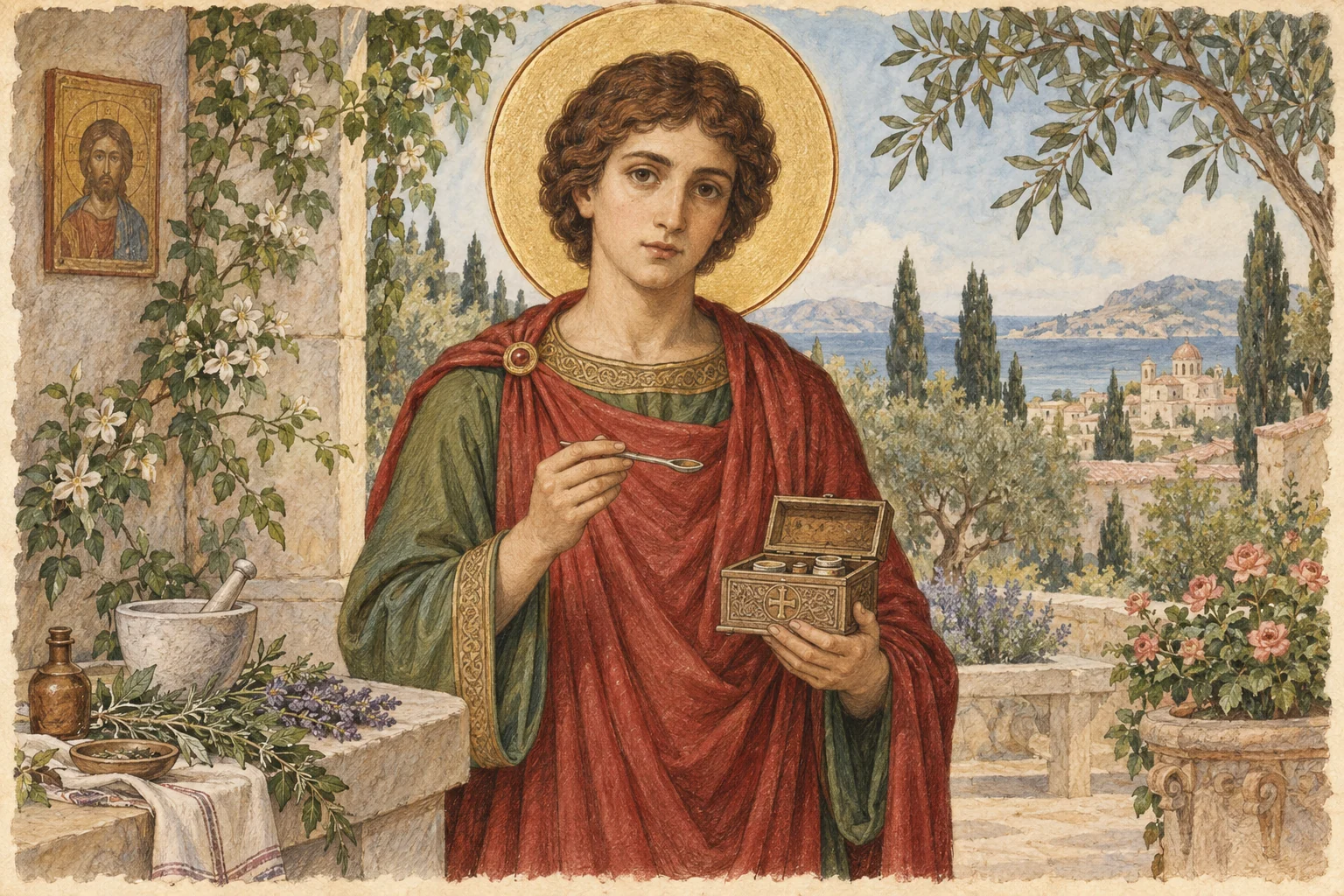
Panteleimon is venerated as a great martyr and healer. His Life joins medical knowledge with compassion and faithfulness to Christ. Presenting a choice between a doctor and prayer therefore distorts the meaning of his memory. People can ask for heavenly intercession while continuing necessary medical care and respecting those who care for the sick.
A physician from Nicomedia
According to his ecclesiastical Life, the future saint lived in Nicomedia, studied medicine and received Christian instruction from the priest Hermolaus. Before Baptism he was named Pantoleon; Panteleimon is associated with the meaning all-merciful. His Life emphasizes help given without demanding payment.
This is an account of a physician's Christian ministry, not a detailed history of an ancient medical school. It cannot supply ready-made treatments, and ancient descriptions of illness cannot automatically be matched to modern diagnoses. For a church reader, the central point is that the patient is not made into an instrument of profit or personal fame.
Martyrdom and accounts of healing
Tradition places Panteleimon's death during the persecutions of the early fourth century, giving the year 305. He is honoured for faithfulness to Christ in the face of violence. Accounts of healings and trials belong to hagiographical tradition; they must not become promises that everyone who prays will experience the same physical outcome.
Martyrdom is not an invitation to seek danger or refuse protection. Nor must a sick person prove endurance by keeping silent about pain. Extraordinary events in a Life and everyday treatment decisions are different kinds of account. It is especially harmful to invoke a saint to pressure a dependent person into rejecting care.
Prayer during illness
You may ask God for healing, relief, wisdom for clinicians and strength for relatives, asking Panteleimon for his intercession. This does not require concealing fear or producing a special emotional state. An honest, simple request is no less meaningful than a long text a weak or exhausted person cannot manage to read.
Prayer does not replace medical assessment, treatment or prescribed medicines. Discuss changes in treatment with the clinician responsible rather than making them on the basis of an online miracle story. When urgent assistance is needed, do not postpone seeking it to finish a prayer rule or visit a shrine. Illness and the absence of healing do not establish a lack of faith.
The feast and care close at hand
Panteleimon's commemoration is July 27 in the church calendar, corresponding to civil August 9 in Russian Old Calendar practice during the twentieth and twenty-first centuries. New Calendar communities may celebrate on civil July 27. Check the date and arrangements for prayer requests with the particular parish.
Honour the healer by supporting a sick person: agree a convenient time to call, bring something needed, help with a practical task or give a carer time to rest. First ask what help is actually wanted. Do not share a diagnosis or photograph without consent, impose advice or demand an account of someone's spiritual experience. Freely offered care that respects personal boundaries is closer to the meaning of Panteleimon's veneration than a promise of an inevitable miracle.
Offer a prayer text to someone in hospital only after asking whether they want it and have the energy. Support does not always require conversation: quiet presence or carrying out a simple request may be enough. A visit should not become an inspection of confession or prayer habits. Care begins with respect for the person's condition and ability to decline.
Personal Prayer and the Church's Prayer
The OCA account of Panteleimon notes his invocation in the Mystery of Anointing the Sick and in prayers for the sick. Veneration therefore extends beyond a domestic image or private reading of his Life. It belongs to the Church's prayer, in which someone need not face illness alone. That does not mean every possible form of participation must be attempted in a single day.
When a patient requests spiritual support, a relative can contact the parish and describe the circumstances: whether the person is at home or in hospital, can speak, and what they want. Arrangements also need to be agreed with the receiving institution. Do not promise a priest's visit before it has been confirmed, or decide on the patient's behalf what participation they require. Clear arrangements reduce unnecessary burdens on someone already facing difficulty.
Generosity and Professional Work
The Life's account of care without payment does not justify demanding unpaid work from every modern clinician. Its moral concern is that a patient should not become an instrument of vanity or exploitation. A doctor has professional responsibilities and may receive an agreed salary. Relatives have responsibilities too: avoid obstructing care with unverified advice or dismissing staff members' daily work while waiting only for an extraordinary event.
A household can divide practical tasks so that one carer is not left responsible for everything. One person prepares food, another assists with travel, and someone else keeps relatives informed with the patient's permission. Such a list is not a medical plan and does not replace clinical instructions. It gives care an understandable form. Honouring Panteleimon as a healer can include thanking those whose assistance does not look miraculous but helps preserve someone's strength and dignity every day.