
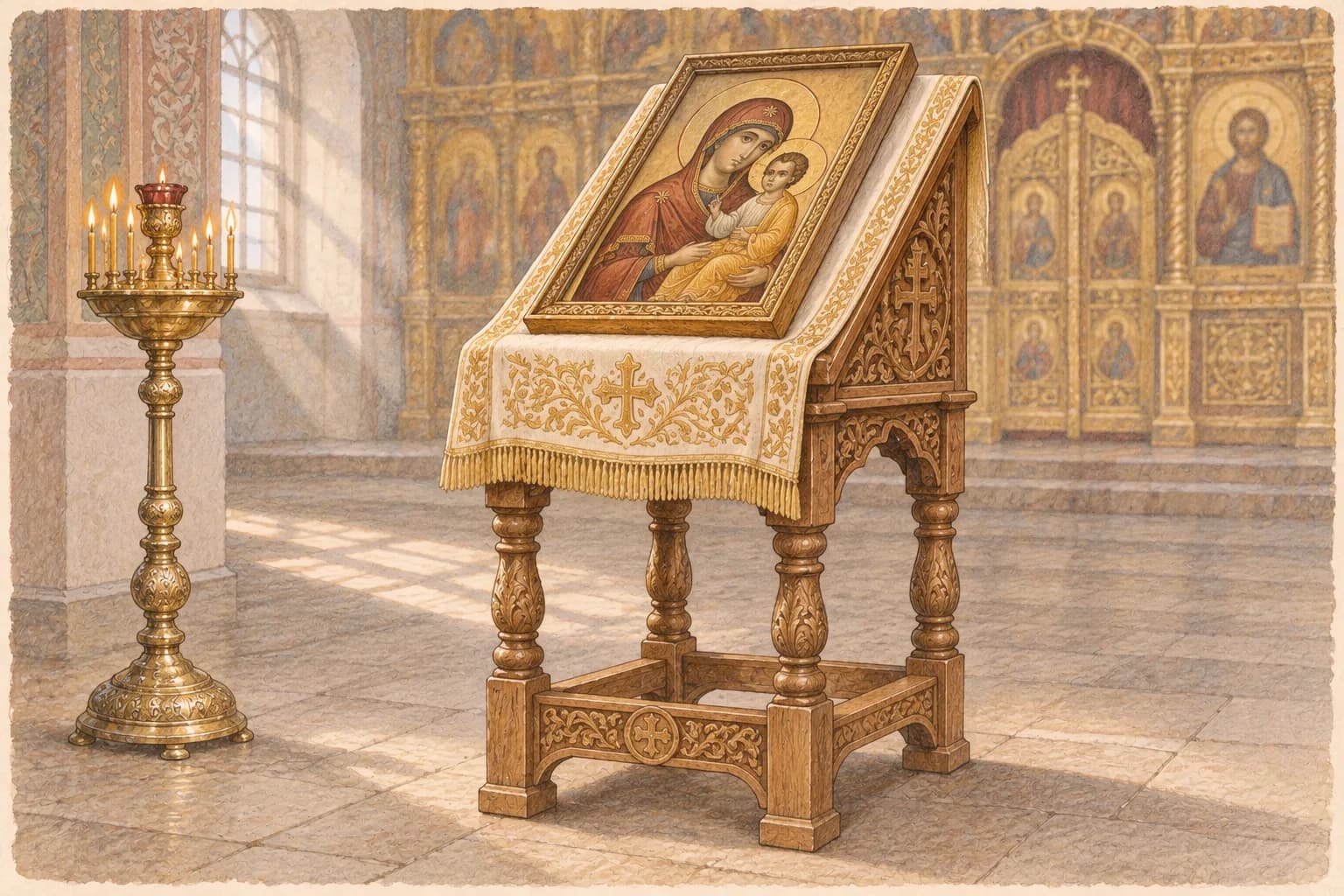
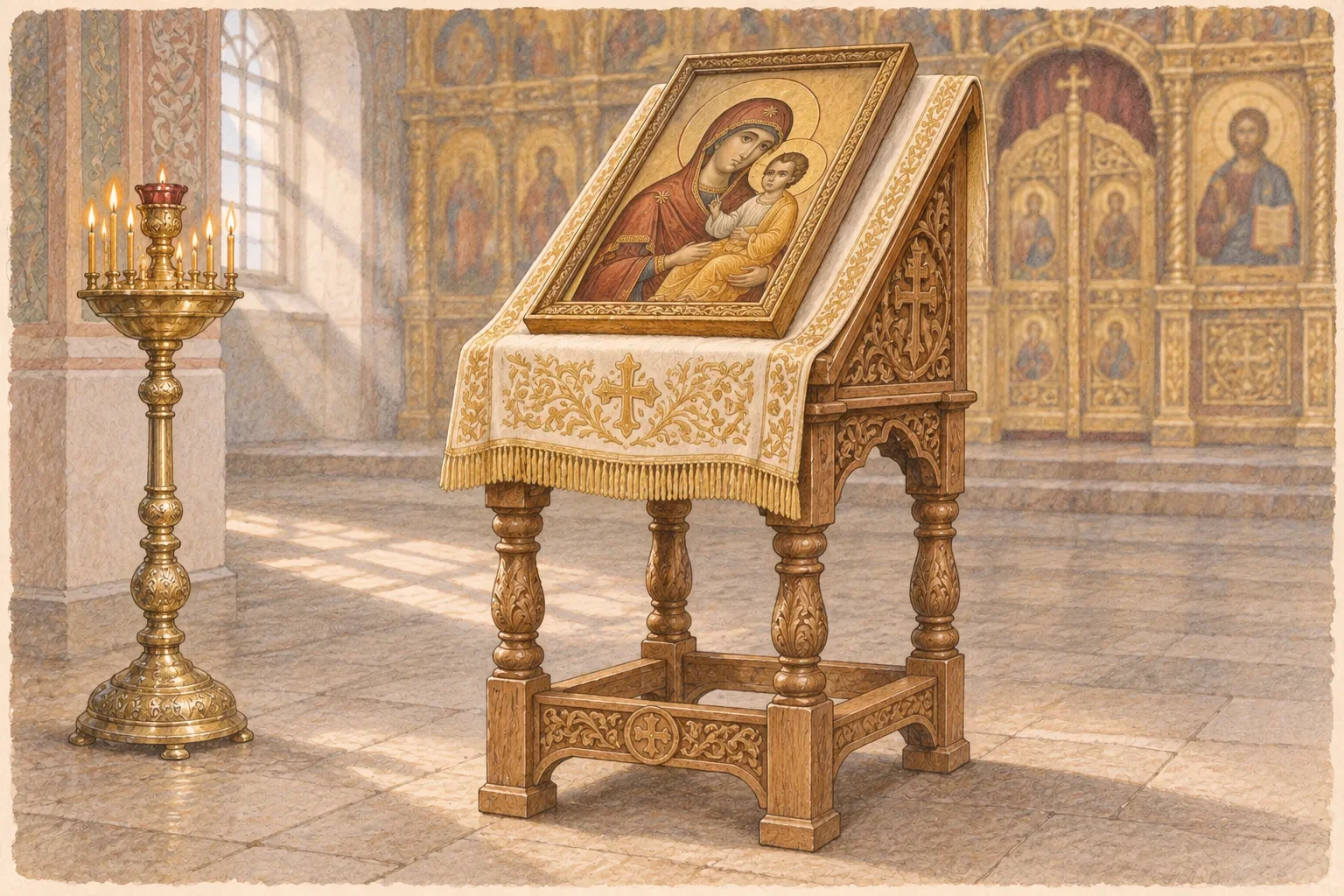
An analogion is a stand with a sloping top for an icon or liturgical book. It makes an image visible and allows a text to be read while standing. Analogions differ in size and decoration, but their appearance does not change their basic purpose.
An icon of the feast is often placed on an analogion in the centre of the church. Another may be used for reading or confession. The same kind of stand serves different circumstances, so a line beside one is not necessarily a queue to venerate an icon.
An analogion should not be confused with the Holy Table in the sanctuary. They have different functions. Avoid putting bags, drinks or a phone on the stand for a photograph: it has been prepared for a particular liturgical use.
If you are unsure whether it is a suitable moment to approach an icon, observe the service or quietly ask a parish worker. There is no need to move the stand or rearrange objects placed on it. Care begins with attention to what is happening around it.
What an analogion holds and why it slopes
An analogion supports a book, icon or another object needed at a particular point in worship. Its sloping surface makes the text or image easier to see without holding it up. During reading, this leaves the reader’s hands free and places the book at a usable height. Analogions may be fixed or portable, wooden or metal; the material does not change their basic function.
Visitors most often notice an analogion displaying a festal icon in an accessible part of the church. A similar stand may be used near the choir for reading or during confession. The purpose of a particular analogion is therefore explained by what it holds and the service taking place, not simply by its shape. The same kind of furnishing can serve several liturgical functions.
An analogion with the icon of the feast
An icon displayed for veneration draws attention to the event commemorated by the Church. An icon of Christ’s Nativity, for example, points towards the subject of the service, while a saint’s icon identifies the person being remembered. It is not a visual timetable of every service. Its meaning unfolds alongside the hymns, readings and preaching.
You may pray quietly before it. Where kissing an icon is customary, do so without pushing or haste, taking account of other people and your own health. Do not rearrange the image, remove a covering or adjust objects on the analogion without asking the person responsible. Churches have arrangements for cleaning and preparing the space; a helpful initiative is most useful when coordinated with those who look after it.
Why an analogion is used during confession
During confession, the Gospel book and a cross may rest on an analogion. They direct attention towards Christ and help show that repentance is more than reporting to a private individual. The priest receives confession as a minister of the Church. The furnishing itself does not perform the sacrament; it provides an appropriate support for sacred objects and helps organise the liturgical action.
If this is your first confession, you need not guess every movement beforehand. Tell the priest and follow his guidance. Where to stand, when to approach and how the confession concludes also depend on the arrangement of the space. Do not try to copy another person’s gestures in every detail: they may have physical limitations or be doing something that is not required of you at that moment.
How an analogion differs from the holy table and prothesis
The holy table stands in the sanctuary and is associated with the celebration of the Eucharist. The prothesis is another sanctuary table used in preparing the gifts. An analogion serves a different purpose and may stand in the part of the church occupied by the congregation. Surfaces covered with cloth can look similar without being interchangeable.
This distinction also helps when reading service descriptions. Saying that the Gospel book was brought out to an analogion does not mean the holy table itself was moved into the nave. Nor should every small table in a church be called a prothesis. When captioning a photograph or explaining the church to a child, use the object’s purpose and location to identify it, and ask a knowledgeable parish worker if uncertain.
Being near an analogion during worship
If a priest or reader is using an analogion, avoid walking between the person and the book, asking questions or passing objects across its surface. Wait until the reading finishes or approach a parish worker elsewhere. When a stand is being moved, leave a clear route: it may be heavy, and the book resting on it may not be secured.
Parents can explain a simple rule: this is not a general storage surface, so toys should not be placed on it and children should not lean their full weight against it. Learning about church furnishings is best done calmly, without frightening a child. Outside a service, point out the sloping surface, name the objects and explain their use. Understanding usually encourages respect more effectively than a lengthy list of unexplained prohibitions.
The covering and stability of the stand
An analogion may be covered with cloth, so its construction is not always visible during worship. The covering does not make it an ordinary shelf: edges or a folding support may lie underneath. Avoid leaning your weight on it when bending towards an icon. Someone who finds standing or bending difficult can pray without that movement. The cloth’s colour may coordinate with the service’s decoration, but one shade does not reliably identify the feast because local sets of coverings and circumstances differ. Read the icon’s inscription and the day’s title instead.
A question for reflection
What is on this stand now, and what is it being used for?