
Andrew is called the First-Called as one of Christ’s first disciples. John’s Gospel describes him following Jesus and bringing his brother Simon to him. The name highlights the beginning of discipleship rather than a competition for apostolic prestige.
The episode moves from hearing testimony to meeting Christ personally. Andrew does not keep that discovery to himself. He tells his brother and brings him to Christ without replacing the Teacher with his own importance.
Gospel accounts should be distinguished from later traditions about missionary journeys. Their sources and historical certainty differ. A saint’s story is not improved by presenting every detailed later narrative as a contemporary documentary record.
Read John’s opening chapter before concentrating on the cross depicted in an icon. When inviting someone to church, think of an invitation to encounter rather than pressure. The person should be free to ask questions or decline without humiliation.
Andrew and Peter: brothers who became disciples
In the first chapter of John, Andrew initially appears among those listening to John the Baptist. After hearing John’s testimony about Jesus, he follows Christ and then finds his brother Simon and brings him to the Teacher. This account underlies the designation First-Called. Its centre is not administrative precedence but a willingness to hear testimony and respond to an encounter.
The Gospels also describe the calling of fishermen beside the Sea of Galilee. These narratives illuminate different aspects of discipleship: an initial meeting and the leaving of an earlier occupation for sustained following. Andrew is connected with his brother without disappearing into Peter’s greater prominence. He learns, tells and brings another person. Understanding his place means reading those particular episodes rather than treating him simply as the less important relative of a better-known apostle.
Two further Gospel episodes
Before the feeding of the multitude, Andrew tells Jesus about a boy with five barley loaves and two fish. He notices an actual provision, although it is clearly insufficient for the crowd. The episode does not make the apostle the author of the miracle: the action belongs to Christ. Yet Andrew is not an indifferent spectator when a large gathering faces a practical need.
Later, John tells of Greeks who wish to see Jesus. They approach Philip, who speaks to Andrew, and the two bring the request to Christ. Again Andrew stands beside people seeking an encounter. These passages reveal a recurring feature of his Gospel portrait: he helps bring another person’s question before the Teacher. This observation does not require constructing an invented psychological biography or pretending that a few scenes reveal every detail of his temperament and daily life.
Preaching after Pentecost and the limits of the sources
Church accounts associate Andrew’s mission with regions around the Black Sea, Asia Minor and Greece. Patras has a particular place as the traditional location of his martyrdom. These details belong to the subsequent remembrance of his ministry. The Gospel does not provide a detailed map of his later journeys, so it cannot be cited as direct evidence for every city mentioned in a later life.
Russian tradition includes an account of Andrew visiting the hills beside the Dnieper where Kyiv would later develop. This should be described as a chronicle tradition, not as a travel report contemporary with the apostle. Making that distinction does not prevent appreciation of its cultural significance: a community understands its place within the spread of Christianity. The historical question about an itinerary and the ecclesial meaning of remembrance are related, but they are not precisely the same question.
Why Andrew’s cross is often shown as diagonal
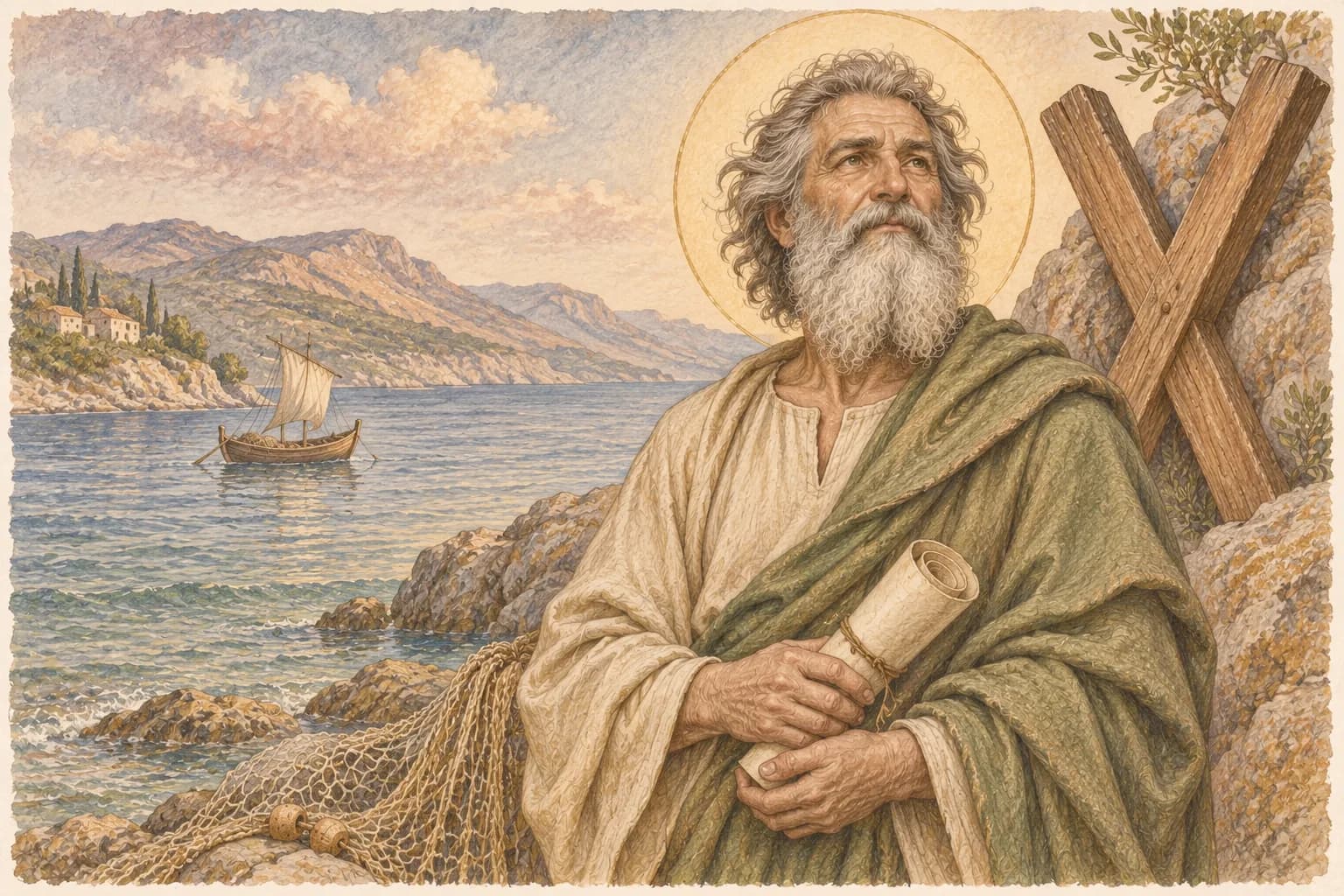
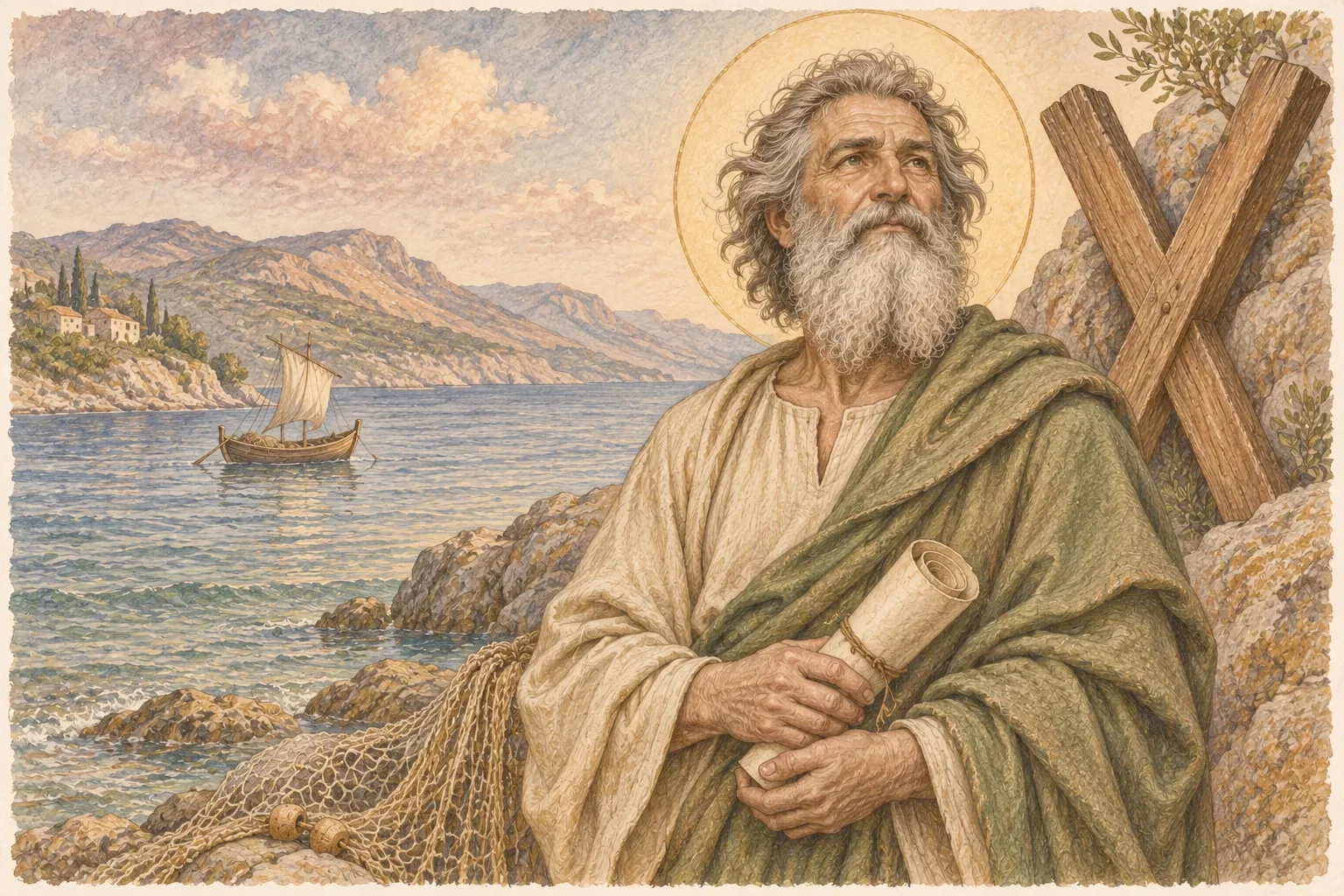
In familiar iconography Andrew holds, or stands before, an X-shaped cross, commonly called Saint Andrew’s cross. This form is associated with the tradition of his crucifixion and became a recognisable sign of the apostle in church art and subsequently in other cultural settings. An image should still be read with its inscription: not every diagonal cross is automatically a portrayal of the saint.
The cross’s shape does not create a separate source of grace or mean that Andrew preached a different understanding of the Cross from the other disciples. The hagiographic narrative centres on fidelity to Christ in the face of death. The development of a particular artistic type can be more complicated than a short caption suggests. When describing an old icon, distinguish the martyrdom narrative, its conventional symbol and the evidence concerning the date and origin of the artwork itself.
Inviting another person without coercion
Andrew’s Gospel action can illuminate an ordinary situation: someone close to you asks about faith, and you offer to attend a service together or read an accessible passage. You can explain what matters to you personally without assuming responsibility for every reaction. An invitation leaves room for a free response; pressure often obscures the very thing you hoped to communicate.
This does not mean indifference to truth or abandoning conviction. Andrew takes the encounter seriously. Yet he brings someone to Christ rather than demanding recognition of his own exceptional importance. A family conversation can follow the same direction: answer the question actually asked, do not humiliate unfamiliarity and do not present a personal habit as a church rule binding everyone. Such concrete attentiveness makes the apostolic example intelligible without attaching artificial promises of an extraordinary result to every invitation.
A question for reflection
How can you invite someone to explore faith while respecting their freedom?