
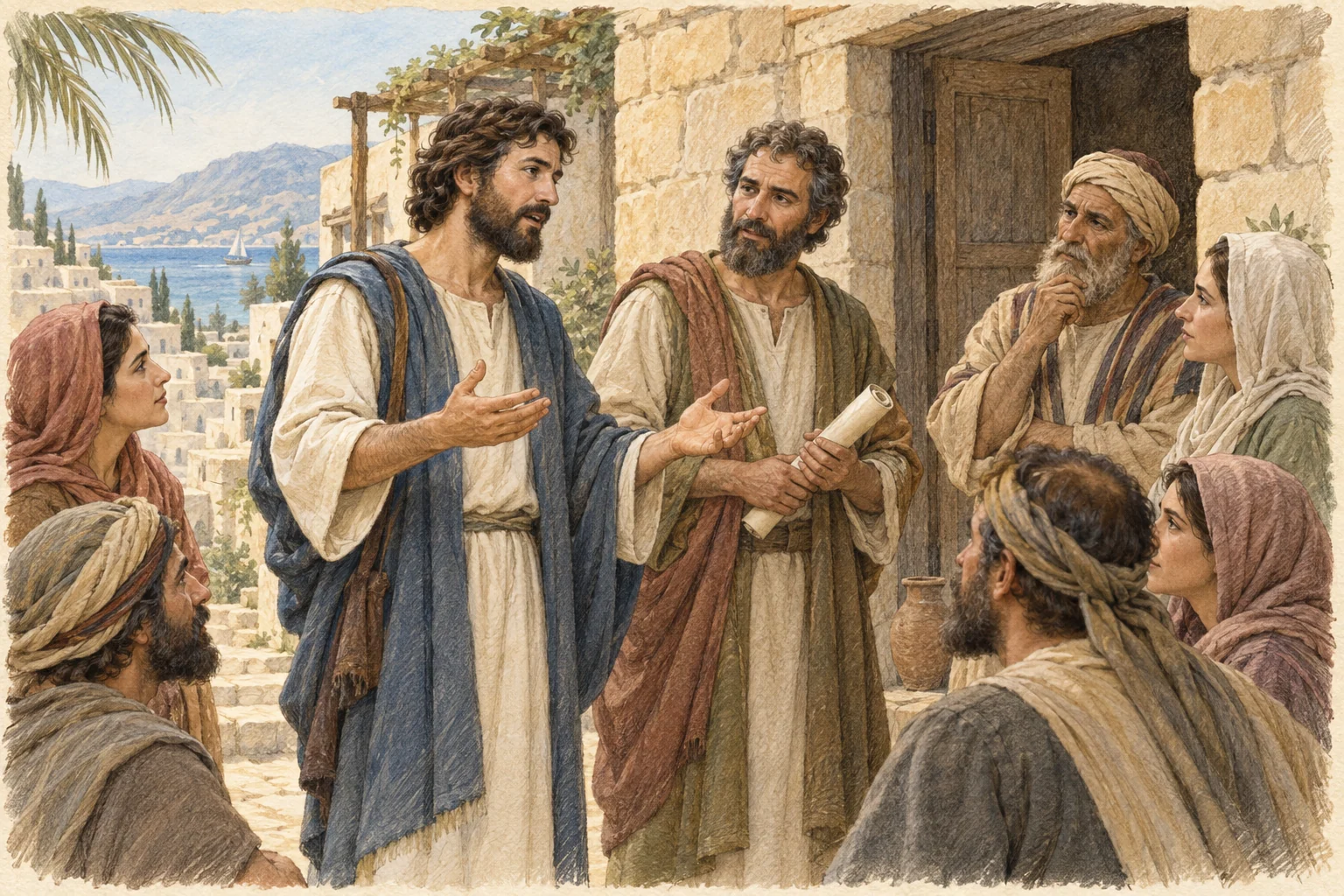
Acts continues the narrative of Luke's Gospel. It tells how Christ's disciples bear witness after his Resurrection and Ascension and how Christian communities emerge. It is not a collection of biographies of every apostle. The main narrative moves from Jerusalem and Peter's ministry toward Paul's mission and his arrival in Rome.
A Mission, Not an Absence
The Ascension does not leave the disciples merely preserving the memory of a departed teacher by themselves. They are promised the Holy Spirit and sent to bear witness. Chapter 2 describes Pentecost, Peter's preaching, the Baptism of those receiving the message, and the community's shared life. The Paschal proclamation becomes the foundation of a new common journey.
Notice ordinary actions as well as extraordinary events: teaching, prayer, meals, and care for people in need. The Church is neither a club of admiring listeners nor a group united only by a shared memory. Faith takes shape in relationships, time, possessions, and responsibility.
The Expanding Mission
The narrative soon moves beyond Jerusalem. Philip's meeting with the Ethiopian official, Saul's conversion, the story of Cornelius, and the missionary journeys bring the good news to different people. Geography matters, but a map alone cannot explain these encounters. A recurring question is whom the community is prepared to receive.
Chapter 15 gives particular attention to the situation of Gentile Christians. This is not treated as the private preference of an individual preacher but as a question requiring the Church's consideration. Testimony, discussion, and a decision all appear. Acts therefore cannot support the claim that the early Church never experienced disagreement.
A Community Without Idealization
Acts portrays generosity and unity alongside deception, complaints about unequal assistance, persecution, and personal disagreements. Chapter 6 is especially useful when considering parish charity: spiritual life does not remove the need to listen to people whose needs have been overlooked.
The miracles bear witness to God's action, but do not authorize a promise that every believer will escape danger in the same way. Some are released from prison; others endure death. The absence of miraculous deliverance cannot establish that someone prayed less effectively or lacked faith. Accounts of martyrdom should never become accusations against sufferers.
Why the Story Ends in Rome
In the closing chapters, Paul undergoes trials, a sea journey, and shipwreck. The ending shows him preaching in Rome without providing a complete account of his later life. The book has its own purpose: to show the witness to Christ reaching new places despite obstacles.
For a first reading, note three things: the location, the audience, and the content of the preaching. Keep a separate note of unfamiliar Old Testament events mentioned by the apostles. Acts is particularly prominent in the Church's readings during the Paschal season. Reading whole chapters at home helps reveal the connection between Christ's Resurrection and the Church's continuing life rather than treating Acts as an optional appendix to the Gospel.
Not every narrated action directly commands identical action regardless of circumstances. Accounts of selling property must be read alongside voluntary generosity and responsibility for dependants, not as an immediate demand to leave a family without resources. Distinguish narrative, a character's speech, and a communal decision. Taking Acts seriously does not mean extracting context-free commands from every event.
Read the whole Pentecost narrative
In chapter two it is easy to dwell on the extraordinary opening and overlook Peter's speech and the listeners' response. Follow the chapter's sequence: an event, its explanation, the people's question, their response to the preaching and their subsequent common life. The account does not end with a powerful impression. It asks us to notice how the message changes relationships and gathers people for teaching, prayer and care for one another.
As you read Peter's speech, distinguish his references to Scripture from his explanation of what the listeners have witnessed. You do not have to explore every Old Testament reference at once. Choose one and read its surrounding passage separately. This is more helpful than treating the speech as a series of interchangeable religious statements. Testimony to an event, a biblical citation and an invitation to respond have different functions within the same address.
Keep people in view alongside the map
A map shows distances, but beside each place name record the human question in that episode. Who needs an explanation? Who is afraid of change? Whose need has gone unnoticed? The journey then becomes more than a list of stops. In discussion, ask not only where Paul went but what prevented people from hearing one another. Look for an answer in the particular account instead of assigning the same motives to everyone involved. This also helps keep a geographical summary from replacing the book itself.
When comparing an apostolic community with your own parish, avoid declaring the present hopeless or excusing every failure because difficulties have always existed. The narrative can help you formulate a more precise question. If assistance is distributed unclearly, for instance, whom could you approach about an overlooked need, and how might the arrangements become easier to understand? This applies the reading to our responsibilities; it does not claim that all the circumstances of an ancient community can be reproduced unchanged today.