
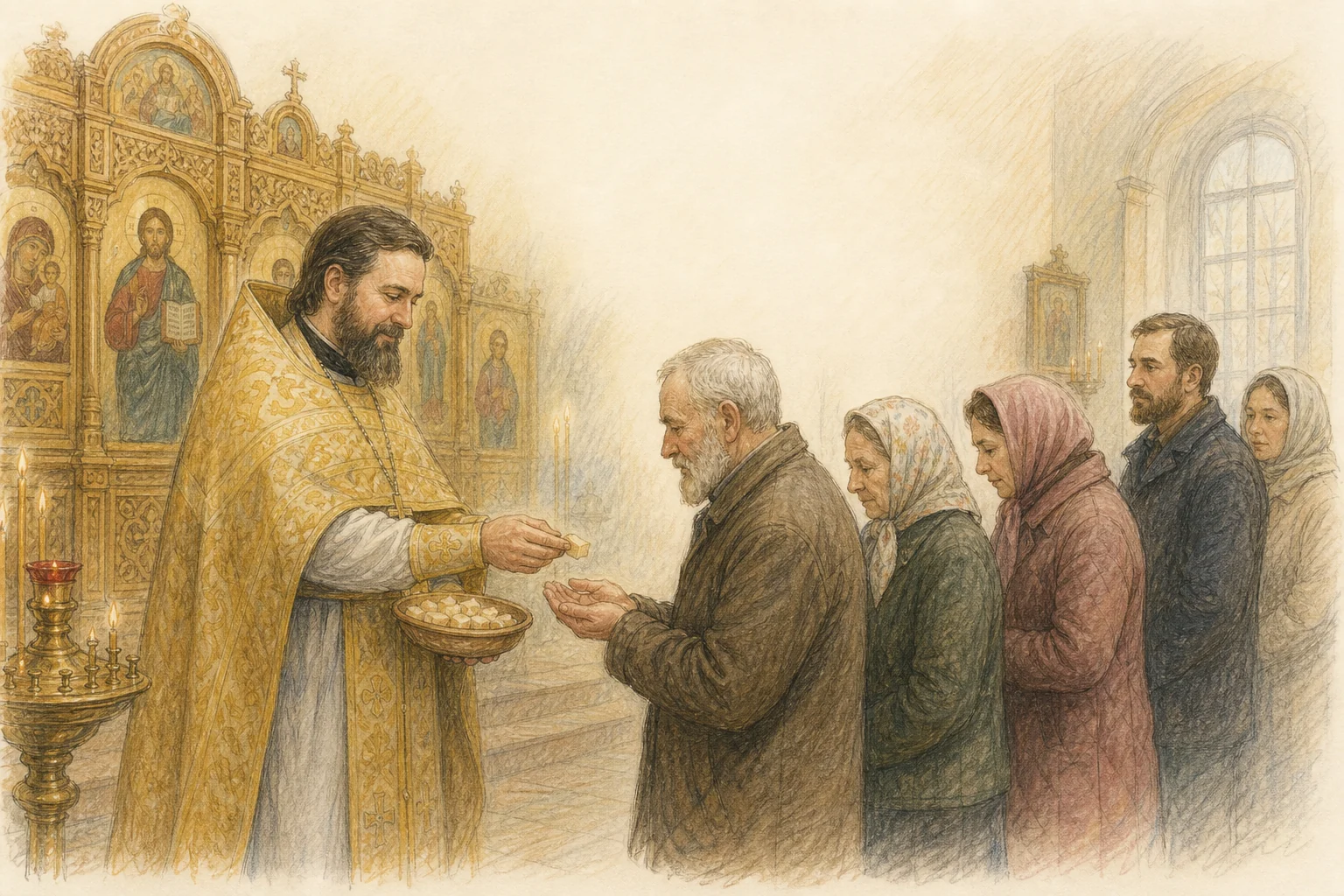
Antidoron is blessed bread distributed to the faithful after the Divine Liturgy. It consists of portions of prosphora remaining after the Lamb has been prepared at Proskomedia. It is received reverently, but it is not Holy Communion and does not replace the Eucharist.
Distribution varies by parish. A priest may give the bread near the cross, an attendant may offer it at the candle desk, or it may be placed at an appointed location. If uncertain, wait and ask calmly.
What does antidoron mean?
The Greek word is commonly translated “instead of the Gifts.” Historically, blessed bread was given to those who attended the Liturgy but did not receive the Holy Gifts. It expressed participation in common prayer and the love of the community, not a second kind of Communion.
“Instead of” can be misunderstood. It does not mean an equivalent substitute for the Body and Blood of Christ. The Eucharist is a Mystery; antidoron is blessed bread connected with the Liturgy.
Where does antidoron come from?
Proskomedia is celebrated before the public portion of the Liturgy. The priest removes the Lamb from a prosphora for the Eucharist. The remaining blessed bread is cut for distribution.
Traditions using several prosphoras may prepare antidoron in slightly different ways. The central meaning remains: the bread comes from the liturgical offering and is received with thanksgiving.
See Prosphora: what it is and how it is received for the larger context.
How does antidoron differ from Holy Communion?
- Holy Communion is reception of the Body and Blood of Christ consecrated at the Divine Liturgy.
- Antidoron is blessed bread that has not been consecrated as the Holy Gifts.
- Communion is approached through the Church’s sacramental preparation; antidoron is normally distributed after worship.
- Antidoron does not automatically compensate for missing Communion and should not make the Eucharist seem routine.
Calling it “a little Communion” erases an essential distinction and encourages a mistaken understanding of the Mystery.
How is antidoron received?
Normally a person approaches without haste, places the right palm over the left, and receives one small piece. It is eaten immediately and carefully so crumbs are not dropped. If a priest distributes it beside the cross, the movement of the line will show the local practice.
Do not reach across another person or take a handful. One piece is sufficient. External precision should not become anxiety; a mistaken hand position can simply be corrected.
Who may receive it?
In Russian parish tradition, antidoron is normally intended for baptized Orthodox Christians who have attended the Liturgy. Practical guidance may vary, especially for visitors and children.
If you are not baptized, belong to another Christian tradition, or are visiting, do not conceal it. You may be able to remain in line for a blessing, or an attendant can explain what to do. An honest question is better than an uneasy guess.
Do not secretly give the bread to another person as protection or healing. Its meaning belongs to conscious participation and thanksgiving.
Must it be received before eating?
Devotional tradition encourages receiving antidoron before other food. Someone prepared for Communion naturally has not eaten. Health, however, must not be subordinated to an external formula.
A person with diabetes, medication that requires food, pregnancy, or another medical need should follow medical advice. A personal question can be brought to a priest without shame.
Do not treat a necessary tablet or drink of water as a reason to avoid church or declare the whole day spoiled.
What is the drink offered after Communion?
After Communion, many parishes provide zapivka: warm water, sometimes with a little wine, and a piece of antidoron. It helps the communicant receive the Holy Gifts reverently.
It is primarily for communicants, though local practice can be broader. It is not another sacrament, a medicine, or an automatic condition of salvation.
May antidoron be taken home?
When the parish distributes bread for this purpose and permits it, a small piece may be brought to an Orthodox family member or used at home. Keep it clean and dry, apart from ordinary bread.
Do not collect a large quantity “just in case.” It is meant for thankful use, not the accumulation of holy objects. Ask where prosphora may be obtained if you wish to keep some at home.
How should it be stored?
It is best eaten at once. A remaining piece may be dried and kept in a clean container or cloth bag. Fresh bread sealed in plastic can mold quickly.
Collect and consume crumbs. If the bread spoils, do not discard it carelessly with household waste; bring it to the parish and ask. This is practical reverence, not fear of punishment for an accident.
Antidoron and children
A child may receive a small, safe piece when permitted by parish practice and developmentally able to chew it. Do not give a hard dry crust to an infant; remember wheat allergy and choking risk.
Explain simply that it is bread from the service, received with gratitude. Do not frighten a child with claims that one lost crumb will cause misfortune.
What does antidoron not do?
It does not guarantee recovery, business success, removal of a curse, or protection of a home. It does not replace medicine, honest conversation, repentance, Communion, or acts of love.
Blessed bread can recall the prayer of the Liturgy and thanksgiving, but a Christian does not use an object to control God. Superstition begins when living faith is replaced by an automatic formula.
Why is antidoron distributed after common prayer?
It is received at the end not as a prize for having remained standing, but as a continuation of thanksgiving and a sign of ecclesial fellowship. Communicants and non-communicants, long-time parishioners and newcomers approach together.
The line becomes a small school of attention: do not hurry an older person, allow someone with a child to pass, and do not take more than others. Reverence toward a neighbor matters as much as careful handling of the bread.
How is antidoron connected with thanksgiving prayers?
After Communion, the Church calls us to give thanks. Antidoron and the warm drink help complete reception of the Gifts, but do not replace thanksgiving. If prayers are read aloud, remain and listen when possible.
Someone who did not commune may also give thanks for the Liturgy and participation in common prayer. Do not compare yourself with others or turn the end of worship into a hurried exit in search of bread.
Frequently asked questions
May I receive antidoron if I did not commune?
Yes; historically this was central to its distribution. Follow the parish order and do not treat it as a substitute for Communion.
Should I kiss the priest’s hand?
A parish may have a normal gesture when the priest blesses and distributes bread. Follow a quiet cue without turning it into a source of fear.
May I eat antidoron after breakfast?
Tradition receives it before food, while medical necessity requires reason. Discuss a recurring situation with a priest.
What if a piece falls?
Pick it up. If the surface is clean, eat it; otherwise wrap it and bring it to church. Do not see an accident as an omen.
Are antidoron and prosphora the same?
Antidoron comes from prosphora, but the word names the blessed bread distributed after Liturgy. Prosphora is the whole loaf prepared for worship.
What should I confirm with the parish?
Ask where antidoron is distributed, who receives it in local practice, whether it may be taken home, and where a spoiled piece should be brought. Check the schedule and use the contacts.
Antidoron is a simple but deep sign: the Liturgy ends, while thanksgiving continues. Receiving the bread without superstition or haste carries the memory of common prayer into an ordinary day.