
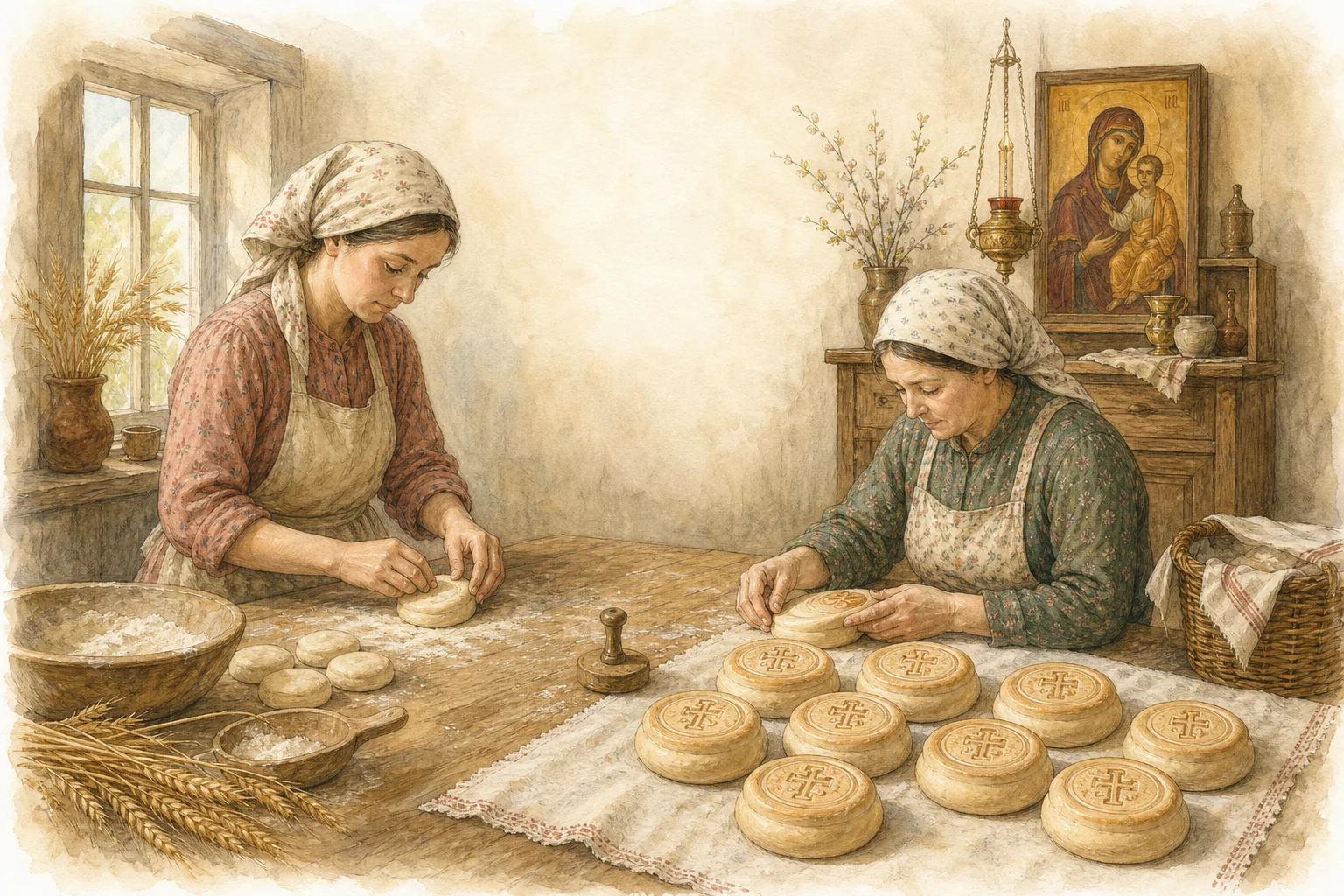
Prosphora is the small round leavened wheat bread prepared for Orthodox worship from flour, water, yeast, and salt. At Proskomedia the priest takes the Lamb from a prosphora for the Eucharist and removes particles in honor of the Mother of God and saints and in commemoration of the living and departed. After Liturgy, the faithful may receive antidoron—portions of the bread that did not become the Holy Gifts.
Prosphora is not a talisman, spiritually “charged” food, or medicine. It is treated reverently because it was offered for the prayer of the Church and used in preparation for the Eucharist.
What does prosphora mean?
The Greek word means an offering. In the ancient Church, Christians brought bread and wine for the Eucharist as well as gifts for a common meal and help for those in need. What was required for worship was selected from these offerings.
Modern prosphora preserves the meaning of a gift: the work of those who bake it, the offering of the community, and bread intended for common prayer and thanksgiving rather than the purchase of an outcome.
What does a prosphora look like?
A prosphora normally has two joined round layers, recalling the union of the divine and human natures in Christ. A seal on top bears a cross and the Greek letters IC XC NIKA, “Jesus Christ conquers.”
Size and appearance differ. Some traditions use several small loaves, while others use one or more larger loaves. The exterior form does not make one prosphora spiritually stronger than another.
An uneven edge or imperfect seal is not a bad omen. People bake the bread, and reverence should not be transformed into anxious superstition.
How is prosphora used at Proskomedia?
Proskomedia takes place before the public portion of the Divine Liturgy. The priest prepares bread and wine for the Eucharist. A cube-shaped portion called the Lamb is removed; during Liturgy it will be consecrated as the Body of Christ.
Other particles honor the Mother of God and saints and commemorate living and departed Orthodox Christians according to the Church’s order. They are arranged on the diskos around the Lamb as an image of the Church gathered around Christ.
This image does not mean that a prayer note or particle automatically produces a requested earthly result. Commemoration is prayerful trust in God. Read Proskomedia in plain language for more detail.
Prosphora, antidoron, and the Holy Gifts are not the same
- Prosphora is bread offered and prepared for worship.
- The Lamb is the portion prepared for the Eucharist.
- The Holy Gifts are the Body and Blood of Christ consecrated at Liturgy; Holy Communion is received according to the Church’s sacramental order.
- Antidoron consists of pieces of blessed bread distributed after Liturgy, especially to those who did not commune and also to communicants according to local practice.
Antidoron is not Holy Communion and cannot replace the Eucharist. If bread is distributed after a service, simply ask what it is and how the parish receives it.
How is antidoron received after Liturgy?
It is normally received reverently, with the right palm resting on the left, and eaten carefully so crumbs are not dropped. Some parishes also offer a warm drink, sometimes with a little wine, especially to those who have communed. The local order varies.
Do not push through the congregation or fear missing the distribution. If the antidoron runs out, that does not make your prayer or presence at Liturgy worthless.
Give bread to a small child only in a safe manner appropriate to age. Someone with wheat allergy, celiac disease, or another medical condition should not risk their health; explain the situation and abstain.
May I take prosphora home?
Many parishes make blessed prosphora or portions available after services or at the candle desk. They may be connected with prayer notes or distributed in another local way. Ask the parish directly.
An offering or donation is not the price of a spiritual result. Where a prosphora is received with a donation, the gift supports parish life and human work; it does not purchase God’s help.
How is prosphora used at home?
A widespread devotional practice is to take a small piece in the morning before other food, after prayer, often with holy water. This can begin the day in thanksgiving and remembrance of God, but it does not replace morning prayer, the Divine Liturgy, or Holy Communion.
A person with diabetes, a stomach condition, medicine that must be taken with food, or another medical need should not harm themselves for the sake of an external rule. Ask a priest how to proceed and follow medical advice.
Do not use prosphora for divination, protection from imagined spiritual harm, or guaranteed healing. Christian reverence is joined to trust in God, not magical control.
How should prosphora be stored?
Keep it apart from ordinary food in a clean, dry place. To prevent mold, it may be cut into small pieces and dried. Fresh bread should not remain sealed for a long time in an unventilated plastic bag.
Take only what you can use. Reverence is shown not by accumulating many loaves “just in case,” but by attentive care without waste or anxiety.
What if prosphora falls or becomes moldy?
If it falls on a clean surface, pick it up and use it. If mold develops, do not discard it carelessly with household waste. Traditional methods include burning it in a clean place or placing it in running water where this is safe and environmentally responsible. In a city, the best choice is often to bring it to the parish and ask.
Collect crumbs with a clean cloth, but do not panic. An accident is not a prediction of misfortune and does not cancel God’s mercy.
Who bakes prosphora?
Prosphora is baked with a blessing and according to the parish’s established order. Cleanliness, sound ingredients, skill with dough, and a prayerful attitude matter. It is neither a cooking competition nor a way to display special holiness.
If you want to help in a parish bakery, do not bring homemade loaves without agreement. Ask whether help is needed and what training is required.
Why is bread at the center of the Liturgy?
In Scripture, bread belongs to daily life, labor, hospitality, and God’s gift. Christ feeds the hungry and calls Himself the Bread of Life. The ordinary fruit of earth and human work therefore becomes in the Eucharist a sign of God’s deepest nearness.
This does not mean that every loaf is automatically holy. Prosphora is prepared and offered for a particular ecclesial use, while the Lamb becomes the Holy Gifts through the prayer of the entire Liturgy. Reverence holds together the material simplicity of bread and the greatness of the Mystery.
How can prosphora be explained to a child?
Say simply: “This bread was baked for the service. The Church prepares Holy Communion from part of it, and other pieces are received with thanksgiving.” No frightening story or elaborate detail is needed.
Show the child how to hold a piece over the palm, avoid scattering crumbs, and give thanks. If something falls, help collect it calmly. Reverence is then learned as care, not fear of punishment.
Frequently asked questions
May prosphora be eaten after other food?
The devotional custom is to take it before eating, but illness, medicine, and other circumstances require reason. Do not harm your health; ask a priest about a personal situation.
May I give prosphora to someone who is not baptized?
Parish guidance may vary. Do not secretly use it as “protection” for another person; explain its meaning and ask a priest.
Does prosphora cure illness?
It is received with prayer but is not medicine and does not replace a doctor, diagnosis, or treatment.
How does prosphora differ from artos?
Artos is a special large loaf blessed at Pascha and distributed on Bright Saturday or according to parish practice. It is not used as the Lamb at Proskomedia.
Can a prosphora be offered for a particular person?
Some parishes connect a prayer note and prosphora with commemoration, but the order varies. Ask what forms are available and do not treat them as the purchase of a guaranteed result.
What should I confirm with the parish?
Ask where and when prosphora is available, whether antidoron is distributed after Liturgy, how names are submitted for Proskomedia, and what to do with bread that has spoiled. Use the official contacts and schedule.
Prosphora reveals a simple connection: human work becomes an offering, bread gathers the community around Christ, and reverence continues in a grateful and attentive life.