
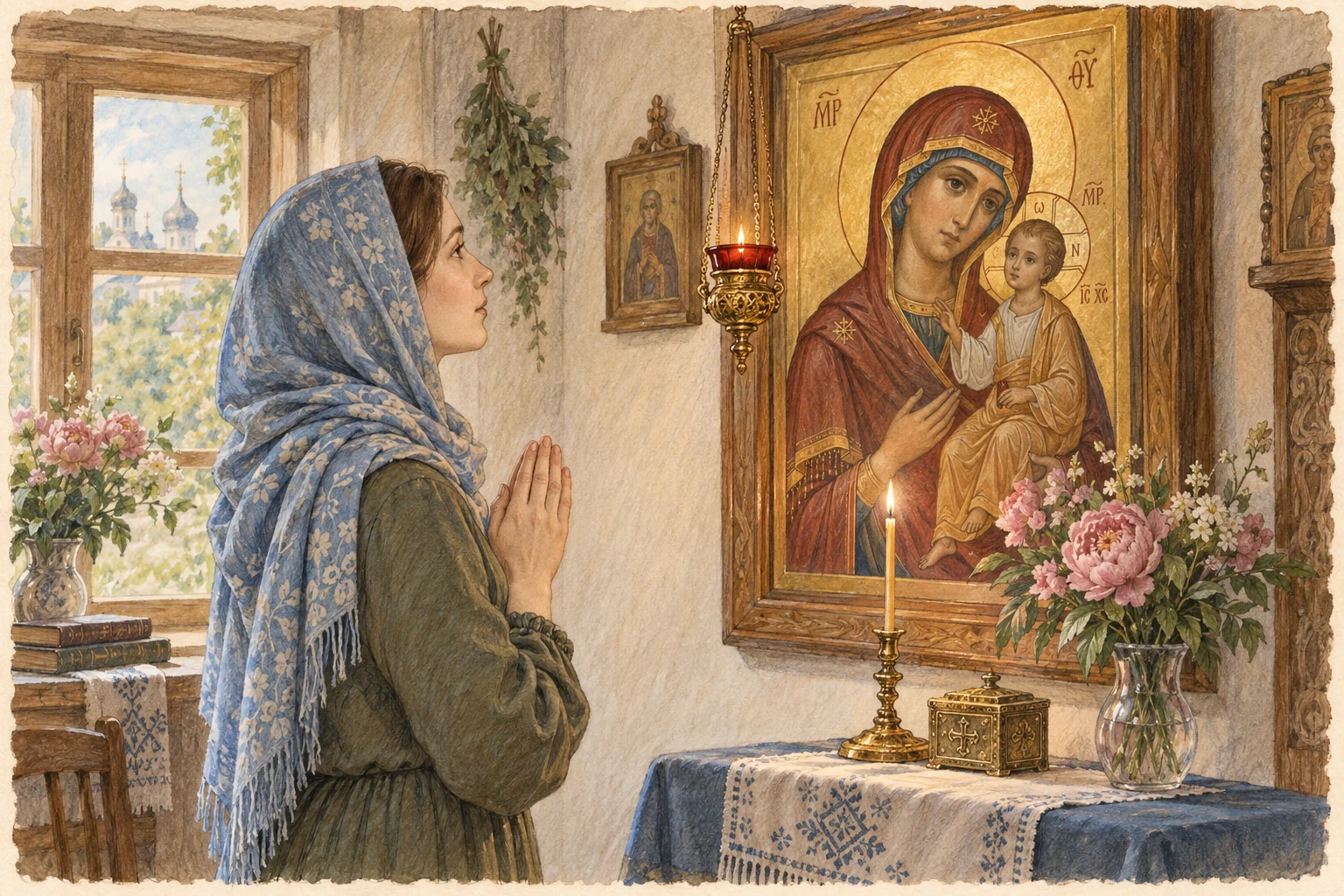
“Rejoice, O Virgin Theotokos” expresses the Gospel’s joy at the coming of the Saviour. Its words recall the angel Gabriel’s greeting to Mary and Elizabeth’s greeting when Mary visited her. Honouring the Mother of God is inseparable from confessing Christ.
The prayer
Rejoice, O Virgin Theotokos, Mary full of grace, the Lord is with you. Blessed are you among women, and blessed is the fruit of your womb, for you have borne the Saviour of our souls.
This English rendering follows the traditional Church Slavonic prayer.
Its Gospel setting
Luke’s first chapter recounts both the Annunciation and Mary’s visit to Elizabeth. The prayer brings their greetings together with the confession of Jesus as Saviour. Its joy is therefore more than a general wish for happiness.
What does Theotokos mean?
The Greek title means God-bearer, commonly expressed as Mother of God. It does not claim that Mary began the eternal Godhead. It confesses that the One born of her as a human being is the Son of God Himself, become human. Honouring her does not place her above or instead of God.
Unfamiliar expressions
“Full of grace” speaks of God’s grace. “Among women” places Mary’s blessedness in human history. The “fruit of your womb” is Christ born from her. The final words explain why we praise her: she bore our Saviour.
Reading at home
You may use a book or screen. Learn unfamiliar terms gradually, then say the prayer without rushing. You do not need to reproduce the choir’s melody before you can pray its words.
Must it be repeated many times?
A particular rule involving many repetitions is not automatically required of every parishioner. A single prayer and an extended personal rule are different practices. Do not turn a number into a guarantee that a wish will be fulfilled. Discuss a sustainable rule with a priest.
Prayer is not a method for forcing someone into a relationship, securing marriage by a deadline or eliminating every trial. It belongs to trust in God and care for others.
From greeting to confession of faith
The prayer has a clear movement: an address to Mary, words concerning God's grace, and a conclusion naming the Saviour. The final clause explains the basis of the praise. Notice this connection rather than treating each expression as a separate beautiful title. Honouring the Theotokos does not turn away from the question of who Christ is; it brings us back to him. The prayer cannot therefore be explained simply as an appeal to a general image of maternal kindness without its Gospel content.
Reading the Gospel setting
Open Luke's first chapter and read the surrounding narrative as well as the familiar greetings. Notice who speaks, whom they address, and what they announce. Then compare the prayer's wording. This distinguishes the Gospel event from a later explanation or your own imagination. You do not need to reconstruct precise domestic details that the text does not provide. If something is not stated, avoid teaching a guess to a child as an established fact.
Ask a simple question: why is the prayer's joy connected with the Saviour rather than a promise of an easy life? This helps prevent the greeting from becoming a formula for obtaining domestic happiness. A person can say it during difficulty when joy is not yet felt. Prayerful praise does not require concealing sadness or proving to others that faith has immediately solved every problem. Its words can remain meaningful while the circumstances of life are still unresolved.
Care for family without pressure
People often pray these words with concern for children and relatives. Yet wanting to protect a child does not authorize religious threats to control every decision. Pray for help while also talking, listening, and correcting your own harshness. If an adult child does not share your faith, do not make recitation a condition of kindness toward them. An appeal to the Mother of God should not become a means of extracting outward agreement or avoiding a necessary conversation.
Someone without a spouse or children need not regard the prayer as belonging to other people. Its content is not limited to one family situation. Do not connect God's closeness with possession of a particular social status, or promise marriage or a child as a reward for correct reading. Support begins by respecting a person's actual life, not by identifying one event that must supposedly repair it. A shared prayer need not erase different circumstances among those who say it.
Learning without mechanical memorization
Divide the text into meaningful phrases. Begin with the greeting and address, then explore the blessing and concluding words. Read aloud at an ordinary pace without trying to reproduce the length of choral singing. If you omit a word, return calmly to the phrase. Remembering is easier when you understand why a sentence continues as it does, rather than turning every repetition into a test of faultlessness. For shared prayer, choose the wording used in your prayer book so everyone can follow.
Praying before an icon
An icon can help focus the address, but prayer should not be tied to a search for an image alleged to produce a faster response. Travelling or being away from your familiar home icon does not make prayer impossible. Do not compare devotion by the size of an image or the expense of its covering. Attention to the words, respect for something holy, and care for people cannot be purchased by acquiring a special object.
Text reference
Azbyka: traditional prayer text (Russian)