
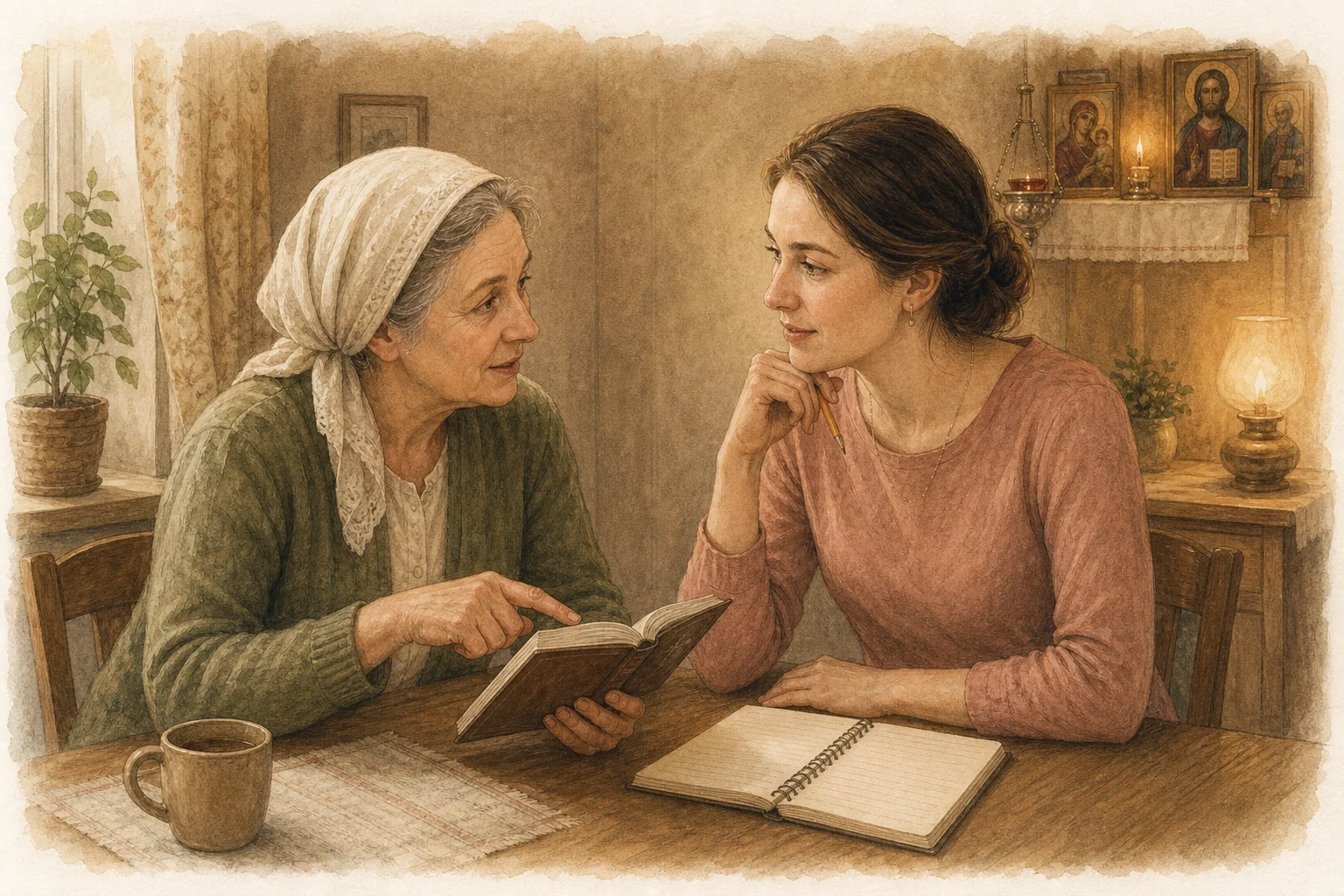
A beginner’s prayer rule should be short, understandable, and regular. A sensible starting point is five to ten minutes in the morning and evening: the sign of the Cross, several prayers from a recognized Orthodox prayer book, the Lord’s Prayer, a brief remembrance of loved ones, and a few personal words. After two or three weeks, the amount can be discussed with a priest and adjusted.
A rule is not an identical quota for everyone, nor a payment for God’s help. It is a stable framework that teaches us to return to prayer on an ordinary day.
What a prayer rule means
Here the word “rule” means an established order of regular prayer at home. It commonly includes morning and evening prayers, but its size depends on age, health, family responsibilities, spiritual experience, and pastoral guidance.
A rule preserves faithfulness when moods change. We do not wait for inspiration before caring for a child, washing, or keeping a promise. In the same way, a small period of prayer receives a dependable place in the day.
What a rule is not
It is not a magical sequence after which a request must be granted. It is not a contest in pages and not evidence that one person is superior to another who prays less. God is not keeping a spreadsheet of completed lines.
Do not call an ordinary routine a vow unless you have discussed it with a priest. A promise made in an emotional moment can bind a person to an unrealistic obligation and produce fear instead of trust.
How much should a beginner take on?
Choose an amount you can keep on a working Tuesday, not only on a free Sunday. For many people, five to ten minutes in the morning and the same in the evening is wiser than immediately adding the full standard rule, canons, and an akathist.
If you have never prayed regularly, begin with three to five minutes. After two weeks, evaluate not the intensity of feelings but sustainability: can you remain reasonably attentive, does the routine damage sleep, and does it make you irritable with family members?
An example of a short morning rule
After waking, avoid opening messages immediately if possible. Stand before an icon or choose a quiet place, make the sign of the Cross, and keep a short pause. Read the usual opening, the Lord’s Prayer, and one or two morning prayers from an approved prayer book.
Give thanks for the new day, name people who especially need help, and ask to live without falsehood or cruelty. You may read a few verses from the Gospel. Finish by identifying one concrete intention for good.
An example of a short evening rule
Before sleep, put the phone aside, remember the day, and give thanks for specific gifts. Name an action for which you are sorry without excuses and without humiliating yourself. If harm can be repaired, decide on the first step you will take tomorrow.
Read the Lord’s Prayer, one or two evening prayers, and remember the living and departed. When extremely tired, shorten the text but keep an honest address to God. Our guide to beginning prayer at home explains this pattern in more detail.
Which prayer book should I use?
Choose an edition approved for Orthodox use, with a clear structure and readable type. A beginner may benefit from an edition that explains unfamiliar words. A digital text is acceptable when the source is reliable and notifications are disabled.
Do not build a rule from random social posts. Online texts may promise guaranteed results, mix prayers with charms, or falsely attribute words to saints. Show a doubtful source to a priest before using it.
Should Scripture be included?
A short reading from Holy Scripture is valuable, but it should not turn the first days into an impossible program. You might read one small Gospel passage in the morning or several verses of a psalm in the evening.
The aim is to hear the meaning and bring it into life. Our guides to reading the Gospel at home and reading the Psalter will help establish a separate, peaceful rhythm.
Standing, sitting, or praying while moving
A healthy person normally keeps the home rule standing as a sign of attention and reverence. Illness, pregnancy, old age, recovery from surgery, and caring for a child are sufficient reasons to sit or pray in bed.
A brief prayer can be said while traveling, but focused prayer should not be combined with driving or dangerous work that requires full attention. Bodily posture serves prayer; it does not replace it.
Work, children, and a changing schedule
Do not copy a monastery’s order into a home with an infant or a night-shift worker. Choose anchors that actually recur: after waking, before leaving, during a daytime break, or after a child has gone to sleep.
A parent who stops reading to care for a crying child has not “ruined the rule.” Care for a neighbor is a Christian act. Return later or finish briefly, and do not make the family guilty for your interruptions.
Illness and exhaustion
Reduce the rule to several familiar prayers, thanksgiving, and the names of loved ones. You may listen to a text when reading is difficult or ask another person to pray nearby. Do not reject prescribed treatment in order to maintain a lengthy rule.
If weakness continues, speak with a clinician and a priest. Spiritual life does not require denial of a diagnosis, and illness does not make a person less worthy of God’s love.
What to do after missing morning or evening prayer
Do not double the next rule as a penalty. Pray at the next realistic opportunity and continue the ordinary order. One missed session does not erase the beginning, just as one missed walk does not cancel care for health.
Repeated misses give useful information. Perhaps the time is impractical, the amount is too large, or late-night phone use consumes the remaining attention. Change the conditions instead of repeating the same accusation against yourself every day.
When the rule should change
An increase may be appropriate when a short rhythm has become stable and the desire is to pray more attentively, not to display an achievement. Add one element at a time: a prayer, a small psalm, or the appointed reading.
Reduction is appropriate during illness, care for a relative, the birth of a child, overload, or when a text has long been read without meaning. Substantial changes, preparation for Communion, and prolonged additional prayer should be discussed with a priest.
The danger of an oversized beginning
Early enthusiasm easily suggests that more must be more spiritual. Then fatigue arrives, a missed day creates shame, and prayer begins to feel like debt owed to an impersonal system. That cycle does not teach free and faithful love.
A small rule reveals another temptation: contempt for what appears too simple. Quiet consistency without an audience often forms a person more deeply than a rare achievement that we want others to notice.
How to distinguish regularity from compulsion
Regularity allows for calm adaptation and receives forgiveness after a failure. Compulsion insists that every phrase be repeated perfectly, demands penalties, and produces panic if the order changes. The first serves relationship; the second makes the form an object of fear.
If you repeatedly restart prayers, cannot stop adding obligations, or fear disaster after a mistake, speak with a qualified mental health professional as well as a priest. Religious anxiety is not cured simply by imposing a larger rule.
The prayer rule, church, and the sacraments
Prayer at home does not replace the Divine Liturgy, confession, Communion, or life in a community. It prepares attention for worship and continues at home what was heard in church. Upcoming services are on the schedule page.
Do not invent a mandatory plan of preparation for Communion on your own, especially during illness, pregnancy, or a difficult life situation. Parish practice may vary; ask the priest who is responsible for your pastoral care.
A plan for the first fourteen days
Choose one morning time and one evening time, prepare the prayer book, and disable notifications. During the first week, keep one short set without adding more. Record only that you prayed and the main obstacle; do not grade your emotions.
In the second week, correct one condition: time, place, or amount. If the rhythm holds, continue for another month. If it does not, make the rule smaller and ask for guidance instead of abandoning prayer completely.
Frequently asked questions
Must every morning and evening prayer be read?
There is no single identical quantity required of every layperson. A beginner should agree on a suitable core with a priest.
May I change the order?
Reasonable adaptation is possible in a home rule, but keep a stable foundation and avoid assembling texts from unreliable sources.
Does prayer count if I felt nothing?
Prayer is not measured by emotion. Attention, honesty, and faithfulness matter more than warmth or an unusual sense of uplift.
May I divide the rule into several parts?
Yes, when the schedule does not allow one uninterrupted period. For example, pray briefly at home, read during a break, and complete the rule in the evening.
Who should review the rule I have chosen?
A priest in your parish, especially if it is long, connected with a vow or sacramental preparation, or producing intense anxiety.
In brief: stability matters more than quantity
Begin with little, understand what you read, take real responsibilities seriously, and do not turn a missed day into a verdict. A sound prayer rule helps a person turn toward God and love a neighbor; it does not make that person a hostage to counting.
For guidance on the contents of a rule, use the parish contact page. Take a trusted prayer book, choose two short periods, and begin quietly today.