
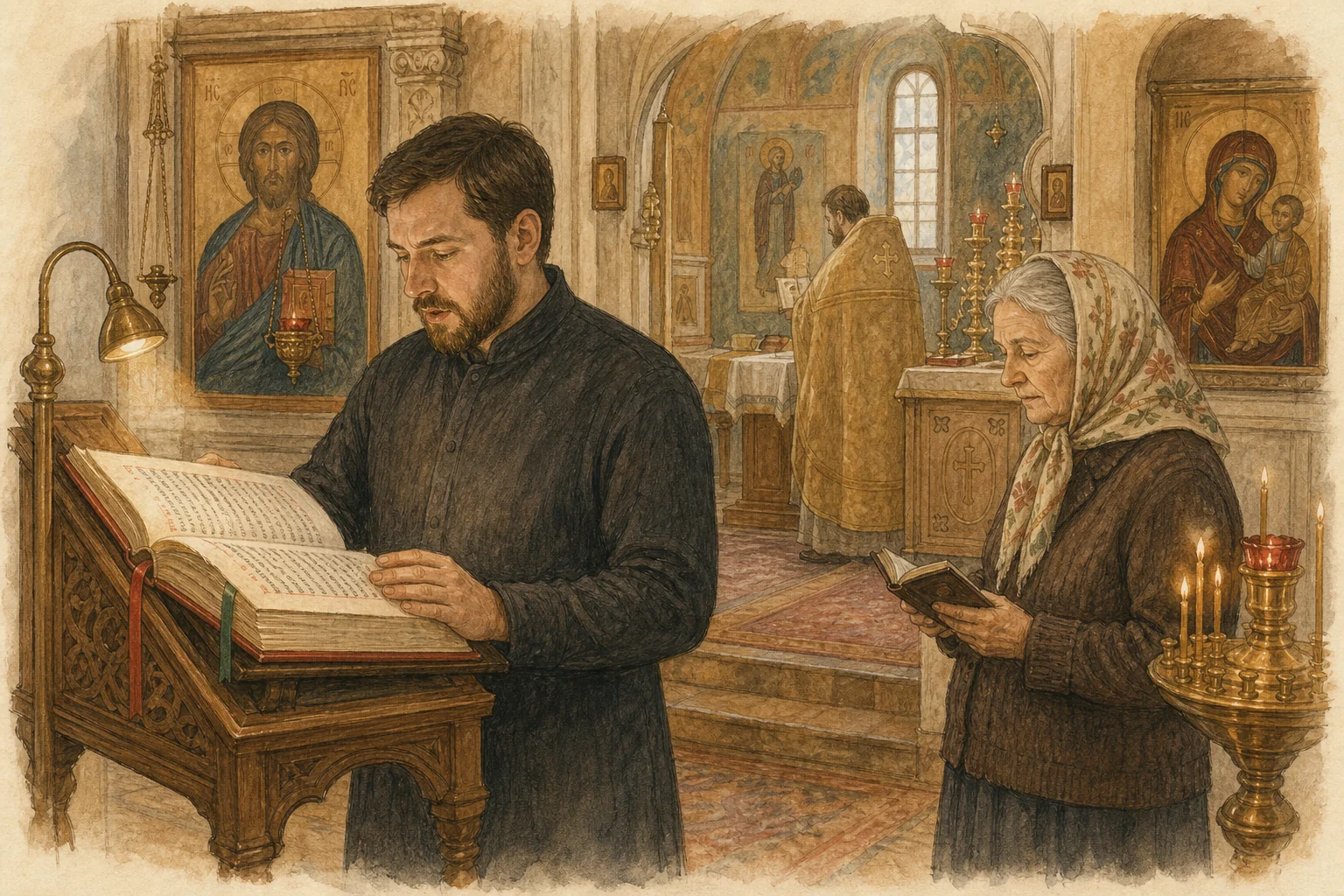
The Hours before the Divine Liturgy are short services of psalms, hymns, and prayers that sanctify the time of day and prepare the Church for the Liturgy. In parish practice, the Third and Sixth Hours are most commonly read before a morning Liturgy. This does not mean two sixty-minute waits: each office often takes about ten to fifteen minutes, though the order varies by day and parish.
If you enter and see a reader at the kliros, closed Royal Doors, and people quietly arriving, the Hours may be underway. Enter softly, choose a place, and join the prayer. The opening exclamation of the Liturgy has not yet sounded, but the liturgical day is already in progress.
Why are these services called “Hours”?
In the ancient world the day was marked by established periods of prayer. The First, Third, Sixth, and Ninth Hours correspond roughly to early morning, mid-morning, noon, and mid-afternoon. The Church fills these moments with remembrance of biblical events and a prayer that all human time may belong to God.
A liturgical Hour is not the same as sixty minutes on a clock. Its office does not last an hour and need not begin at exactly nine or twelve. The name describes its place in the daily cycle and its spiritual theme.
Which Hours are read before Liturgy?
Before an ordinary morning Divine Liturgy, parishes most often read:
- The Third Hour, which recalls the descent of the Holy Spirit upon the Apostles and events in the Lord’s Passion.
- The Sixth Hour, which remembers the Crucifixion and brings prayer into the struggles and work of midday.
The First Hour normally concludes Matins, while the Ninth belongs with the evening cycle. On the eves of the Nativity and Theophany, and on certain days of Holy Week, special Royal Hours include readings from the Prophets, Epistles, and Gospels.
The calendar may appoint a different order on a particular day. Do not assume there is an error if you hear something unfamiliar; consult the schedule or ask a parish attendant.
What is read at the Third and Sixth Hours?
Each Hour is built around three psalms. Troparia and kontakia of the day, verses, and concluding prayers are added. In a normal parish order, a reader at the kliros reads most of the text and the priest gives concluding prayers or exclamations.
The texts hold two dimensions together. They remember events in the earthly life of Christ and the history of salvation, while also asking God to sanctify this particular day—our thoughts, work, decisions, and relationships.
If the reading seems fast, do not try to catch every word at once. Listen for repeated appeals to God and allow the rhythm of the psalms to gather your attention before Liturgy.
What is happening in the altar?
While the Hours are read in the nave, the clergy complete preparations for Liturgy. The Proskomedia is the first part of the Liturgy, when bread and wine are prepared for the Eucharist and the living and departed are commemorated. It may take place behind the closed Royal Doors while the Hours are being read.
The quiet before the public opening therefore does not mean “nothing has started.” The community hears the psalms, preparation continues in the altar, and names submitted in time are commemorated according to the parish order.
See Proskomedia in plain language for a fuller explanation.
When does the Divine Liturgy itself begin?
After the Hours and their concluding prayers, the Royal Doors open and the priest begins the Liturgy with the proclamation, “Blessed is the Kingdom of the Father and of the Son and of the Holy Spirit.” This is a clear landmark for a newcomer.
Yet the Hours are not accidental waiting before the “important” service. They belong to a single path of prayer and help us move from travel, conversation, and daily haste into attentive participation in the Liturgy.
Should I arrive for the beginning of the Hours?
Arriving for the Hours gives practical space to remove outdoor clothing, submit a prayer note, light a candle at a suitable moment, and choose a place before Liturgy begins. The short offices also help the mind become still.
Being late for the Hours is not a reason to remain outside altogether. Enter quietly and join the prayer. If the question concerns preparation for Communion, repeated lateness, or your personal prayer rule, speak with a priest.
Read the actual beginning time in the service schedule. Some schedules name the Hours separately; others give one time for the whole morning service.
May I light candles or submit prayer notes during the Hours?
Many parishes permit this when it can be done quietly. Arriving early is still best. If there is a queue or the reader has begun, choose your place first and ask a church attendant about local practice.
Names for commemoration at Proskomedia are normally submitted before or at the beginning of Liturgy, but the precise time and available forms belong to the parish. Do not promise yourself that a late note must be commemorated in a particular way; ask and accept the explanation peacefully.
How can I listen when Church Slavonic is difficult?
You may read translations of the psalms of the Third and Sixth Hours at home. A printed text is often less distracting than following a phone during worship.
At first, remember three ideas: the Church sanctifies time, remembers Christ, and asks that a person be guarded from sin and distraction. Meaning grows as the same psalms become familiar.
How do ordinary Hours differ from the Royal Hours?
The Royal, or Great, Hours are celebrated only on appointed days and have a more solemn form. In addition to psalms and hymns, each Hour includes Old Testament, Epistle, and Gospel readings. The name comes from the historic attendance of the Byzantine emperor, not from a special prayer intended only for rulers.
Today the Royal Hours lead the faithful more deeply into the Nativity, Theophany, and the Passion of Christ. Their date and length must be checked in the current calendar and parish schedule.
How do the Hours sanctify ordinary time?
The daily cycle did not arise so that every Christian must remain in church around the clock. It teaches that morning, noon, work, and evening can all become times of meeting God. A brief pause before an important task continues this school of attention.
Someone may remember the Third Hour amid morning pressure and the Sixth in the middle of work. There is no need to take on the full office without guidance; a short turning toward God can keep a schedule from consuming the heart.
Why do the Hours matter when few people notice them?
The Hours are often read in a nearly empty church while people enter, write prayer notes, and greet one another. Their quiet sound shows that the Church’s prayer does not begin only when a crowd is present and a choir becomes loud.
The reader’s unobtrusive faithfulness and the attention of a few worshippers prepare the common Liturgy. This is also a lesson for home: prayer’s worth is not measured by an audience or an intense feeling.
Frequently asked questions
Are the Hours part of the Divine Liturgy?
They are distinct offices of the daily cycle immediately preceding Liturgy. Proskomedia, which may be occurring at the same time, is already the first part of the Liturgy itself.
Why does the reader speak quickly?
The pace reflects liturgical tradition and local habit, though prayer should not become meaningless sound. If following is difficult, read the text at home and hold onto the larger meaning.
May I sit during the Hours?
People ordinarily pray standing, but illness, pregnancy, age, weakness, or pain are sufficient reasons to sit. Do not damage your health or judge someone else.
If I missed the Hours, may I remain for Liturgy?
Yes. Enter and take part in the service. Personal questions about preparation for Communion belong in a conversation with a priest, not an automatic prohibition.
How early should I arrive?
Fifteen to thirty minutes before the published beginning is often practical, but first check whether the schedule’s time already includes the Hours. Allow more time on major feasts.
What should I confirm with the parish?
Ask when the Hours begin, when prayer notes for Proskomedia are accepted, and where a practical question can be asked without interrupting the reading. Use the official schedule and contacts.
The Hours teach a simple truth: the meeting with the Divine Liturgy does not begin abruptly. The Church gives us time to stop, remember Christ, and offer the coming day to God.