
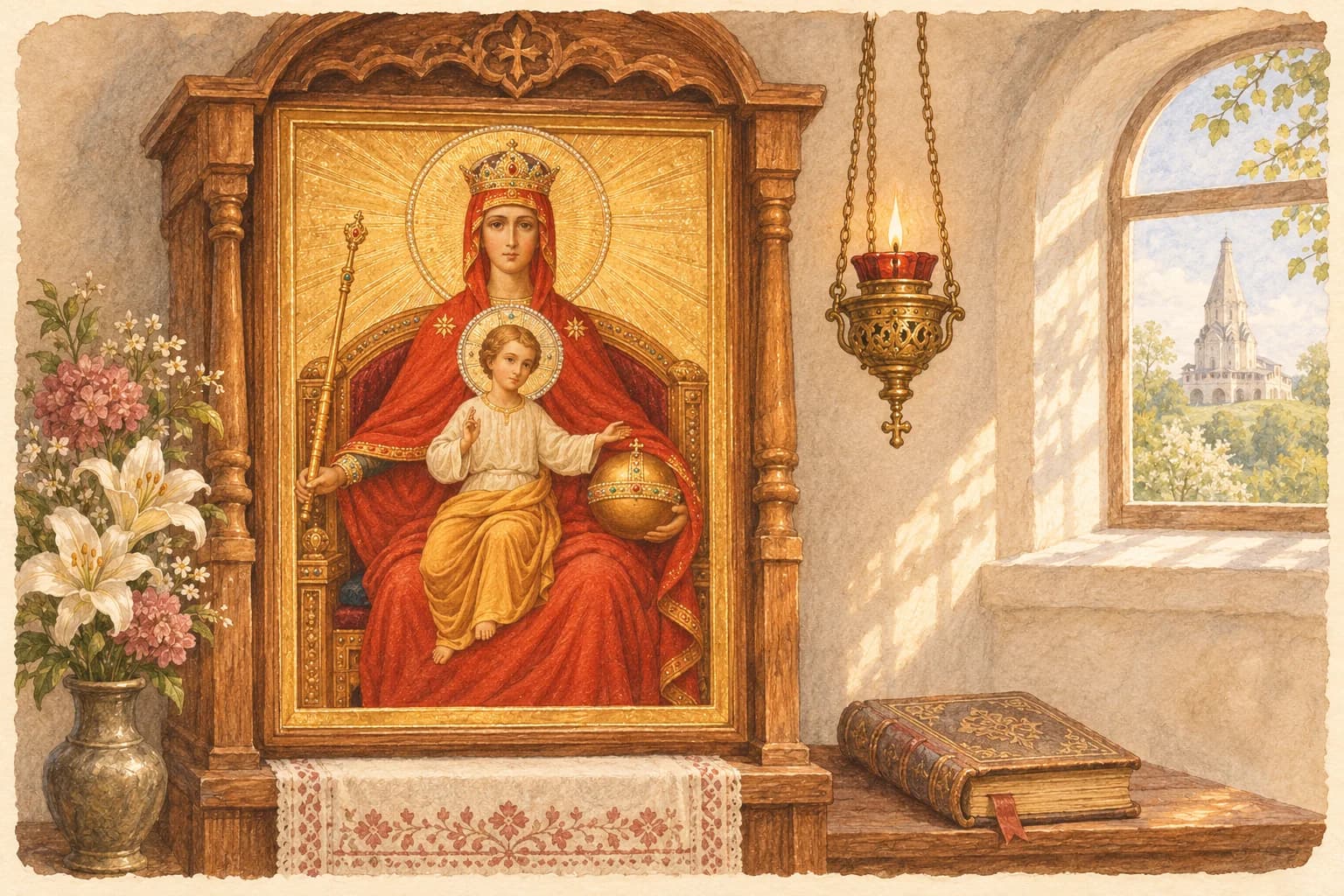
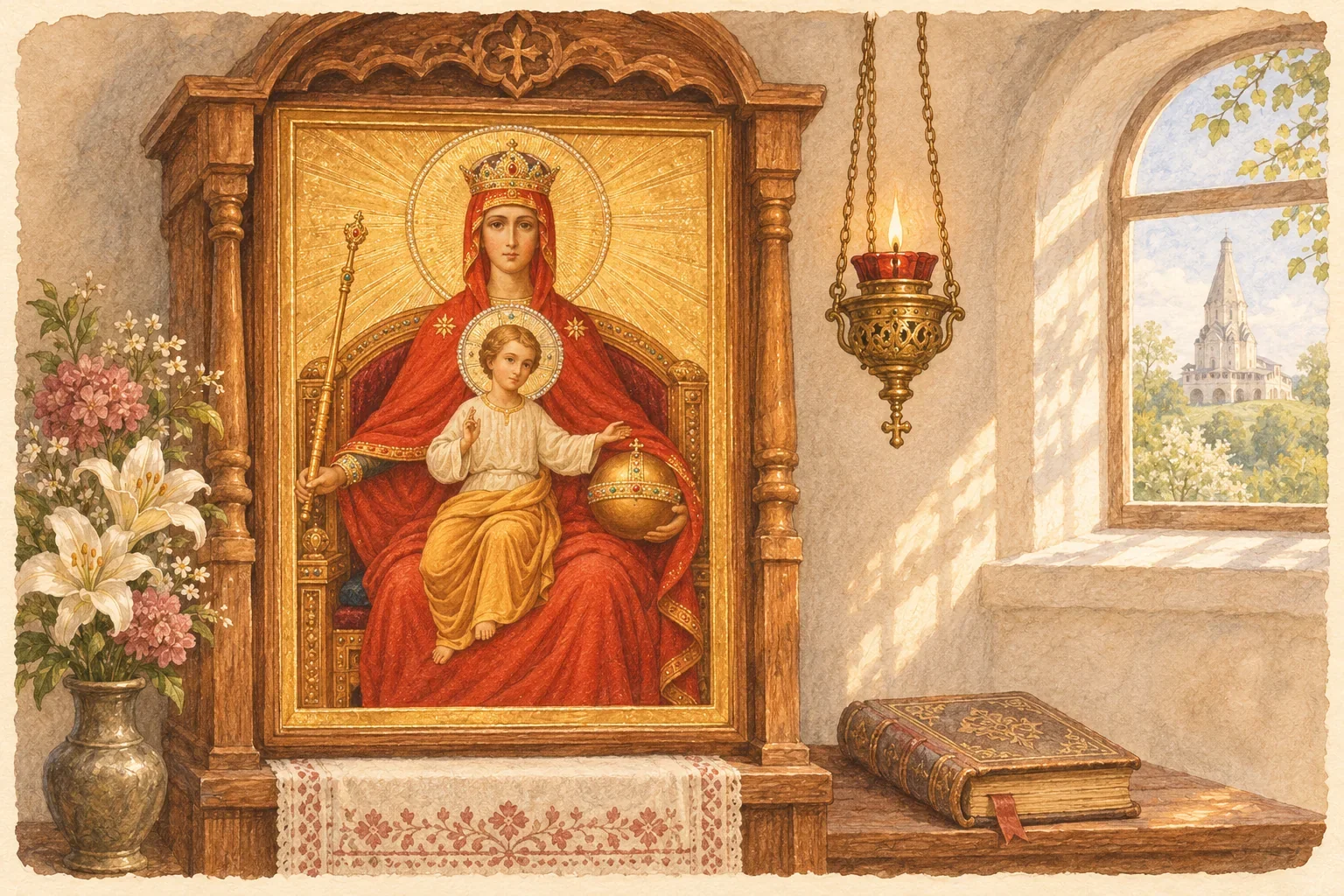
The Reigning Icon shows the Mother of God enthroned with the Christ Child and royal attributes. Orb and sceptre belong to the image’s symbolic language, not a promise of earthly authority to the person praying. The icon calls for Christian rather than magical interpretation.
The icon’s discovery is associated with Kolomenskoye and events in 1917. That setting matters for its remembrance. It does not make every present-day political interpretation a compulsory element of church belief.
Do not seek permission for domination over others from the image. Royal attributes do not sanctify pride, violence or a struggle for influence. Prayer is directed to God and the Mother of God, not to objects of power depicted in the icon.
Read its history through a church source and distinguish it from online prophecies. A normal place of prayer is appropriate if you receive the icon as a gift. Possessing it does not require a special political declaration.
The Mother of God enthroned: the composition
The Reigning icon portrays the Mother of God seated on a throne with the Christ Child. Royal signs—a crown, sceptre and orb—make the image readily recognisable. The sceptre signifies authority, while the orb evokes royal dignity and care for the world. These belong to the language of an image in which Mary is honoured as Queen of Heaven, rather than providing a diagram for an earthly constitution.
The composition remains centred on Christ: the Saviour is on his Mother’s lap. Looking only at the regalia and overlooking the Child reduces the icon to a political emblem. Maternal intercession and royal dignity are brought together here. Attention should not stop at costly objects but turn towards the One through whom the Mother of God holds her particular place in the Church’s veneration.
The rediscovery at Kolomenskoye
The renewed veneration of the image is associated with Kolomenskoye in 1917. The church account describes Evdokia Adrianova approaching the rector of the Ascension Church after experiencing dreams. A search of the church premises uncovered a darkened icon; after cleaning, its royal depiction of the Mother of God became visible. Distinguish the physical discovery from testimony about dreams preserved within church memory.
The account does not establish a general rule that every personal dream should direct an individual or a parish. The significance of this particular event is connected with subsequent ecclesiastical veneration, not merely with an unusual experience. When reading, attend to the people, place and sequence, and avoid adding contemporary messages or predictions absent from the original narrative.
Why the year 1917 matters
The discovery is remembered in connection with Emperor Nicholas II’s abdication and the beginning of profound upheaval in Russia. For believers, the concurrence became significant: the royal attributes were understood as a sign that the Mother of God had not abandoned the people amid the collapse of familiar institutions. This helps explain the strong historical memory surrounding the icon.
Historical interpretation should not silently become a claim that every contemporary political conclusion is already contained in the painting. The icon supplies neither a timetable of future events nor a party programme, and it does not remove the need to judge particular actions morally. Prayer for a country can ask for peace, justice, repentance and care for its people without requiring exhaustive knowledge of revolutionary history.
Understanding the red clothing
The familiar image prominently includes the Mother of God’s red royal clothing. Church explanations connect it with her dignity as Queen and with historical remembrance of the people’s suffering. Colour symbolism should nevertheless be read within the composition and its interpretive tradition. Every shade in a particular photograph need not become a separate hidden message.
Copies may differ in the saturation of colours, the throne’s design and the amount of decoration. Such differences can reflect period, workshop and reproduction technology. Identification depends more on the combination of central features: the enthroned Mother of God, the Child and the royal regalia. When an image differs substantially or an inscription is unclear, compare it with a church description instead of deciding from the impression created by a single colour.
Discussing the image with children and family
For a first explanation, begin with what is visible: who is depicted, why Mary holds Christ and which objects signify royal dignity. Then describe the discovery at Kolomenskoye and the troubled period in which people particularly needed hope. This is more accessible than immediately burdening a child with dynastic controversies and complicated political symbolism.
In family prayer, the image can bring to mind people responsible for others: parents, managers and those making public decisions. Asking for wisdom and justice also entails personal responsibility. Someone who prays for peace while circulating unverified accusations every day creates a contradiction between words and conduct. The history of the Reigning icon becomes more fruitful when it helps reveal that connection, rather than serving only to judge distant historical figures.
A question for reflection
Which parts of your understanding come from church explanation and which from political interpretation?