
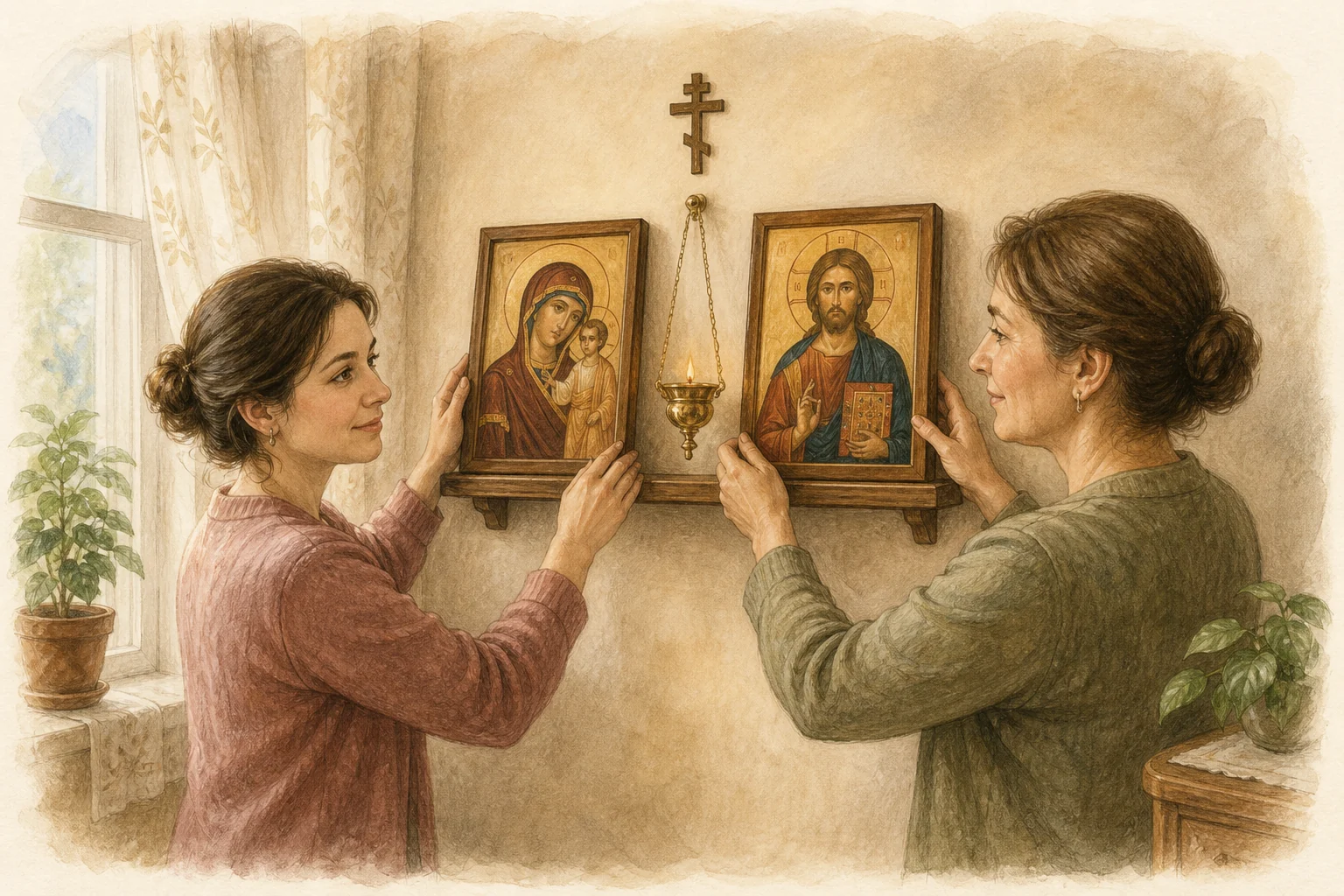
A home prayer corner can begin with an icon of Christ and an icon of the Mother of God placed or hung in a clean and quiet location. A cross, icons of patron saints, a prayer book, and an oil lamp may be added. The essential point is that a person can stop and pray there, not that the apartment satisfies a complicated diagram.
Christians traditionally prefer an eastward orientation when possible, but layout, light, and safety matter more than a literal compass direction. Icons are not amulets or an interior-design method of “protecting” a room.
Why Orthodox Christians keep icons at home
An icon bears witness to the Incarnation of the Son of God and reminds us that Christian faith is not directed toward an abstract idea. Before an image, a person gathers attention, prays to God, and asks the saints for intercession.
Honor passes to the person depicted; it is not directed toward wood, paint, or paper as an independent force. The number and price of icons therefore do not measure a family’s faith.
Which icons should come first?
A sound foundation is an icon of the Lord Jesus Christ and an icon of the Most Holy Theotokos. Families often add the saint whose name a person bears, other patron saints, and an image connected with the parish or an important event.
There is no need to purchase dozens at once. One or two icons before which the family actually prays are more useful than a wall crowded into a collection.
How to position Christ and the Mother of God
In a common Russian arrangement, as the viewer faces the prayer corner, the icon of Christ is placed on the right and the Mother of God on the left, echoing the central part of an iconostasis. At home this is a helpful orientation, not a reason to rebuild a room or argue about inches.
The images may be at the same level, or a central image may be emphasized. Do not place a favorite saint ostentatiously above Christ merely because of personal attachment.
Must the prayer corner face east?
Prayer toward the east is an ancient Christian tradition connected with expectation of Christ and the image of rising light. If an eastern wall is suitable, it is a good choice.
In an apartment, that wall may contain a window, wardrobe, radiator, or passage. Choose a quiet and safe wall before which you can stand. A compass is not a condition for God to hear prayer.
Where in the home should it be?
A place accessible to the household and not dominated by a constantly running screen is best. It might be a corner of the living room, a bedroom wall, or a dedicated shelf. Leave enough room to stand and, where appropriate, bow.
Avoid dampness, direct heat, kitchen steam, and strong sunlight that may damage paint. Secure heavy icon cases carefully, especially in a home with children or animals.
May icons be kept in a bedroom?
Yes. Married life does not make a bedroom unclean. An icon reminds a couple that all family life takes place before God, not only the minutes spent in church.
Place the image respectfully, not where clothing constantly strikes it or amid careless clutter. Do not associate the icon with fear of surveillance or punishment.
Icons in a kitchen, entryway, or child’s room
A small image in the kitchen may recall prayer before meals; one near an entrance may remind the family to pray when leaving; an icon in a child’s room may speak of God’s care. Additional images are appropriate when treated reverently.
Do not place an icon on every door and appliance because you fear misfortune. A home is sanctified by prayer, the sacraments, love, and honest life, not by the quantity of religious images.
What may be kept nearby?
A shelf can hold an Orthodox prayer book, a Gospel book, a list of names for commemoration, a cross, and a closed container of holy water. Fresh flowers are welcome when they do not cover the images and water cannot damage books.
Do not mix occult symbols, charms, or divination objects into the prayer corner. Family photographs are not icons and are better placed separately, although the people may of course be remembered by name in prayer.
Oil lamps and candles: safety first
An oil lamp or candle expresses prayer and offering but is not required for prayer at home. Never leave an open flame unattended, near curtains, paper, dried flowers, or where a child or pet can overturn it.
Use a stable, nonflammable base, ventilate appropriately, and extinguish the flame before leaving or sleeping. An electric lamp may be safer for some households, but it possesses no separate spiritual power.
Does a purchased icon need a blessing?
Icons from an Orthodox church shop are ordinarily intended for prayer. If an image came from another source, was received as a gift, or raises questions about the depiction and inscriptions, show it to a priest and ask about local practice regarding blessing.
Do not understand a blessing as switching on a magical feature. What matters is whom and how the icon depicts and whether it becomes part of a life of prayer.
Printed reproduction or hand-painted icon?
A canonical printed image can serve home prayer. Hand painting, a costly cover, and great age are not prerequisites. Faithfulness to Orthodox iconography and respectful condition are what matter.
A low-quality or uncertain religious picture should be checked. Not every devotional image found online is an Orthodox icon.
How to care for icons
Remove dust with a soft dry cloth and no pressure. Do not apply water, household chemicals, or oil to a painted surface. Never attempt to brighten an old or darkened icon with solvent.
Show a valuable or damaged image to a qualified conservator recommended by the parish or a museum professional. If a simple printed icon is beyond use, ask the parish how to dispose of it reverently rather than putting it casually into household waste.
A prayer corner in a rented or very small home
A small stable shelf, one wall fastening used with the owner’s permission, or a closing icon case may be enough. In a dormitory or while traveling, a folding icon and prayer book can be kept in a clean case.
Do not postpone prayer until you own a separate room. Our guide to beginning prayer at home explains how to start within real circumstances.
Respect without turning the corner into a museum
Cleanliness and care are appropriate, but the family should not become afraid to approach the shelf or touch a prayer book. A home icon corner is a place of living prayer, not an exhibition protected from ordinary people.
Teach children to handle icons gently while answering questions freely. Reverence grows through meaning and example, not through threats that an accidental touch will bring punishment.
How to pray before home icons
Stop the household task, silence notifications, stand calmly, and make the sign of the Cross. Read a short rule, name loved ones, and keep a little silence. The icon supports attention, while prayer is addressed to the living God.
Our article on praying in your own words shows how a prayer book and personal speech belong together. Home prayer continues in worship; upcoming services are on the schedule page.
Frequently asked questions
May an icon be placed near a television?
It is physically possible, but a frequently running screen distracts from prayer and visually mixes a holy image with entertainment. A quieter location is preferable.
Must icons be hung above head level?
They should have an honored and convenient place, but there is no universal household measurement. Secure mounting is more important.
May an icon be stored inside a cabinet?
A travel icon or an image kept under temporary circumstances may be stored cleanly and closed. A visible place is normally more convenient for daily prayer.
What should I do with a gifted icon I cannot identify?
Do not begin using it automatically. Show it to a priest or someone knowledgeable in iconography to identify the subject and its suitability.
Must an oil lamp burn continuously?
No. An open flame must never be left unattended. Light the lamp for prayer only when fire safety can be maintained.
A short practical plan
Choose a clean, quiet wall; place Christ and the Mother of God; add a cross and family saints if desired; keep a prayer book nearby; leave a safe place to stand. That is enough.
If the image or arrangement raises questions, take a photograph and use our contact page. The meaning of a home prayer corner is revealed not through perfect composition but through regular prayer and life according to the Gospel.