
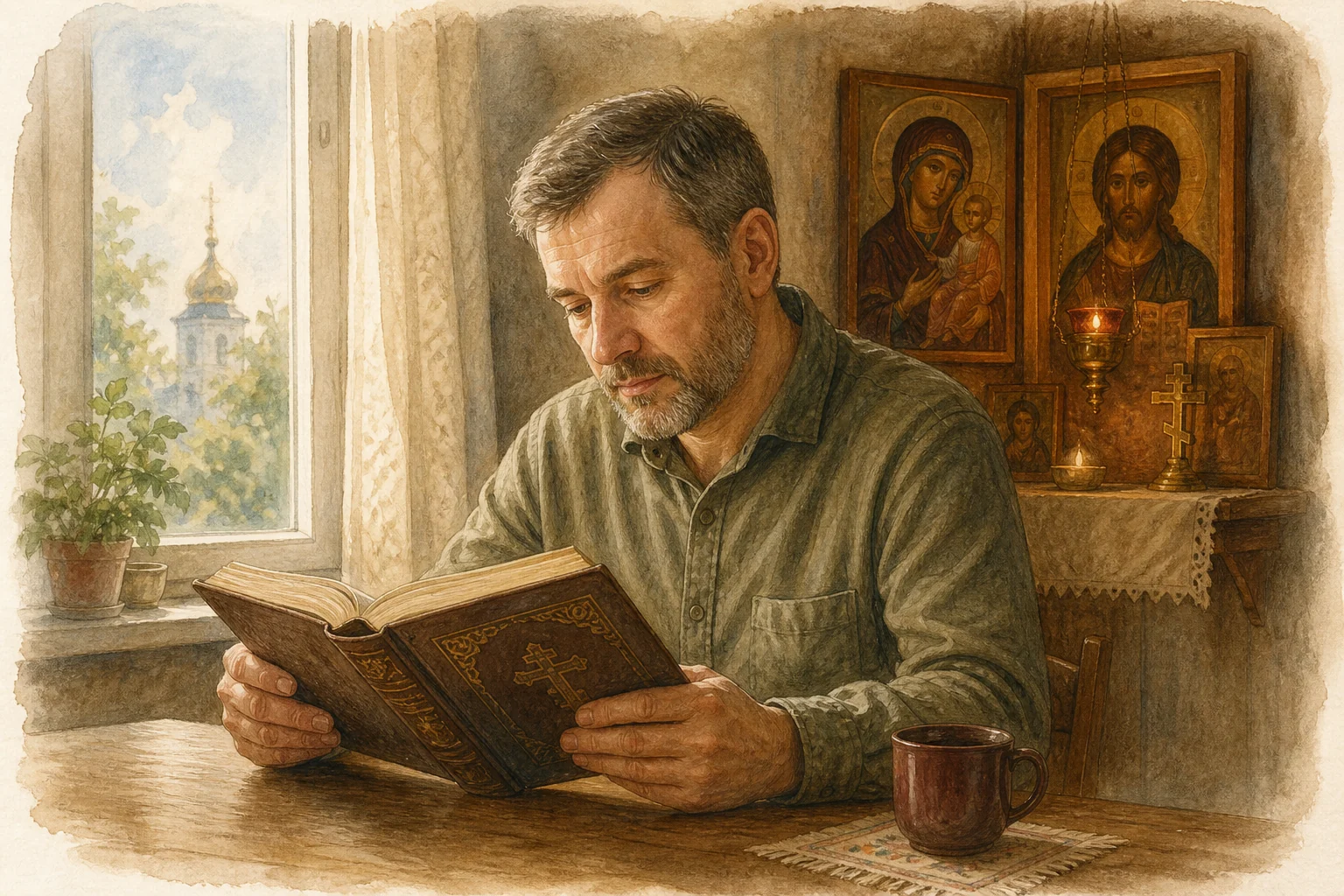
A beginner can read the Gospel at home every day in a small portion—about ten to twenty verses or one complete scene. Pause before reading, ask God for understanding, read slowly, examine the context, and identify one implication for life. Do not attempt the entire Bible at once, and never open a random page to obtain a prediction.
For a first continuous reading, the Gospel according to Mark is concise, while Luke offers a detailed narrative. There is no single compulsory order for everyone.
What “the Gospel” refers to
The New Testament contains four Gospels: according to Matthew, Mark, Luke, and John. They bear witness to Jesus Christ, His teaching, Cross, and Resurrection, presenting one Good News from distinct perspectives.
The word also refers to the liturgical Gospel book read in church. At home, an ordinary edition of the New Testament or Bible with readable type and cross-references is practical.
Which edition should be chosen?
Use a stable translation issued or recommended for Orthodox Christian reading in your language. A beginner benefits from clear notes, maps, and an index, but an explanation covering every line can become distracting.
A modern translation may clarify a difficult phrase, while the principal reading can remain in a familiar ecclesial edition. If the notes or origin of a volume seem uncertain, show it to a priest.
Which Gospel should come first?
Mark is brief and moves quickly, helping many first-time readers see the whole narrative. Luke gives extensive attention to Christ’s mercy, prayer, and those pushed aside. Matthew highlights fulfillment of Scripture, while John invites especially slow theological reading.
You may begin with Mark, then read Luke, Matthew, and John. Another sound approach is to read the passage appointed by the Church for the day when you also have an explanation of its context.
How much should be read at one sitting?
Do not make chapter count the main goal. One healing, parable, or conversation often forms a sufficient unit. Ten to fifteen attentive minutes are more fruitful than an hour after which nothing remains in memory.
Stop early when the meaning needs reflection. On the following day, briefly retell the previous scene to yourself and continue.
How to prepare
Choose a stable time, silence notifications, and have the book ready. If the home has a prayer corner, reading nearby can help; our guide explains how to arrange icons at home.
Make the sign of the Cross and ask briefly, “Lord, help me hear Your word and live by it.” This prayer does not replace study of the text; it gives that study its proper purpose.
Read within the context
Do not detach one sentence from its conversation. Notice who speaks, to whom, what occurred beforehand, and how the episode ends. Headings in a printed Bible are editorial aids and were not part of the ancient text.
When a word is unfamiliar, first finish the scene. Then examine the note, a parallel passage, or a reliable commentary. Context often resolves an apparent contradiction.
Three questions after a passage
Ask: what does the text reveal about Christ? What does it show about the human person? What truthful step can I take today? The final question should not force every line into a direct household instruction.
Sometimes the response is not an action but a changed perspective, thanksgiving, or a question that needs to remain open. Write one or two sentences rather than copying an entire commentary.
Is a notebook useful?
A notebook makes the path of reading visible. Record the date and passage, one key point in your own words, one question, and one application. Do not turn the entry into a school report.
After a month, reread the notes and notice recurring themes. The issue is not only how much was understood but whether relationships and decisions are changing.
Which commentaries can be trusted?
Choose patristic and responsible contemporary Orthodox commentaries recommended by the parish or a recognized Orthodox publisher. A commentary supplies historical background and protects against arbitrary private conclusions.
Do not replace Scripture itself with endless opinions. Read the Gospel first, formulate the question, and then consult an explanation or priest.
What to do with difficult or frightening passages
Do not construct a conclusion from one sentence, especially when the subject is judgment, family, violence, or the end of the age. Mark the question, read the whole episode, and look for an ecclesial explanation. Some phrases require knowledge of language, history, and genre.
Do not be ashamed of confusion or disagreement. An honest question is better than pretending to understand. Use the parish contact page to ask about a conversation or study meeting.
Why random-page divination is wrong
Opening the Gospel to ask “what will happen to me?” and treating the first line as a personal forecast is not Christian reading. It converts Holy Scripture into a tool of divination and discards context.
When making a decision, ask for wisdom, learn the commandments, seek counsel, and accept responsibility. God’s word forms freedom; it does not remove freedom through an accidental “answer.”
How reading becomes prayer
After the passage, give thanks, name what corrected or comforted you, and ask for strength to practice what was heard. You may finish with the Lord’s Prayer. Our article on praying in your own words helps with honest personal speech.
Do not demand a powerful feeling. A word may work slowly and become clearer through an event, worship, or a conversation.
Reading aloud, audio, and a phone
Quiet reading aloud keeps the eyes from sliding over the page. An audio recording can help while traveling or when sight is limited, but driving needs attention; it is not the time for detailed analysis.
A phone is acceptable when the source is reliable, notifications are off, and the screen does not lead immediately to other apps. A printed volume often marks the time more clearly.
How to read with children
Choose a short and understandable scene, explain unfamiliar details, and ask one open question. Do not use the Gospel as a threat: “God will punish you if…” Show mercy, truth, and responsibility.
Five minutes of family reading are better than a long lecture. A child may draw the event, name a person in the story, or suggest one kind action without turning the encounter into a test.
Connect home reading with worship
At the Divine Liturgy, the Gospel is proclaimed in the assembly of the Church. A passage read in advance is easier to hear, and the homily helps apply it. Find the next service on the schedule page.
Home reading does not make anyone a self-sufficient final interpreter. Shared prayer, Tradition, and pastoral conversation protect the reader from a closed private fantasy.
Historical background without losing the message
Maps, timelines, and notes about Jewish and Roman life can clarify a scene, but they are tools, not the destination. Do not spend every reading period chasing minor details while avoiding Christ’s direct call to repentance and love.
Use one question at a time. If a larger historical issue matters, mark it for a separate study period so that ordinary daily reading remains possible.
A plan for the first month
Read Mark consecutively, one complete scene each day. Keep the place with a bookmark, record one question, and do not “catch up” after a missed day by doubling the amount.
When finished, review the notes and choose the next Gospel. Reduce the pace if needed. The goal of the month is not the label “completed” but the beginning of a continuing encounter with Christ.
Frequently asked questions
Must I read standing?
Standing can express reverence, but sitting at home is acceptable, especially for longer reading, illness, or weakness.
May I begin somewhere other than Matthew?
Yes. The order of books in the New Testament does not require a newcomer to start with the first; Mark or Luke is often easier for an initial complete reading.
What if I understand nothing?
Reread the immediate context, use a reliable explanation, and record the question. Do not invent a secret meaning.
Must I read every day?
Regularity helps, but a missed day does not require restarting. Return to the bookmark at the next available time.
May I underline passages?
Careful notes are acceptable in a personal study copy. Do not mark a liturgical or borrowed book without permission.
The essentials for beginning
Use a trusted edition, read a short consecutive passage, attend to context, write one question, and take one step in life. Do not chase volume or use an accidental line as a prediction.
Begin today with the first scene in Mark or Luke. Read slowly, name what you have learned about Christ, and return tomorrow.