
The history of the Don icon brings together Church remembrance, medieval painting, and traditions about Moscow's protection. An accurate account should not treat all this material as documentation written at the same moment. Veneration does not depend upon proving every detail of a later narrative. The object of faith is not a reconstruction of a military campaign.
History and Tradition
The ancient Don image belongs to the late fourteenth century and is traditionally associated with Theophanes the Greek. That attribution should not be presented as a surviving signature. Ecclesiastical tradition connects it with the Battle of Kulikovo and Prince Dmitry Donskoy. “According to tradition” is an appropriate phrase: it does not pretend that a detailed contemporary record of the transfer survives.
Three questions should be kept separate: when the surviving panel was painted, when its narrative took shape, and when its feast was established. Their answers may belong to different centuries. A year mentioned in a military legend is not by itself a scientific dating of the wood or paint.
A Distinctive Composition
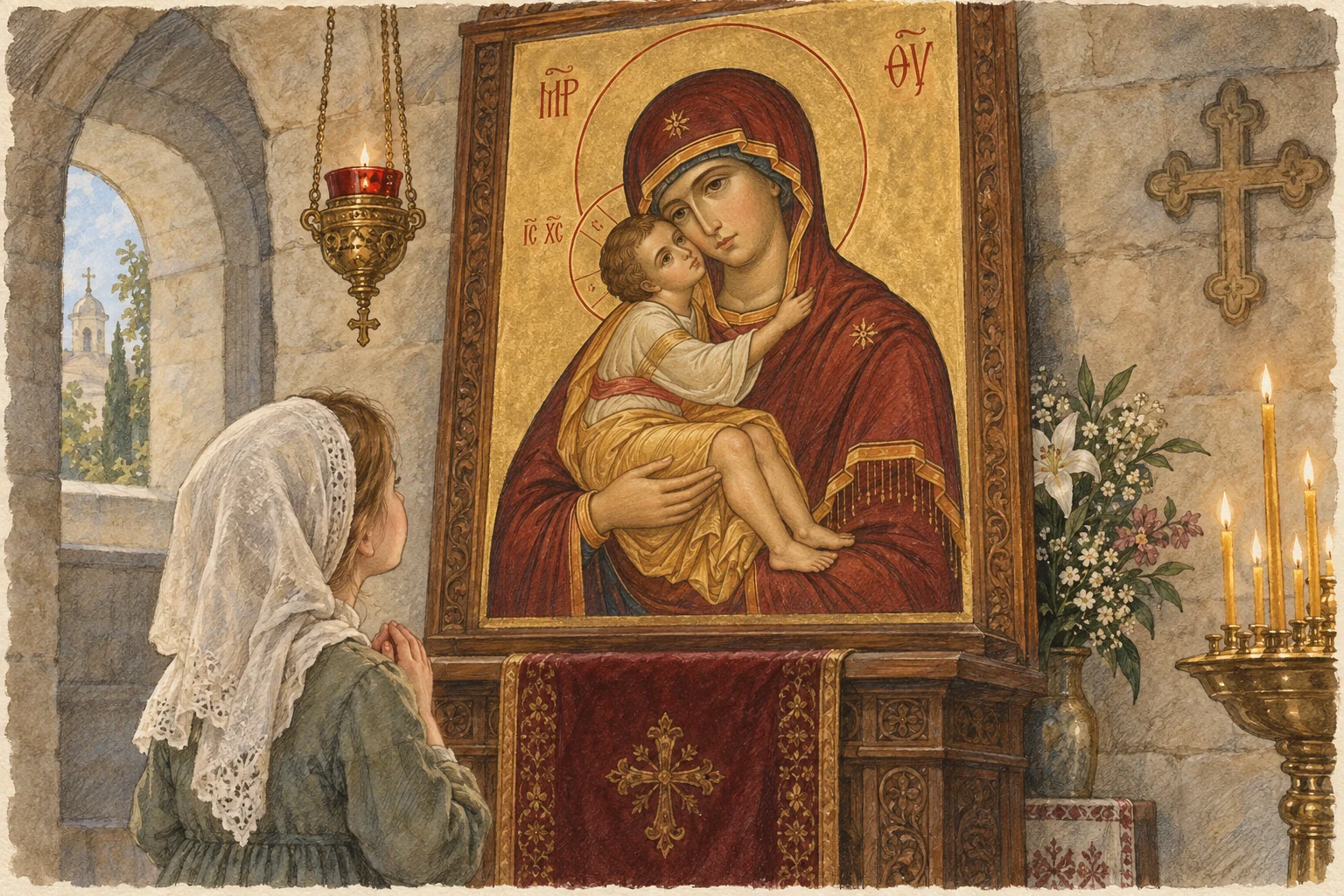
The icon belongs to the Tenderness family, showing Mother and Son in a close embrace. The Child's position and exposed lower legs help distinguish this particular composition. The ancient double-sided panel also has an image of the Dormition on its reverse. Taken together, the two sides invite reflection on receiving Christ and on the hope of life with him.
Not every modern reproduction includes the reverse. Its absence from a domestic icon does not make that icon defective: a reproduction may intentionally show only one side. When studying the historic object, seek catalogue views of both faces instead of inventing the unseen composition from an incomplete description.
Why This Feast Day?
The commemoration is associated with Moscow's deliverance from danger in 1591 and the foundation of the Donskoy Monastery. Russian churches using the Julian calendar observe it on civil September 1, which is Julian August 19. This explains why an English-language calendar may display a date different from the one familiar in Russia.
The military setting does not exhaust the meaning of veneration. Prayer for protection can include peace, an end to violence, preservation of human life, and freedom from answering hatred with hatred. Historical thanksgiving does not authorise a person to call every private conflict a holy war or to treat prayer as permission for cruelty.
Identifying a Particular Icon
There are many copies of the Don image. Each may have its own parish history of donation, restoration, or transfer. Establish which actual object a caption describes. Information about the original should not be attached without explanation to a photograph of a later copy, however closely that copy follows the composition.
Historical research is not an entrance examination for prayer at home. Knowing who is depicted and approaching the Mother of God with trust is enough to begin. Publishing a family or parish history, however, requires greater precision. An honest gap is preferable to an attractive invention. “Date unknown” or “provenance still being investigated” can be entirely appropriate descriptions. Care for the truth is itself part of respecting a sacred image, and it leaves future researchers a clearer foundation than certainty which the evidence cannot support.
When introducing the icon to children, do not begin with battle details. Identify Mary and Christ first, then explain thanksgiving for help. Military history supplies context without eclipsing prayer for peace and the preservation of life.
What a Cautious Attribution Means
“Traditionally associated with Theophanes the Greek” is not the same as saying the artist signed the panel. Authorship, workshop, period, and artistic circle can carry different degrees of certainty in a catalogue. If a museum label is more cautious than a popular retelling, do not remove that caution to obtain a stronger headline. The painter's identity matters to art history, but is not a condition of the image's veneration.
The Don icon offers a useful occasion to read captions in full. Does the date belong to the ancient panel or a later copy? Does the artist's name refer to the work pictured or to its model? Even a precise repetition of the composition does not make a new painter a fourteenth-century artist. A family photograph can simply identify the image and the location. Do not import further details from a catalogue without checking which object it describes.
Two Sides and Two Ways of Looking
The embrace on the front and the Dormition on the reverse are not a sequence of domestic photographs. Looking for the same apparent age of the figures or one consistent viewpoint would ask the wrong question. First examine each composition separately, then consider why the closeness of Christ and his Mother extends beyond his earthly childhood. Comparison allows reflection without pretending to recover an undocumented intention of the painter.
If only the front is available, it is reasonable to begin and end there. A museum visit or family discussion need not explain everything at once. Start, for example, with the movement of the figures and the Child's exposed lower legs; later consult an identified reproduction of the reverse. This helps reveal an actual work rather than merely a familiar name from a historical account. Reverence for the icon and attention to its painting need not compete. Both ask us to avoid replacing what is present with a story prepared before we looked.
Sources
- OCA: the ecclesiastical tradition of the Don icon
- Tretyakov Gallery: the Don icon and a later copy (Russian)