
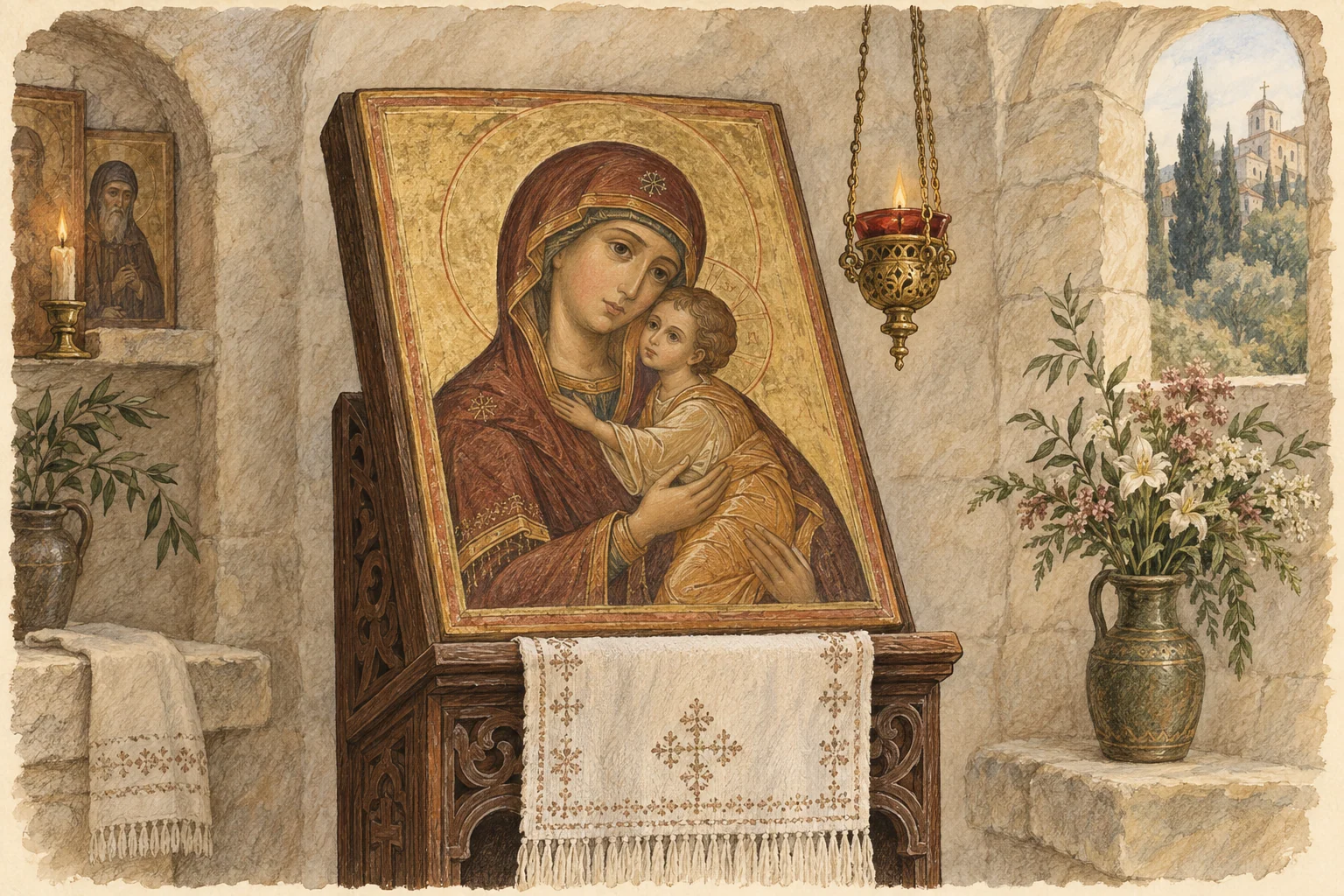
“It Is Truly Meet” is a hymn honouring the Mother of God, familiar from the Divine Liturgy and prayer at home. Its older language expresses the Church’s praise of the Mother of the incarnate Son of God.
The hymn in explanatory English
It is truly right to call you blessed, O Theotokos, ever blessed and all pure, the Mother of our God. More honourable than the Cherubim and incomparably more glorious than the Seraphim, who gave birth to God the Word without corruption, true Theotokos, we magnify you.
This is an explanatory translation, not a replacement for the approved text used by your parish.
“Meet” and “blessed”
The older English “meet” means fitting or right. Calling Mary blessed recognises God’s grace; it does not mean that our words manufacture her happiness. “Ever” corresponds to the Church Slavonic word meaning always.
Cherubim and Seraphim
These are angelic ranks. The comparison expresses the unique honour of the Mother of Christ. It does not make her part of the Godhead or invite contempt for angels. Saints and angels glorify the one God.
God the Word
The Word is the Son of God, not a book or spoken sentence. The phrase about birth without corruption confesses the mystery of Christ’s birth and Mary’s perpetual virginity. “True Theotokos” affirms who her Son is: God become human.
Where the hymn belongs
In the usual order of the Liturgy of Saint John Chrysostom, the hymn follows the consecration of the Gifts. Certain feasts appoint another hymn in its place. A different hymn therefore does not in itself indicate an error. At home, follow the order given in the prayer book.
Learning it with understanding
Read one sentence at a time with its explanation, then return to the prayer as an address rather than a pronunciation exercise. Different musical settings can carry the same words. You do not have to master the music before you can attend to the meaning.
Two sentences, one address
The first sentence says that it is fitting to praise the Theotokos; the second unfolds whom we magnify. If the sequence of descriptions makes the grammar difficult, find its conclusion: “we magnify you.” The preceding phrases belong to that address. For study at home, read the sentence's main structure first and then restore the descriptions one at a time. This is a reading exercise, not a proposal to shorten the received prayer when using it devotionally.
Likewise, understand “more honourable” as speaking of honour, not as a comparative score for honesty. A mistaken reading might suggest that the hymn questions the truthfulness of angels, which is not its subject. Check vocabulary before building a theological problem around it. One small clarification can make an entire phrase easier to follow. This is particularly useful when moving between older English, contemporary English, and Church Slavonic explanations.
Praise does not replace the address to God
The hymn itself calls Mary the Mother of our God and names Christ as God the Word. Those words prevent it from becoming an account of a power independent of God. Honouring the Theotokos and believing in Christ are not two competing directions from which a worshipper must choose. Nor does the praise suggest that precise pronunciation lets a person control heavenly help. Understanding the hymn matters more than finding an allegedly unfailing means of obtaining what you want.
Not filling a mystery with speculation
The expression about birth without corruption confesses the Church's faith; it is not a detailed account of a bodily process. Do not supply explanations the text does not give or teach invented physiological details to children. State the meaning offered in the prayer book and acknowledge the limits of that explanation. Reverent language does not require presenting guesses as knowledge or answering every possible question immediately.
Words about the Theotokos's purity must not be used to demean ordinary motherhood, people living with illness, or survivors of abuse. Praising a particular holiness does not establish that the human body is shameful. If such associations arise, distinguish them from the prayer's meaning and speak with someone able to explain without pressure or accusation. An honest question deserves more than a demand to stop thinking about it.
Familiar words in unfamiliar music
Another church may use a different melody, pace, or translation. Do not force shared worship into the shape of a favourite recording. Listen for the beginning and end of a phrase and return to its familiar meaning. If you wish to join aloud, learn the parish's practice. Silent listening can still belong to the shared address. Musical beauty should not make neighbouring worshippers seem like obstacles or become a reason to resent a less experienced choir.
Home prayer and personal requests
The hymn chiefly offers praise rather than a list of private needs. You need not insert names and personal requests between its lines. Read the text as given and remember loved ones separately at an appropriate place in your home rule. This makes room for a way of addressing God and his saints that differs from everyday urgency: not only requesting immediate help, but gratefully recognizing God's action. Learning the short hymn begins with noticing that distinction, rather than undertaking an obligation to master its entire history at once.
Text reference
Azbyka: traditional prayer text (Russian)