
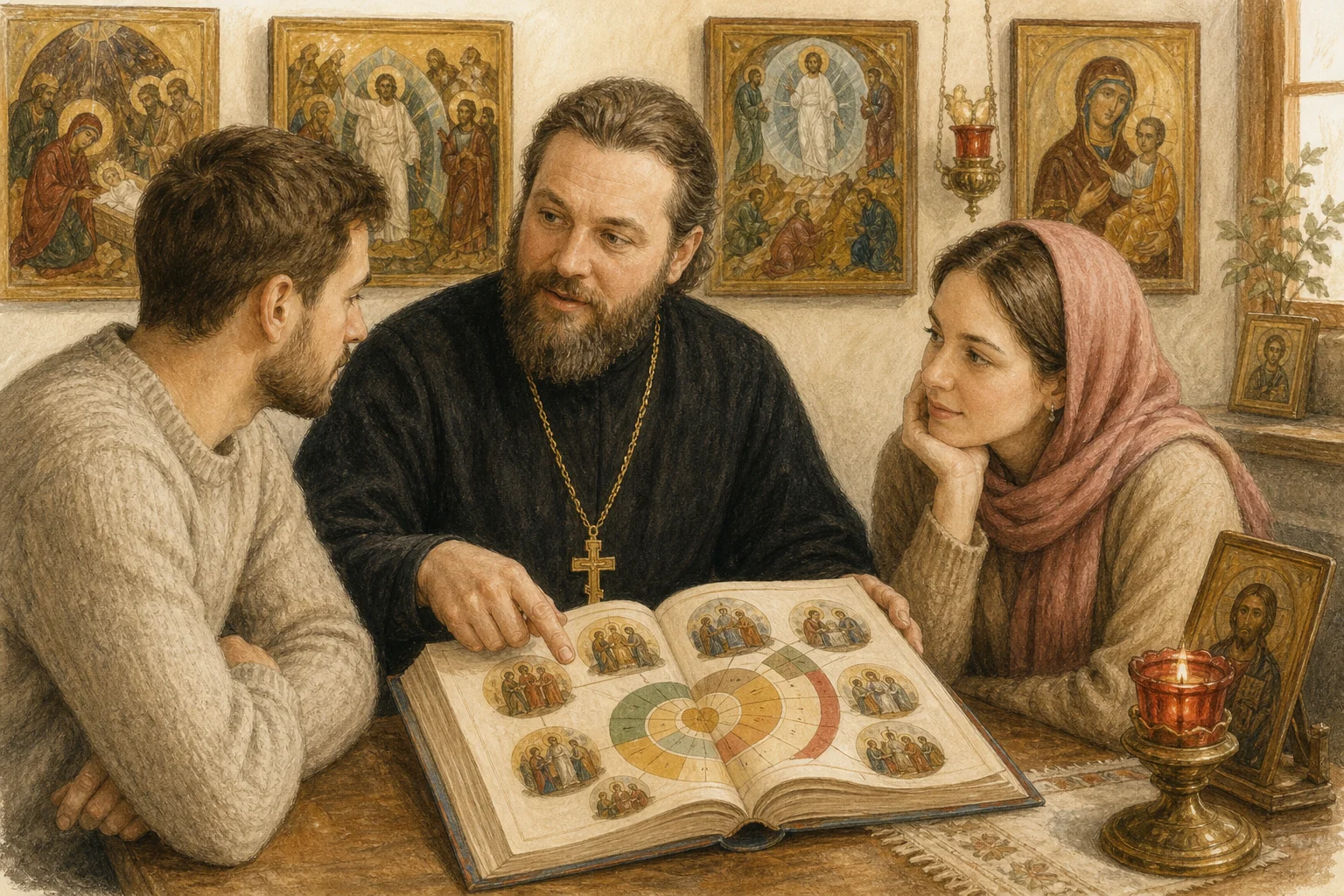
The Twelve Great Feasts are the twelve principal feasts of the Orthodox church year after Pascha. They commemorate events in the earthly life of Jesus Christ and the Mother of God. Some have fixed civil dates, while others move with the date of Pascha.
Pascha is not one of the twelve because it stands above the entire festal cycle as the “Feast of Feasts.” The calendar is not a collection of prohibitions. It allows Christians to enter the Gospel story year after year through worship, prayer, fasting, and thanksgiving.
How the Orthodox church year is organized
The liturgical year joins several cycles. The fixed cycle follows calendar dates; the movable cycle follows Pascha; the weekly cycle returns to Sunday, Wednesday, and Friday. Every day also includes commemorations of saints.
The ecclesiastical new year is September 1 in the Julian calendar, corresponding to September 14 in the current civil calendar used by the Russian Orthodox Church. Yet the death and Resurrection of Christ remain the spiritual center of the whole year.
Why are there twelve Great Feasts?
The number twelve became the traditional name for the circle of the most important feasts of the Lord and the Mother of God. This does not make other days unimportant or mean that all twelve have an identical liturgical rule.
Together the feasts reveal one history of salvation: the birth and vocation of Mary, the Incarnation of the Son of God, His manifestation to the world, the Cross, the Ascension, and the descent of the Holy Spirit.
Pascha stands above the Twelve Feasts
Christ’s Resurrection is the foundation of Christian faith and the summit of the calendar. Its date changes each year, and Great Lent, Palm Sunday, Ascension, Pentecost, and other observances are calculated from it.
Thus the phrase “twelve greatest feasts” always needs this clarification: Pascha is not a thirteenth item. It is the center and source of the whole list.
Feasts of the Lord and feasts of the Theotokos
Feasts of the Lord directly celebrate events in Christ’s life and ministry. Feasts of the Theotokos concern the Virgin Mary, but they never separate her from Christ: her vocation and faithfulness serve the mystery of the Incarnation.
Orthodox Christians worship God alone. They venerate the Mother of God as the Mother of the Lord and ask her prayers. This distinction prevents the calendar from being misunderstood as a group of independent cults.
Fixed and movable dates
Nine of the Twelve Great Feasts have fixed dates in the civil calendar used by the Russian Orthodox Church. Three are movable: the Entry of the Lord into Jerusalem, the Ascension, and Pentecost. Their dates are determined by Pascha.
Civil dates may differ in another Orthodox calendar tradition. Consult the calendar of the jurisdiction and the current parish service schedule.
Nativity of the Mother of God — September 21
The festal year opens with the birth of the Virgin Mary to the righteous Joachim and Anna. It announces the beginning of the fulfillment of God’s purpose and brings hope to a family that had lived with the pain of childlessness.
The Gospels do not narrate the event; its details belong to the Church’s Tradition. The feast does not promise an automatic solution to family suffering. It teaches trust in God without despair.
Exaltation of the Holy Cross — September 27
This feast glorifies Christ’s Cross and remembers its finding and elevation in Jerusalem. Its center is not an object used as an amulet but the saving self-offering of Christ.
It is an appointed strict fast even when it falls on a weekend. The service includes particular prayers and prostrations according to the liturgical order and each person’s physical ability.
Entrance of the Mother of God into the Temple — December 4
The feast remembers the young Mary being brought by her parents into the Jerusalem Temple and dedicated to God. The hymns see her as the living temple who will receive the incarnate Word.
For a family this is not permission to force religious performance on a child. Dedication to God belongs together with freedom, love, and the trustworthy example of adults.
Nativity of Christ — January 7
The Son of God becomes human and is born of the Virgin Mary. The poverty of Bethlehem reveals more than a sentimental story: God humbly enters human vulnerability.
The Nativity Fast and its final vigil prepare the feast. Family food, gifts, and decorations are good when they do not displace the Liturgy or care for someone in need.
Theophany, the Baptism of the Lord — January 19
Christ receives Baptism from John in the Jordan, and the Holy Trinity is manifested: the Father’s voice, the Son in the water, and the Spirit in the form of a dove. The Great Blessing of Water is celebrated both on the eve and on the feast with the same rite.
Holy water is received with prayer and reverence, not used as magic. Winter immersion in a river or lake is neither a sacrament nor an obligation and cannot replace repentance.
Meeting of the Lord — February 15
On the fortieth day the infant Christ is brought to the Temple and met by the righteous Simeon and Anna. The Slavic name of the feast means “meeting.”
It speaks of faithful waiting and the meeting of the Old and New Covenants. A blessed candle is used in prayer; it is not a charm against storms or misfortune.
Annunciation — April 7
The Archangel Gabriel announces that Mary will become the Mother of the Savior, and receives her free response: “Let it be to me according to your word.” The Incarnation begins as God’s action freely received by human faith.
The feast usually falls within Great Lent but brings radiant joy. Releasing birds is a regional custom, not the essence of the day and never a justification for mistreating animals.
Entry of the Lord into Jerusalem
One week before Pascha the Church remembers Christ entering Jerusalem. The crowd greeted Him with branches; in northern lands worshipers traditionally bring budding willow branches.
The blessed branch witnesses to Christ but does not heal through striking or protect a house magically. The feast leads directly into Holy Week.
Ascension of the Lord
On the fortieth day after Pascha, Christ ascends without abandoning human nature or ceasing to be present in His Church. The feast always falls on a Thursday.
The Ascension does not mean that Christ simply traveled far away. It reveals the glorification of humanity and sends the disciples to witness in the world.
Pentecost, the Day of the Holy Trinity
On the fiftieth day after Pascha, the Holy Spirit descends upon the apostles. The Church recognizes the revelation of the Trinity and the beginning of the worldwide proclamation of the Gospel.
Vespers after the Liturgy includes kneeling prayers. Greenery in the church expresses life and renewal; it does not function as a protective charm.
Transfiguration of the Lord — August 19
On Mount Tabor, Christ reveals to the disciples the glory ordinarily concealed by His humble appearance. Moses and Elijah witness to the unity of the Law, the Prophets, and their fulfillment in Christ.
Blessing grapes and other fruit is thanksgiving for the harvest. The Russian popular name “Apple Savior” must not obscure the Gospel event.
Dormition of the Mother of God — August 28
The feast remembers the end of the Theotokos’ earthly life and proclaims hope in the resurrection. Its icon joins the grieving apostles at her bed with Christ receiving the soul of His Mother.
The Dormition does not deny bereavement. It teaches Christians to grieve without hopelessness and concludes the two-week Dormition Fast.
Eve, forefeast, and afterfeast
A major feast is not limited to one date. The Church prepares through a forefeast, commonly celebrates a vigil on the preceding evening, and continues the theme during an afterfeast.
When the feast falls on a workday, a person may attend the evening service or another realistic part of the schedule. Real participation is better than guilt about an impossible ideal.
What happens during a festal service?
Vespers, Matins, and the Divine Liturgy interpret the event through readings, hymns, and the icon. Vestment colors and special rites assist worship, but they are not a secret code a visitor must master before entering.
Arrive early, read the short Gospel background, and listen for words repeated in the troparion. The meaning becomes visible even during a first encounter with Church Slavonic worship.
Fasting and Communion on a feast
Some feasts occur during a fasting season, others relax the food rule, and the Exaltation is always a fast day. Check the calendar instead of deducing the rule from how festive the day appears.
Preparation for Communion includes the Eucharistic fast, prayer, repentance, and parish order. Festal joy does not cancel preparation, and a fasting day does not make the Chalice inaccessible.
Explaining the calendar to a child
Do not begin by requiring twelve dates to be memorized. Build the year around four accessible events—Nativity, Theophany, Pascha, and Pentecost—then add the feasts of the Mother of God and the Cross.
Look at an icon, read a few Gospel lines, attend part of a service, and perform one act of love. Experience is remembered more deeply than an examination.
A one-year plan for a beginner
Mark Pascha and the Twelve Feasts, follow parish announcements, and read a concise explanation on the eve. Choose several services you can attend fully and participate in the others according to real ability.
After each feast, answer one question: what does this reveal about Christ, and how does it change a decision today? The calendar then ceases to be a catalogue of folk omens.
Common questions
Is Pascha included among the twelve?
No. Pascha stands above the Twelve Great Feasts as the central Christian feast and the center of the movable calendar.
Why do civil dates differ among Orthodox countries?
Orthodox Churches use different calendar systems for fixed feasts. The content is shared while the civil date may differ.
Must I attend both vigil and Liturgy?
The fullness of the feast appears in worship, but illness, care duties, and work may limit attendance. Choose an honest measure without using an impossible ideal to justify indifference.
May Christians work on a Great Feast?
Necessary labor and service to people are not sins. Make room for prayer when possible and avoid reducing the day to ordinary distraction.
Why are water, branches, and fruit blessed?
They are offered in thanksgiving and the created world is dedicated to God. A blessed gift is not an amulet; receive it prayerfully and share it.
The essential point
The Twelve Great Feasts lead Christians through the history of salvation, while Pascha illuminates the whole year with the Resurrection. Dates help the Church meet each event together but do not replace faith and participation.
Begin with a calendar, the Gospel, and the parish schedule. Gradually the festal cycle becomes not an external list but a rhythm of prayer, thanksgiving, and life in Christ.