
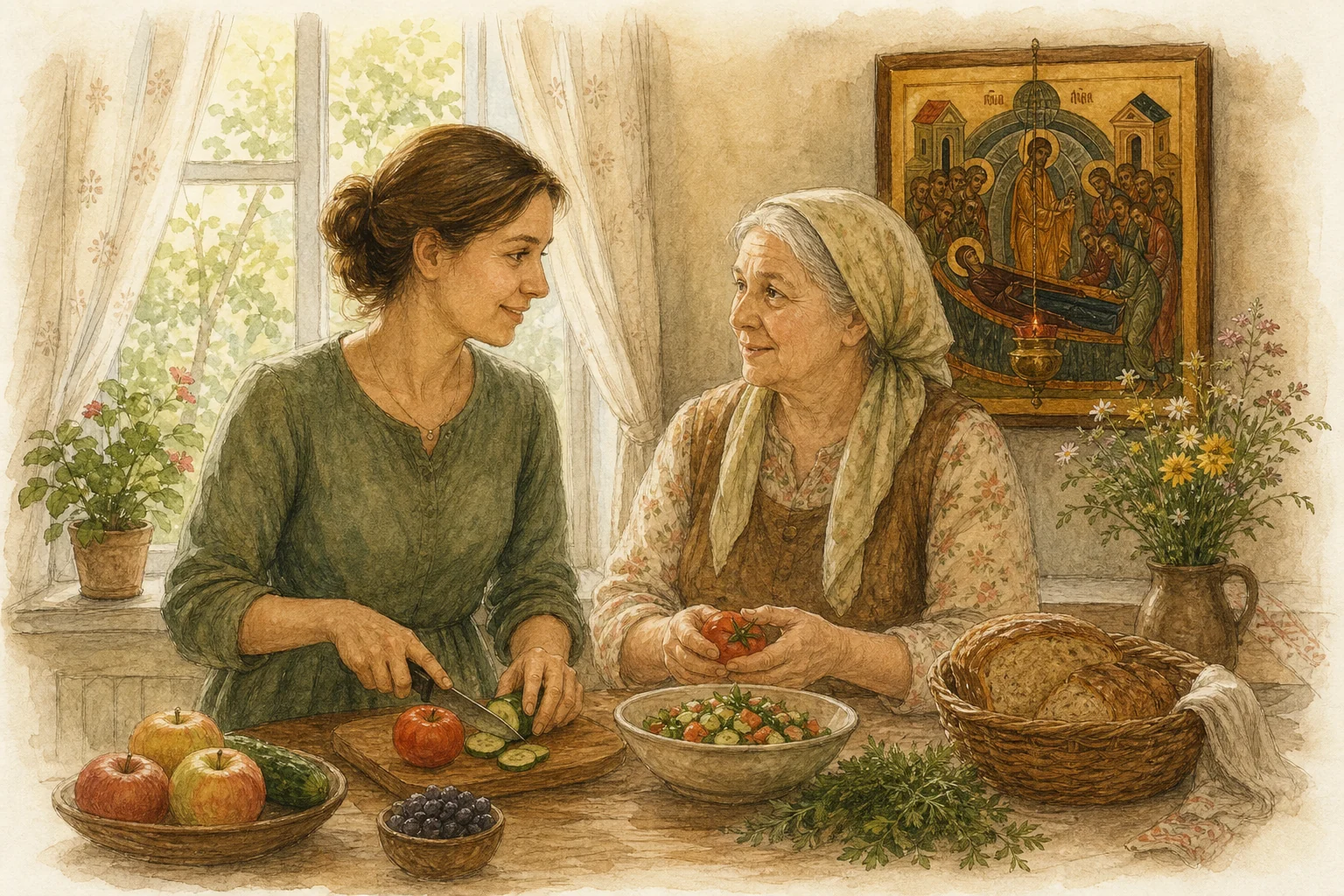
The Dormition Fast is a two-week season from August 14 through August 27 that prepares for the Dormition of the Mother of God on August 28 in the calendar used by the Russian Orthodox Church. Its purpose is prayer, repentance, hope in the resurrection, and imitation of the Theotokos’ faithfulness—not magical restrictions concerning apples, honey, or work.
Its food rule is considered austere, but a personal measure accounts for health, age, and labor. It is better to live two weeks attentively than to attempt an impossible severity for three days and become angry.
What does “Dormition” mean?
The church term emphasizes that death does not have the final word. On the icon, the apostles stand at the bed of the Mother of God while Christ receives her soul. The feast joins the sorrow of separation to Paschal hope.
A Christian does not pretend that death is painless. The Church teaches us to grieve without despair and entrust life to God.
Why is the fast associated with the Theotokos?
The Church honors Mary as the Mother of the Lord and an example of a free response to God. Her humility is not passivity or absence of will; it is faithfulness able to receive a vocation and remain at the Cross.
Orthodox Christians worship God alone and venerate the Mother of God, asking her prayers. Our article on why Christians pray to saints explains the distinction.
When it begins and ends
In the civil dates used by the Russian Orthodox Church, the fast runs from August 14 through August 27, with the Dormition on August 28. These dates are fixed and do not depend on Pascha.
Other Orthodox calendar traditions may use different civil dates. Confirm the jurisdiction and current parish service schedule.
Why it is short and austere
Two weeks form a concentrated path without a long introduction. The appointed food rule resembles Great Lent: meat, dairy, and eggs are excluded, while fish is normally permitted on the Transfiguration.
Austere does not mean starvation. A layperson keeps an adequate diet and does not copy a monastic chart without regard for circumstances.
The first day and the popular “Honey Feast”
On August 14 the Church commemorates the Procession of the Precious Wood of the Life-giving Cross and the Maccabean martyrs. In Russian popular speech the day is called the Honey Savior, and some parishes bless honey.
Blessing gives thanks to God and asks His blessing. Honey does not become an amulet, a cure for every illness, or an object that cannot be shared with a neighbor.
The Transfiguration in the middle of the fast
The Transfiguration of the Lord is celebrated on August 19. In Russian tradition, new fruit—especially grapes or apples—is blessed after worship, and fish is permitted by the rule.
The popular name “Apple Savior” does not exhaust the feast. Its center is the revelation of Christ’s glory to the disciples, not a prohibition against tasting an apple before a certain hour.
May apples be eaten before the Transfiguration?
There is no universal church prohibition binding every layperson. Waiting for the blessing of first fruits arose in agricultural culture and may be kept as a voluntary tradition.
Do not shame a child, an ill person, or someone from another region. Gratitude for the harvest matters more than superstitious fear.
What happens on August 28?
At the festal Liturgy the Church glorifies God and commemorates the Dormition. Some parishes celebrate a special rite involving the shroud of the Mother of God; its date and order may differ locally.
Ask about local practice. Do not declare a parish wrong merely because a familiar rite is held differently or is absent.
Prayer during these two weeks
Keep the ordinary rule and add a brief appeal asking the prayers of the Theotokos. A canon or akathist may be read in a reasonable measure without replacing the Gospel or direct prayer to God.
Our guide to the difference between an akathist and a canon helps avoid confusion.
What to read
Read the Gospel accounts of the Annunciation, the visit to Elizabeth, the Nativity of Christ, the Meeting in the Temple, and Mary standing at the Cross. Notice her trust and action rather than invented domestic detail.
Read liturgical and biographical traditions with responsible church commentary. Do not construct doctrine from an anonymous video.
Confession and Holy Communion
A short fast reaches the feast quickly, so do not postpone Confession to the final evening. Learn the parish order during the first week.
Agree on preparation for Communion with the priest. Two weeks of food abstinence do not replace reconciliation, prayer, and repentance.
Mercy during the harvest
August abundance can naturally become help: share fruit, bring groceries to an older person, or support a family preparing children for school. Give good food rather than what is nearly spoiled.
A blessed fruit is especially fitting to share. Blessing does not require keeping it until it decays.
Physical labor and heat
Gardening, construction, and outdoor work require water, salt, and energy. Do not restrict drinking or create heat illness. Fasting food must remain sufficient.
For chronic disease or pregnancy, use the guidance in fasting during illness.
Vacation and travel
Locate a church and simple food beforehand, but do not turn a family journey into an endless search for a special café. When choices are limited, preserve the measure available and maintain peace.
A short prayer while traveling and Sunday Liturgy often matter more than the flawless composition of an accidental lunch.
Children during the Dormition Fast
Explain that the feast concerns hope and the Mother of Christ, not only apples. Choose a small limitation of sweets or screens and one shared act of help.
Do not impose adult food severity on a growing body. The child’s measure must account for health and age.
May a marriage be crowned?
Orthodox Crowning is generally not celebrated during the Dormition Fast. Agree on a date with the parish before booking a venue and vendors.
Civil registration and difficult life circumstances are handled separately. A church date cannot be chosen solely from a commercial wedding calendar.
Personal grief and remembrance of the departed
The Dormition is particularly close to someone who has recently lost a loved one. Do not force yourself to feel festal joy immediately. Bring pain into prayer, submit a commemoration according to parish practice, and allow trusted people to remain near.
Hope in the resurrection does not require searching for secret signs, interpreting dreams, or refusing psychological support. A person may believe, weep, remember what was good, and learn to live after bereavement at the same time.
Living the fast without gloom
Repentance does not require a gloomy face. Reduce noise, pray more attentively, ask forgiveness honestly, and give thanks for summer gifts. The joy of the Transfiguration already shines within this austere season.
Do not correct everyone who does not know the calendar. Meekness is a more convincing fruit than public severity.
A fourteen-day plan
During the first week establish food, prayer, and one work of mercy. At the Transfiguration participate in the Liturgy when possible and give thanks for creation. During the second week prepare for Confession and the Dormition.
Choose one lasting result: Gospel reading, help for a particular person, or freedom from a destructive digital rhythm.
Common questions
May Orthodox Christians eat fish?
Fish is normally permitted on the Transfiguration, August 19. Check other days in the calendar and follow the personal measure agreed.
Must apples and honey be blessed?
No. Blessing first fruits is a pious act of thanksgiving, not a condition that makes food permitted or beneficial.
May I work in the garden?
Yes. Preserve prayer and safety in heat, and do not use labor as an automatic reason to avoid all worship.
What if I noticed the fast late?
Begin today with a sustainable measure. A short season does not require panicked compensation.
Why does a feast focus on death?
It sees death in the light of Christ’s Resurrection. Grief is not denied; it is given hope.
The essential point
The Dormition Fast joins concentrated austerity, love for the Theotokos, and Paschal hope. Its center is not August produce but faithfulness to God, prayer, repentance, and generosity.
Live the two weeks attentively and without superstition. Share the blessed fruit and preserve the peace acquired after the feast.