
Great Martyr Euphemia the All-Praised is honoured for fidelity to Christ during persecution. Her remembrance is associated with Chalcedon. Russian spellings vary in popular accounts, so checking the complete church designation helps identify the correct life.
Church tradition also associates her relics with a miraculous witness at the Council of Chalcedon. That narrative differs from the council’s doctrinal definition itself. Read both the life and an explanation of the council’s question to understand the setting.
A saint’s life should not become a collection of frightening torture details for a child. Its centre is witness to faith, not graphic suffering. A miracle narrative also does not remove the need to understand what the Church confesses.
Begin with a concise church account and the meaning of martyr. If Chalcedon interests you, separately study its teaching about Christ. This connects the saint with the substance of faith rather than only an extraordinary episode.
Chalcedon and the period of persecution
Chalcedon stood on the Asian shore of the Bosporus, opposite Constantinople. In Euphemia’s story this is more than a geographical label: the city is associated both with her martyrdom and with the subsequent veneration of her relics. Her hagiographic tradition places her suffering in the early fourth century, during the persecution under Diocletian. She belongs to the Christians whose fidelity was tested before Christianity received recognition within the empire.
In church usage, martyrdom means bearing witness to Christ in the face of coercion. The life should therefore be read as an account of refusing to renounce faith, not of seeking pain. Confession and steadfastness matter more than comparing the brutality of different punishments. In family reading, it is possible to explain the persecution and the saint’s decision without repeating graphic descriptions of torture.
Why her name is associated with the Fourth Ecumenical Council
The Council of Chalcedon met in 451, long after Euphemia’s earthly life. Its sessions are associated with the church where the martyr was venerated. It would therefore be wrong to describe Euphemia herself as a historical participant in the theological debate. The connection concerns later generations honouring the saint and her relics.
The council addressed how the one Lord Jesus Christ is confessed as truly divine and truly human. This was not a competition for elegant wording: the answer concerned the meaning of the Incarnation and salvation. Christ is neither merely a human being granted exceptional honour nor a deity only appearing to live a human life. The conciliar teaching safeguards the fullness and reality of both natures in the one Person. This setting helps explain why the saint’s name appears in accounts of a doctrinal council centuries after her death.
The miraculous witness and the doctrinal definition
The church account of the miracle connects the saint’s reliquary with confirmation of the Orthodox confession. This episode belongs to the tradition surrounding the council; it should not be confused with minutes of its sessions or treated as an independent replacement for the doctrinal text. In the Church’s memory the miracle points towards the truth of faith, but that truth still needs to be explained in words.
A beginner can first understand the central balance: the union of Christ’s natures neither destroys the distinction between divinity and humanity nor divides Christ into two persons. Further study can then introduce the definition’s precise terminology. When a child asks about Euphemia, connect the miracle account with a straightforward question: why do Christians confess that the Son of God truly became human rather than merely seeming to be human?
Recognising an image of Euphemia
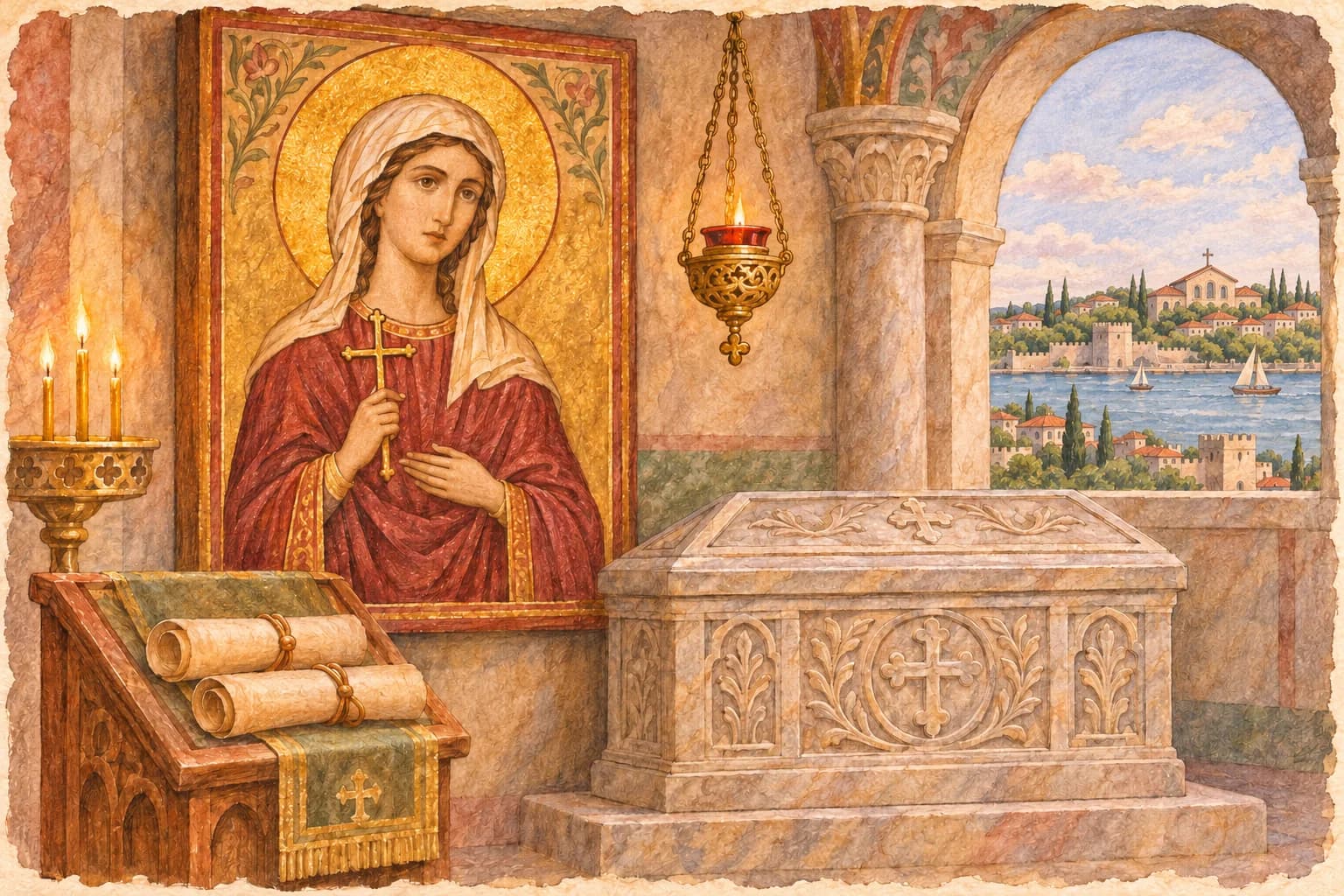
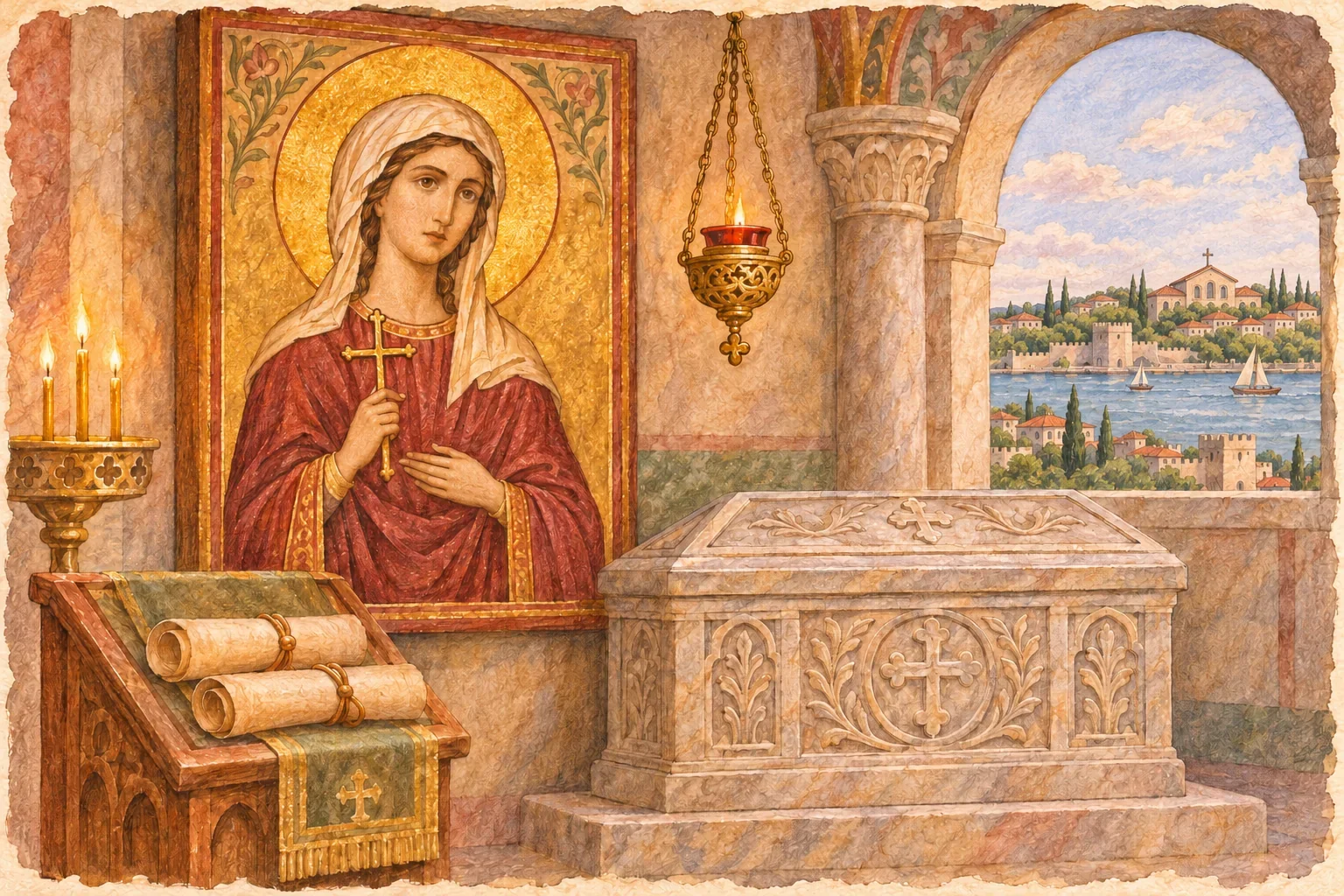
An icon commonly shows the martyr holding a cross, a sign of her confession of Christ and the victory of faith. The inscription gives her name and ecclesiastical designation. A cross alone, however, cannot identify her securely: many martyrs share this attribute. If an image is small or its inscription is damaged, compare it with a reliably identified example rather than the first similar picture found online.
A narrative icon may contain separate scenes concerning persecution and later veneration. Distinguish the central image of the saint from the surrounding narrative panels. An artist can bring together events separated by centuries because the composition presents the history of the Church’s remembrance. It does not mean that all the people shown met during their earthly lives. Reading the inscriptions is consequently more useful than treating every visual detail as a literal chronology.
Remembrance and personal devotion
Euphemia has a commemoration of her martyrdom and a separate remembrance of the miracle associated with the council. Different calendar entries are therefore not necessarily contradictory. For a name day, clarify which commemoration is observed for the person concerned and which calendar the parish follows. Dates in the old and new calendars should not be combined without identifying the difference.
Honouring the saint does not require recreating her external circumstances. A contemporary reader will not ordinarily face an ancient imperial trial, but the question of honest witness remains: can one refuse a convenient falsehood and explain convictions without hatred? Reading her life need not culminate in a search for an extraordinary experience. It can lead instead to attentive study of the faith to which she remained faithful and to more truthful conduct in ordinary responsibilities.
A question for reflection
What meaning remains in her witness when sensational details are removed?