
The Jerusalem Icon of the Mother of God is known through different copies. Its title connects it with church remembrance of the Holy Land, but does not prove the age or origin of every copy offered for sale. A particular object’s history requires separate inquiry.
Traditions concerning ancient Marian icons express their place in veneration. They should not automatically be equated with museum attribution of a panel and paint layer. Distinguishing tradition from investigation allows accuracy alongside respect.
A label saying from Jerusalem does not make an image more necessary for prayer than an ordinary parish icon. Resist claims that only such a purchase will protect a home. Christian hope does not depend on a shop’s location.
Before buying, inspect the image, inscription and condition. For a gift, establish what is genuinely known without inventing a family legend. Prayer remains possible even if the complete history of a reproduction is unknown.
The title Jerusalem is not a shop label
Jerusalem designates a particular venerated image of the Mother of God and copies related to it. At the same time, many different icons may be sold as having been brought from Jerusalem. These meanings are not identical: the place of purchase does not determine the iconographic title. An image of another type remains that type even when purchased during a pilgrimage to the Holy Land.
A question about which Jerusalem icon someone owns should therefore begin with the image and inscription. Establish who is represented, how the figures are arranged and whether the full designation appears. Receipts, packaging and a seller’s account may help trace a purchase without accurately describing the ecclesiastical history of the composition. This clarification is especially useful for an inherited icon when only fragments of family memory survive.
Recognising the Jerusalem image by its composition
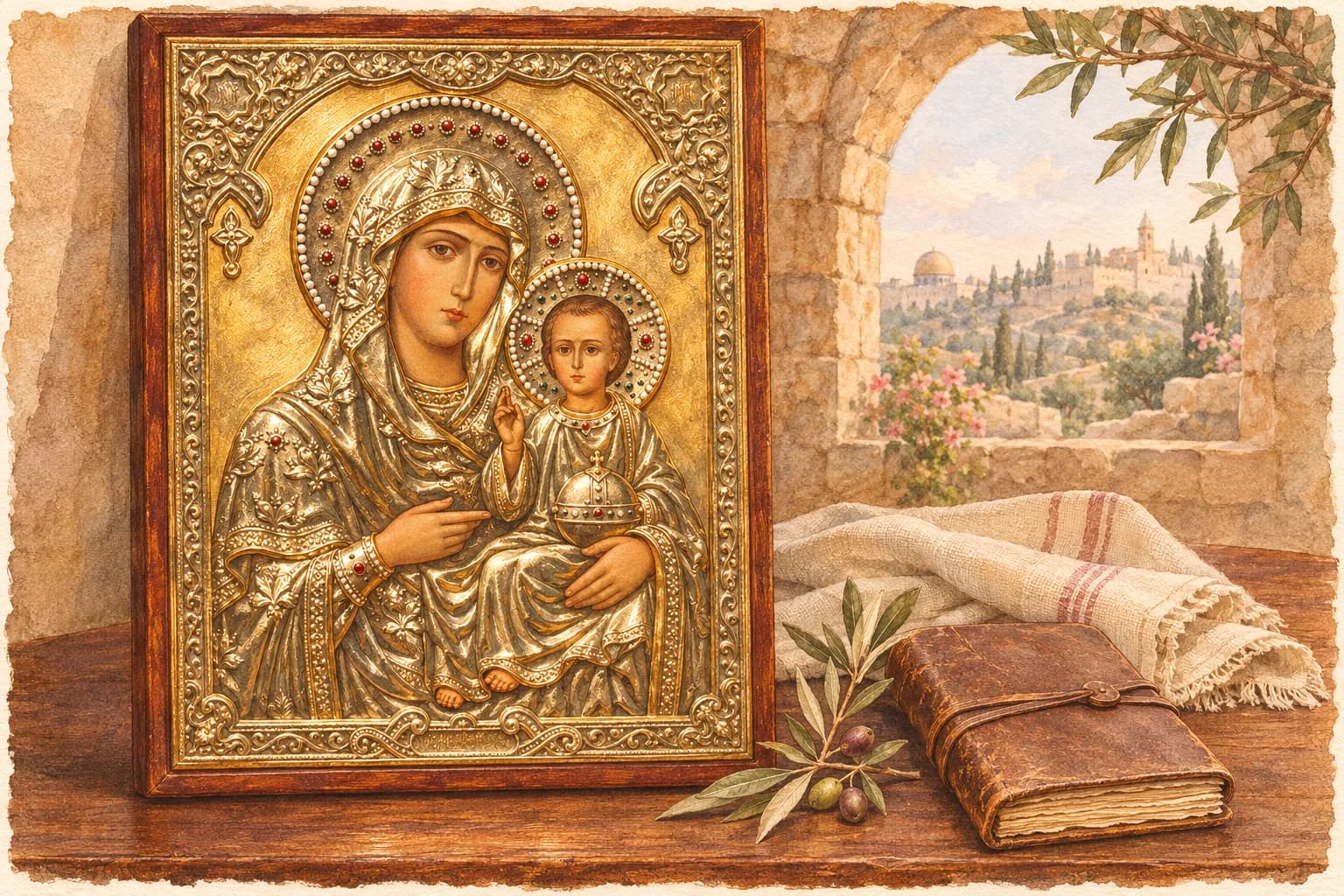
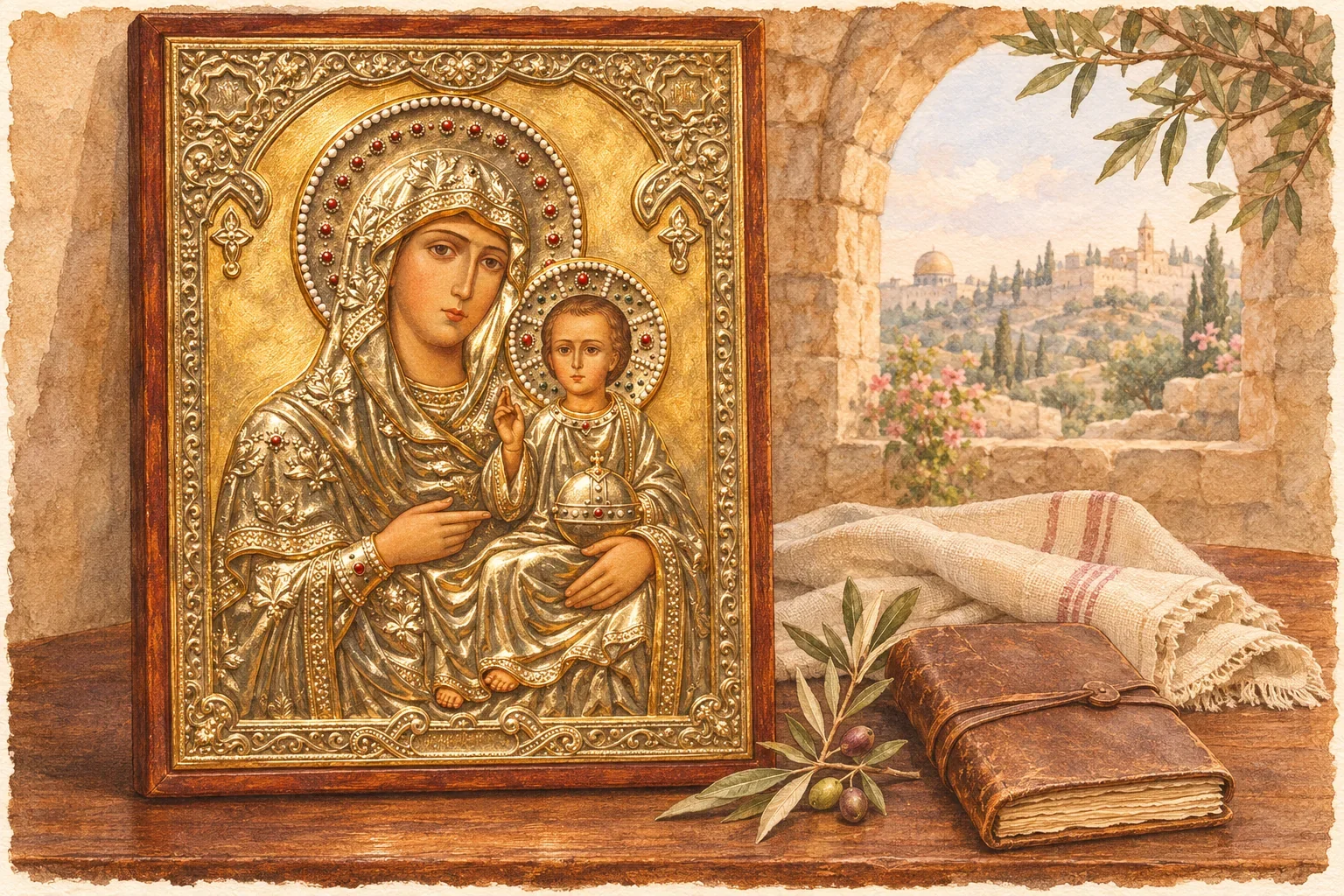
The Jerusalem icon belongs to the Hodegetria, or She Who Shows the Way, type. The Mother of God holds the seated Christ on one arm, while her free hand directs attention towards her Son. The Child raises a hand in blessing. Unlike the characteristic Tenderness composition, the principal recognisable motif here is the indication of Christ rather than cheeks touching. This gesture explains the designation: the way towards which Mary points is connected with her Son.
In the reproduction published by the church reference, the Child appears on the viewer’s right, supported by Mary’s left arm; her right hand is directed towards him. This describes the particular copy shown, not a rule for rejecting every different version. Identification depends on the full designation and the arrangement of figures and gestures together. Two works should not be identified as the same image merely because the Child is on the same side.
A metal covering, crowns and other added ornaments can conceal clothing and the object in Christ’s hand. Begin with faces, hands and the complete composition, then examine inscriptions and adornment. The colour of gilding or number of jewels does not determine the iconographic type. Recognising an image through its content helps both in choosing the intended icon and in understanding how it differs from simply any reproduction brought from Jerusalem.
The tradition of Luke and the limits of historical inference
Church tradition places the original Jerusalem image among those associated with the evangelist Luke. Such attribution expresses remembrance of ancient veneration and its relationship with Gospel witness. It does not automatically establish that every surviving panel or subsequent copy was made in the first century. The history of a prototype and the material dating of a particular object are separate questions.
Art historians examining an old icon consider timber, ground layers, painting technique, later overpainting and documentary evidence. A church narrative of origin does not replace that investigation. Respect for tradition can coexist with precise statements about what is known and what remains uncertain. Prayer does not require transforming devotional remembrance into an unsupported expert attribution. This distinction is particularly important when discussing objects offered for sale as exceptionally ancient.
Movements of the image and the question of loss
Church accounts describe movements of the Jerusalem image between centres of the Christian world and its later veneration in Rus. A detailed historical study must examine each stage separately: later tradition, documentary records and the history of an existing copy offer different kinds of evidence. Not every popular itinerary is an uninterrupted, documented biography of one physical object.
A separate question concerns the disappearance of the old Moscow image after the events of 1812. Accounts of its removal to France circulate, but the church reference notes the lack of confirmation that it is held in Notre-Dame in Paris. Readers should therefore not be confidently directed to see the original there. When an object’s fate is unknown, preserving uncertainty is more accurate than completing the story with an attractive legend.
An icon copy is not a counterfeit of faith
In church usage, a copy means an image made after a particular model. The term does not necessarily imply reproducing every crack, measurement or later ornament. An icon painter can preserve the composition and designation while working at a different scale and in another artistic manner. Being a copy does not make an image unsuitable for prayer.
Individual copies can acquire their own histories: donation to a church, preservation by a family or local veneration. These should be described separately from the tradition of the original. For a family possession, recording the donor’s name and circumstances of receipt is a useful beginning. That modest but verifiable testimony is worth more than a confident assertion of antiquity based only on dark varnish or a metal cover. Honest provenance can itself become part of a family’s shared memory.
Choosing an image and asking useful questions
When buying, check that the faces and inscriptions are legible, the surface is undamaged and the dimensions suit the intended place at home. If a seller claims antiquity, authorship or unusual provenance, ask what supports the assertion. A plainly identified reproduction is preferable to an object marketed through an unverified sensational story; a high price does not establish a greater degree of help in prayer.
If you specifically want the Jerusalem type, clarify that designation rather than simply the country from which an item is shipped. If you want a souvenir of a pilgrimage, another recognisable image can be chosen without renaming it. In either case, a thoughtful gift includes a clear explanation of whom the icon represents, why it was selected and which facts about its origin are actually known.
A question for reflection
Which claims about the icon’s origin are supported, and which are only sales language?