
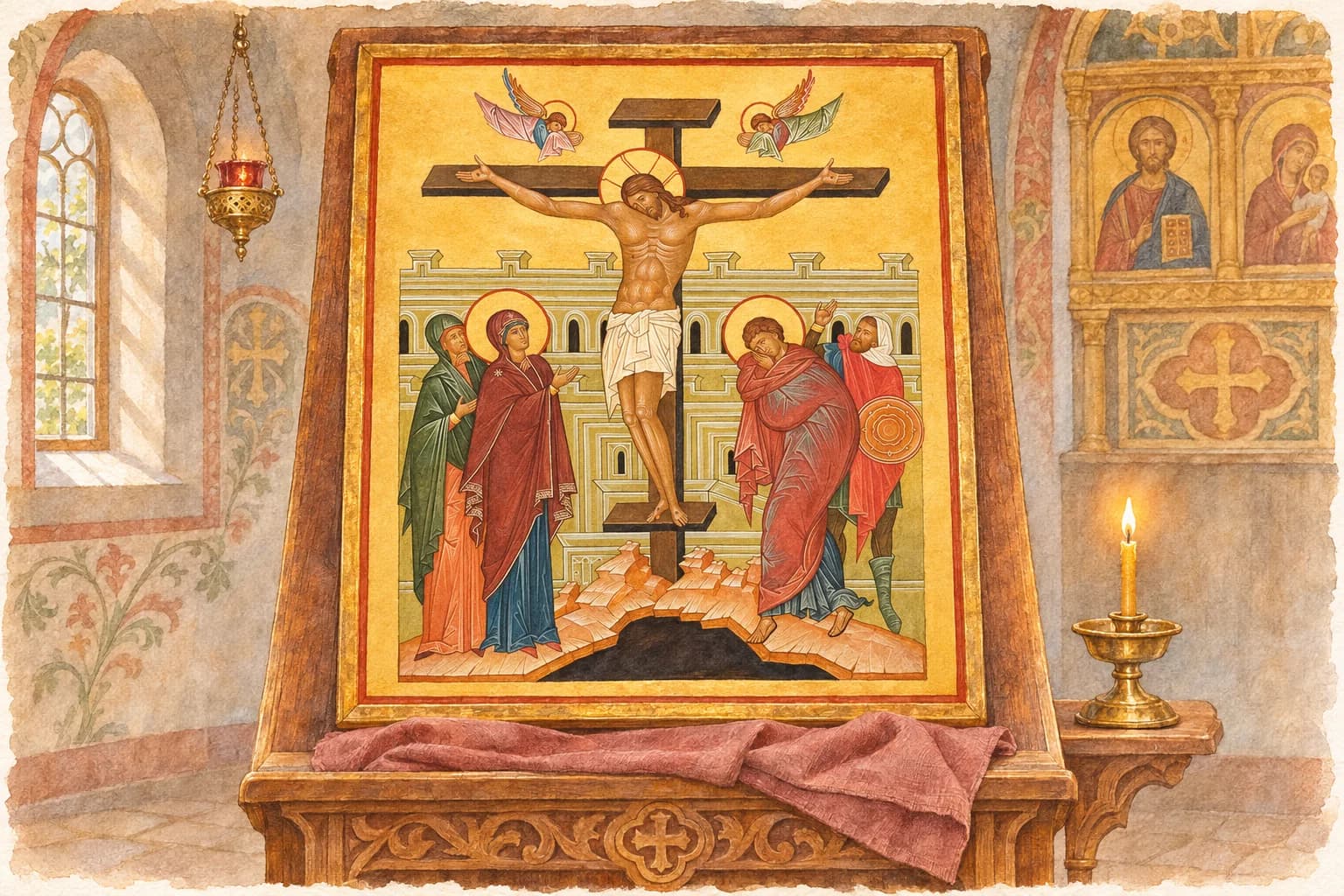
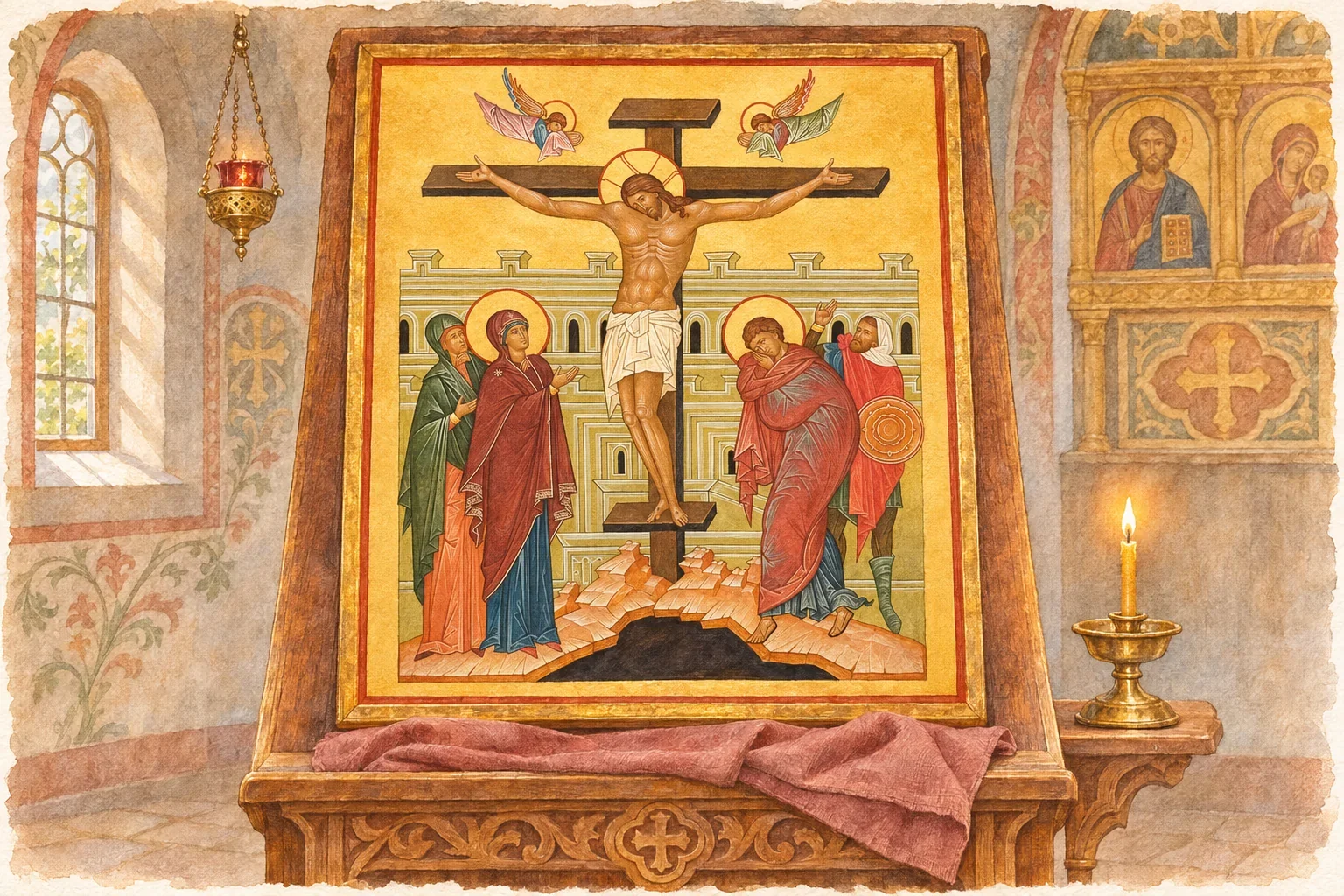
The Crucifixion icon witnesses to Christ’s death on the Cross and saving work. It is not merely an image of physical pain. Orthodox remembrance does not separate the Cross from the Resurrection, while recognising them as distinct Gospel events.
The Mother of God, John and other witnesses may appear beside the Cross. The composition depends on the iconographic form. Compare a particular detail with Gospel narratives and church interpretation rather than assuming every version is identical.
Christ’s suffering does not justify inflicting suffering on others. An icon cannot be invoked to demand endurance of domestic abuse. Discussion of sacrificial love must distinguish free service from another person’s coercion.
Read the Gospel passage and study the image calmly without seeking graphic details. With a child, discuss Christ’s love and the hope of Resurrection in an age-appropriate way. Difficult questions can be addressed gradually without frightening them.
From the Gospel narrative to the icon
Begin reading the Crucifixion icon with the Gospel narratives, especially chapter nineteen of John, listed among the sources. An icon does not attempt to reproduce one photographic instant in every ordinary detail. It gathers recognisable testimony to Christ’s death and expresses the Church’s understanding of the event. Details emphasised at different points by different evangelists may therefore appear together in one composition.
The central confession remains that the Son of God truly accepts human death rather than merely appearing to suffer. At the same time, a church image does not seek its effect exclusively through graphic brutality. Its restrained artistic language helps the person praying perceive the love and saving significance of the Cross. This does not deny pain: the reality of suffering is confessed without turning it into a spectacle that obscures Christ himself.
Who stands beside the Cross?
The Mother of God and the apostle John occupy an important place in many versions. Their presence relates to the Gospel testimony about those who remained nearby and to Christ’s words entrusting them to each other’s care. More extensive compositions may include other women, a soldier and additional witnesses. Do not identify every person solely by a position on the right or left: inscriptions and a description of the particular image are more reliable than a fixed diagram.
Gestures of sorrow do not take away the dignity of those standing beside the Cross. The icon shows remaining close to someone who suffers when the event cannot be stopped. In ordinary life this recalls the value of presence: listening, supporting and refusing abandonment. Yet the Gospel scene must not become a command to remain passive before preventable violence. Helping someone who is harmed may involve protection, medical care and ending an unsafe situation.
Golgotha, the skull and inscriptions
A rocky base and a skull often appear below the Cross. Golgotha belongs to the Gospel naming of the place of execution, while the skull in church interpretation recalls Adam and the salvation of humanity. This is symbolic language, not a claim that each painter possessed archaeological findings. A detail must be interpreted at the level on which it functions within the composition.
The inscription above Christ relates to the statement of his kingship in the Gospel account. Different traditions use different languages and abbreviations. Additional letters around the Cross can also abbreviate familiar ecclesiastical expressions. If an inscription is unfamiliar, seek an explanation of that particular lettering rather than constructing secret formulas from isolated signs. Understanding the symbols should return attention to the event’s meaning, not divert it into a search for a hidden code.
The Cross, Resurrection and speaking with children
Orthodox veneration of the Cross belongs within Easter faith. This does not make Christ’s death unreal or allow suffering to be skipped as an insignificant part of the story. Death and Resurrection are distinct events understood within one proclamation of salvation. Alongside sorrow, the Church’s remembrance therefore contains hope: evil and death do not have the final word about human life.
A child can be told that Christ did not abandon love for humanity even in the face of cruelty, and that Christians celebrate his Resurrection. There is no need to describe physical injuries in detail or test whether a child is sufficiently frightened. If they ask why God allowed this, acknowledge the difficulty and continue the conversation gradually. Adults likewise need not immediately produce a prescribed emotion before an icon. Attentive Gospel reading and participation in worship disclose its meaning more deeply than trying to manufacture an intense feeling at any cost.
Can the tradition be identified solely from the cross?
The number of crossbars, the position of the feet and the number of nails are often presented as simple identifying marks. Christian art has a more varied history than a single chart suggests. Assess the whole image, its inscriptions, provenance and reception within a church tradition. One feature separated from the composition does not always support a reliable conclusion.
For a practical question about keeping an inherited cross at home or bringing it for a blessing, show the actual object to a priest. Do not immediately declare a family sacred object incorrect through a casual comparison of photographs. Historical care does not weaken a definite confession of faith; it prevents that faith from being replaced by hasty classification of objects.
A question for reflection
Does your explanation reveal love and hope while respecting a person who suffers?