
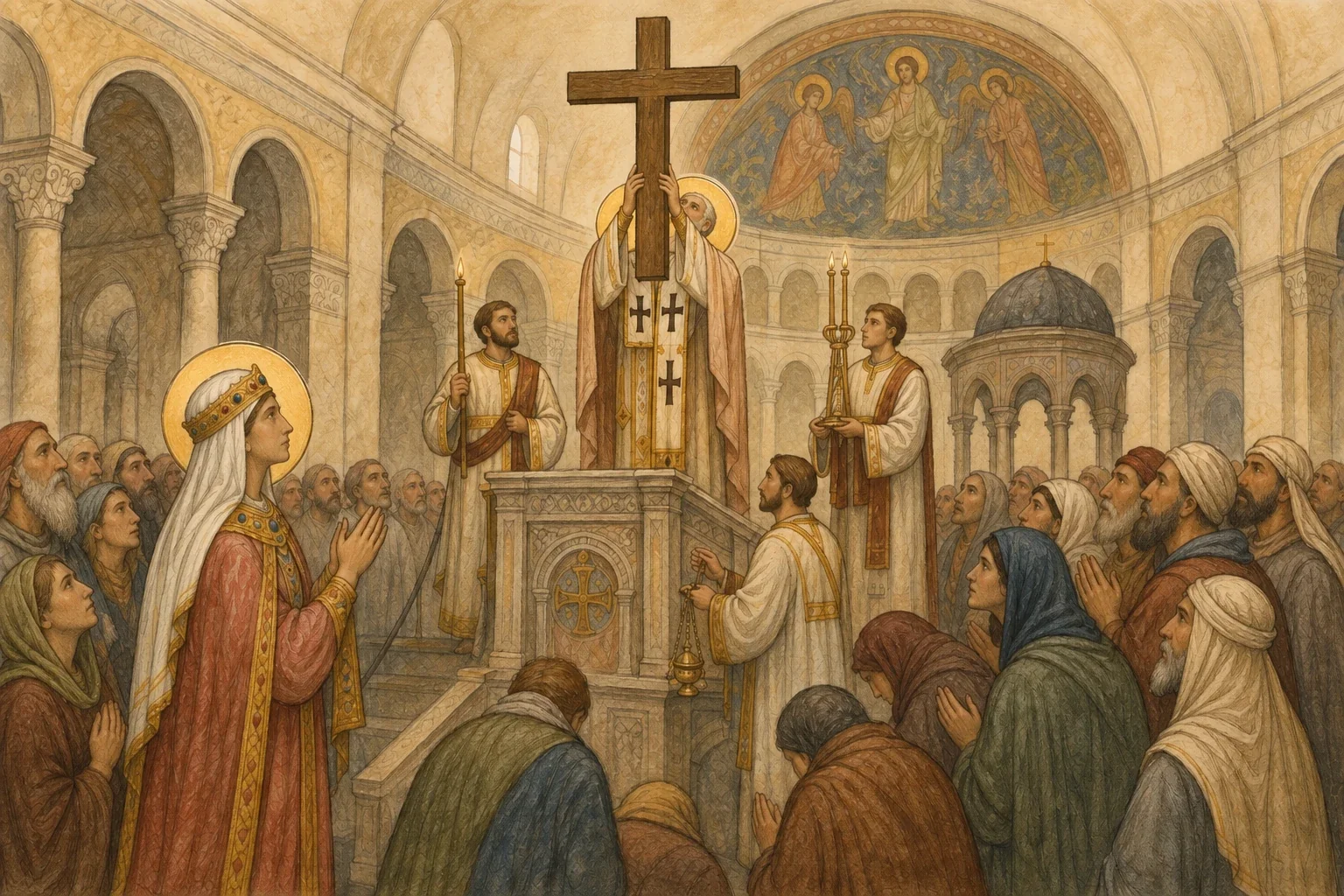
The Exaltation of the Precious and Life-giving Cross is the Great Feast celebrated on September 27 in the Russian Orthodox calendar, devoted to Christ’s Cross and the historical memory of its finding and elevation in Jerusalem. The Cross is raised for all to venerate while the community repeatedly prays, “Lord, have mercy.”
The Church does not glorify an instrument of cruelty by itself or suffering as a value. The Cross becomes life-giving because Christ freely passes through death, destroys its dominion, and transforms a sign of shame into a witness of love and Resurrection.
What does “exaltation” mean?
The word means raising or elevating for people to see. Tradition says that Saint Macarius of Jerusalem lifted the discovered Cross so that a great crowd could behold and venerate the holy object.
The liturgical gesture neither repeats the Crucifixion nor charges wood with power. It directs common attention toward Christ and His saving self-offering.
Which events are remembered?
The feast is connected with the fourth-century finding of the Cross during the work of Saint Helena, the dedication of the Church of the Resurrection in Jerusalem, and the public veneration of the relic.
Church memory also includes the Cross’s return to Jerusalem after Persian capture in the seventh century. Several historical layers unite around the triumph of Christ’s Cross.
Saint Helena and the search
Helena, mother of Emperor Constantine, traveled to the Holy Land, supported church construction, and according to Tradition participated in searching for the site of the Crucifixion.
Her image does not justify state coercion in religion. The Church honors service to holy places and Christian witness, not imperial violence.
How was Christ’s Cross identified?
Tradition speaks about several crosses and a miraculous sign that distinguished the Savior’s Cross. Sources transmit details in different forms.
Faith need not rest entirely upon reconstructing each detail. Historical veneration matters, but the center is the crucified and risen Christ.
Why is the Cross called Precious?
The church adjective means worthy of honor and precious. The Cross is venerated because of the One who was crucified upon it.
The material is not a deity. A bow before its image passes to Christ, just as honor before an icon concerns the person depicted.
Why is it called Life-giving?
An instrument of death becomes a way of life because the Son of God accepts death and rises. The paradox lies at the center of the Gospel: victory comes through self-giving love.
This is not an invitation to seek pain or endure evil passively. Christ gives His life freely; another person’s violence does not become holy through religious language.
The Cross and Resurrection cannot be separated
Without the Resurrection, the Cross would remain an execution. Without the Cross, Paschal joy would become abstract optimism unable to face human pain.
Orthodox veneration is always Paschal: Christ truly died and truly defeated death.
What does it mean to carry one’s cross?
The Gospel means faithfulness to Christ, refusal of selfishness, and responsibility in love. A “cross” cannot automatically name every problem a person is supposedly required to tolerate.
Domestic abuse, exploitation, and crime are not crosses prohibiting protection. Leaving danger, contacting police, or seeking medical help may be a responsible Christian act.
Reading the feast’s icon
A hierarch stands at the center upon a raised platform and elevates the Cross; deacons assist while Saint Helena and the people pray below. The architecture recalls the Jerusalem church complex.
The icon expresses a shared church memory rather than a photograph of one second. Its vertical form lifts the eye from the crowd toward the Cross.
When it is celebrated
The Russian Orthodox Church keeps September 14 in the Julian calendar, corresponding to September 27 in the current civil calendar. The date is fixed.
The feast is always a fast day, even when it falls on Saturday or Sunday.
Why the fast is strict
Food abstinence preserves the memory of Christ’s Passion within the festal day. Meat, dairy, eggs, and fish are normally omitted; details concerning oil and meals follow the calendar and tradition.
An ill person, pregnant woman, child, or heavy laborer must not damage health. The fast points toward the Cross rather than a medical crisis.
The vigil and bringing out the Cross
The Cross is prepared in the altar and brought solemnly to the center of the church. At Matins the faithful approach for veneration.
In some churches the rector celebrates a full or abbreviated rite, raising and lowering the Cross during repeated petitions. Identical performance is not required in every parish.
Prostrations before the Cross
The rite includes prostrations. Someone with joint disease, pregnancy, dizziness, or another limitation may make a bow from the waist or pray standing.
Faith is not measured by physical depth. Do not push another person and leave safe space for movement.
How to venerate the Cross
Approach without haste, make the customary bows according to ability, sign yourself, and kiss the lower part or the place indicated by a server. Then move aside.
Do not kiss the face of the Savior, rub objects upon the Cross, or take flowers without permission. Our guide to venerating holy objects in church gives the shared principles.
Why the Cross is decorated with flowers
Flowers express victory of life and the community’s love. They do not hide the tragedy of the Crucifixion but show that the tree of death became a tree of life.
A flower distributed with a blessing may be dried near the icons, but it is not required medicine or an amulet.
The Cross, crucifix, and baptismal cross
A cross may appear without Christ’s figure or as a crucifix. Both forms exist in Orthodox tradition and emphasize different aspects of the same faith.
A baptismal cross recalls Baptism and belonging to Christ. It is not a guarantee against accidents, and spiritual strength is not measured by metal or price.
The sign of the Cross in daily life
By making the sign, a Christian confesses the Trinity and salvation in Christ. The gesture is attentive but not theatrical and not governed by fear that an imperfect motion will attract disaster.
Our guide to making the sign of the Cross explains the order. Meaning matters more than anxious control of centimeters.
Relics and caution
Particles associated with the Cross are venerated in many churches. Learn their provenance through official parish or diocesan information rather than an unknown seller’s advertisement.
Holy things are not sold as guaranteed miracles. Commercial claims of an undocumented “particle” require caution.
Explaining the feast to a child
Say that Christ showed love to the end upon the Cross and rose, so a sign of death became a sign of hope. Find the elevated Cross in the icon.
Do not describe torture graphically to a young child or threaten a “heavy cross” for disobedience. Choose one small act of costly love instead.
May Christians work?
Necessary employment, medicine, care, and household duties are permitted. Attend vigil or Liturgy when possible and preserve the food fast.
Prohibitions against cutting, sewing, sawing, or eating round vegetables are wordplay and not Church teaching.
A practical plan
On the eve, read the Crucifixion narrative without haste, check the schedule, and prepare safe fasting food. During worship listen to the prayer for mercy upon the whole world.
Afterward choose one “cross of love”: fulfill a difficult promise, support the ill, or reject revenge. This is not seeking pain but remaining faithful to good.
Common questions
Why is a Great Feast a strict fast?
The triumph of the Cross remains joined to the Passion. Fasting preserves seriousness without denying victory.
Are prostrations mandatory?
They belong to the rite, but a physically limited person bows according to ability. Safety does not exclude prayer.
Does every church celebrate the full elevation rite?
No. Parish practice and the rector’s judgment determine its form; absence of the full rite does not diminish the feast.
May a baptismal cross be visible over clothing?
It is normally worn discreetly, but circumstances differ. Do not turn the question into judgment.
Should losing a cross cause fear?
No. Try to find or replace it, but loss does not predict disaster or cancel Baptism.
The essential point
The Exaltation raises the Cross before the Church as a sign of Christ’s voluntary love and victory over death. Veneration concerns the Savior, not pain in itself.
Fast according to strength, bow without superstition, and carry responsibility in love. Never call abuse a cross that must not be stopped.