
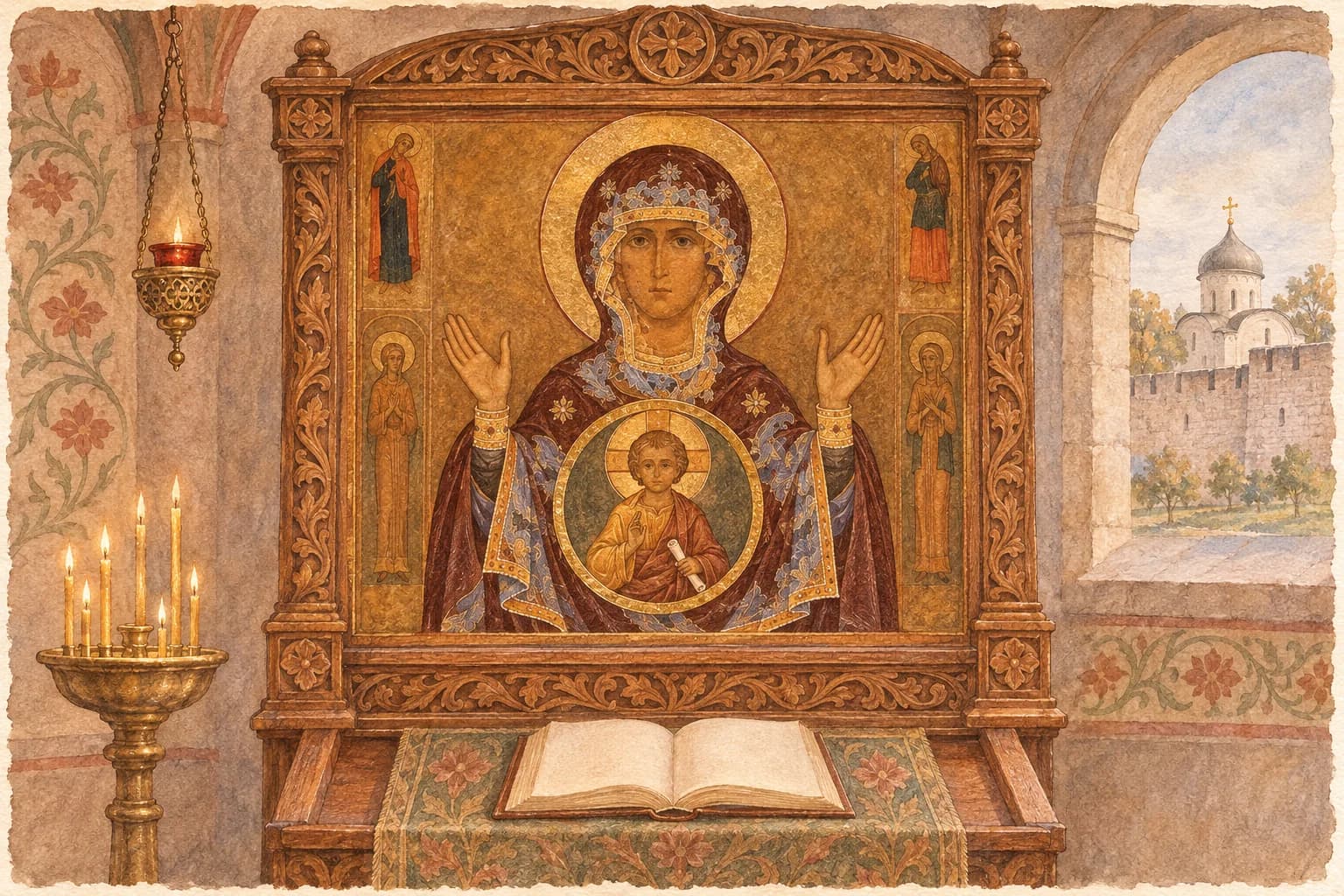
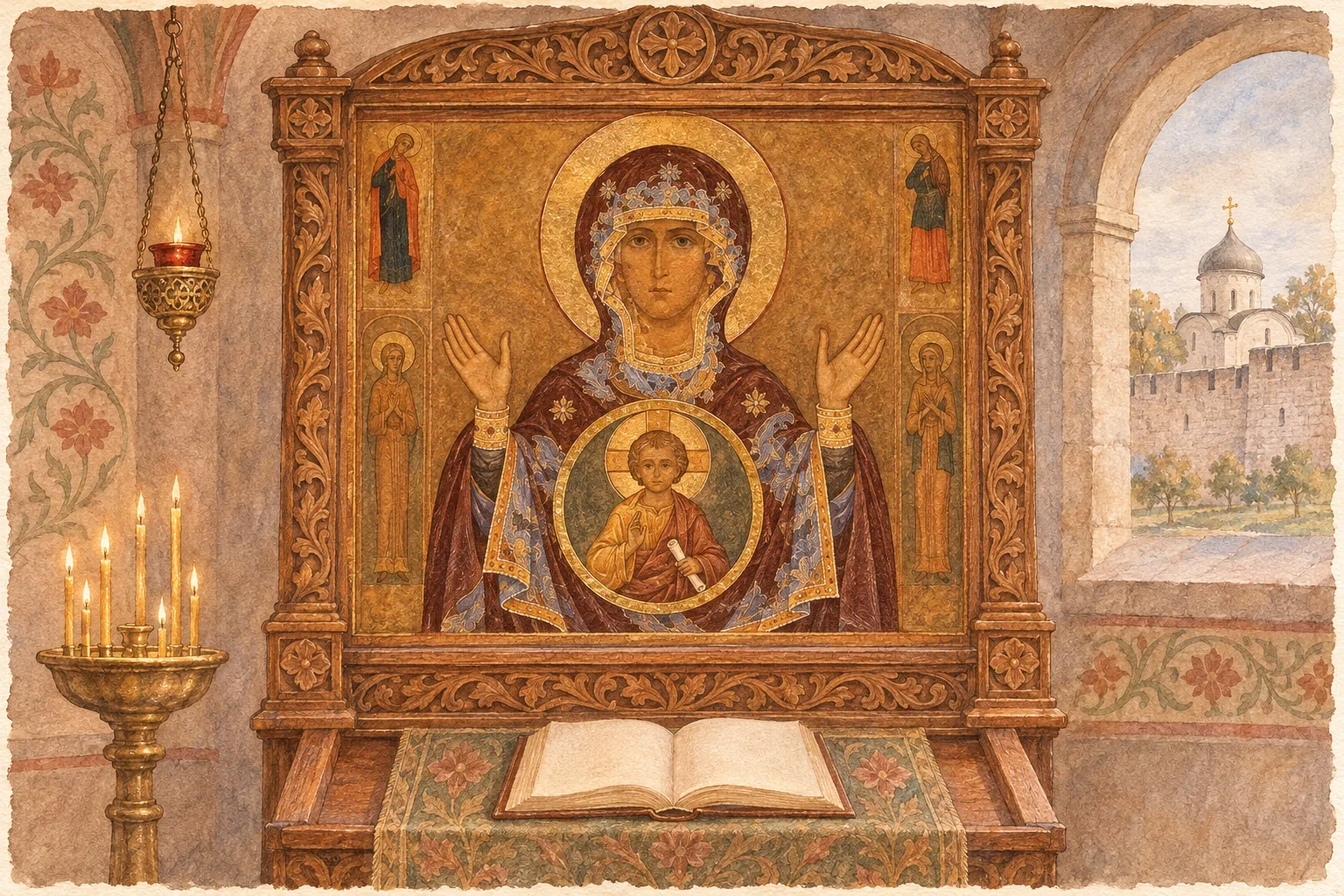
The Icon of the Sign usually shows the Mother of God with hands raised in prayer and Christ within a circular form before her breast. It concerns confession of the Incarnation. This is theological imagery rather than an anatomical illustration.
Title and composition show that honouring the Mother of God is connected with Christ. Particular copies have their own histories, with the Novgorod tradition especially well known. Distinguish one icon’s historical narrative from explanation of the broader iconographic type.
The word sign is not an invitation to seek predictions in accidental marks or reflections. A photograph of a household icon cannot reveal a family’s or city’s future. Iconography expresses faith rather than a system of divination.
Look at the whole image: the hands, depiction of Christ and inscriptions. Then read a church explanation of the Incarnation. Ask about an unusual detail in the context of the actual image rather than isolating it.
The prayerful gesture and the image of Emmanuel
The Mother of God’s raised hands belong to an ancient gesture of prayer. Such a figure is called an Orans, meaning one who prays. In the Sign composition, Christ Emmanuel appears before her, commonly within a circular frame. The circle is not an ordinary household object needing a literal explanation; it marks the manifestation of the incarnate Son and directs attention to the image’s theological centre.
Emmanuel is associated with the biblical confession of God’s presence with his people. Christ is represented as a child or youth, but the meaning is not limited to a moment in his development. His blessing gesture and the inscriptions identify who is depicted. The icon brings together Mary’s motherhood and her Son’s eternal dignity rather than offering a diagram of an ordinary family portrait.
Instead of asking why the Child is painted inside, ask what the circle communicates about his manifestation to the world. This moves beyond a narrowly literal reading towards the meaning of the whole composition.
The sign and prophetic expectation
The image is associated with the prophetic announcement of Emmanuel’s birth and the Church’s reading of the Incarnation. A sign here points towards God’s action, rather than an accidental omen used to predict good fortune. Mary is represented as the one through whom the Son of God enters human life. Her veneration remains connected with the One whom she bears and reveals.
A beginner can compare the image with the Gospel account of Christ’s birth and the Creed’s confession of the Incarnation. That gives a substantive foundation: the icon concerns the reality of Christ’s coming, not a mysterious arrangement of geometrical shapes. Technical terms can be studied gradually, but even a first explanation should preserve the relationship of Mother and Son. Otherwise the most distinctive feature of the composition remains visually noticed but theologically unexplained.
The Novgorod event of 1170
The Novgorod history of the Sign is especially well known and concerns the siege of 1170. According to the church account, Archbishop John brought the image to the city wall; an arrow struck it, and miraculous intercession followed. This explains the local remembrance and feast, but it is not the sole foundation for the existence of the iconographic type itself.
Distinguish the ancient prayerful depiction of Mary with Emmanuel from the particular history of the Novgorod sacred object. The composition has roots wider than one medieval event. Some icons include scenes of the siege around the central image; these belong to the history of its veneration. Their presence does not mean that every Icon of the Sign is simultaneously a depiction of that specific day. Type and local narrative illuminate each other without being identical.
Why individual copies differ
The icon may be half-length or more extensive, and figures, framing and supplementary images vary according to the particular work. An unfamiliar detail is not sufficient reason to declare a copy incorrect. First establish the designation, provenance and compositional type. A praying Mother of God without a visible Child and the Icon of the Sign share a gesture but do not show precisely the same content.
Notice the symmetry of the hands, Christ’s position, his blessing and the inscriptions. There is no need to search the circle for a concealed astrological sign or treat the image as a representation of bodily anatomy. Its visual language expresses what an ordinary photograph cannot: the reality of the Incarnation, the Son’s dignity and the Mother’s intercession. Recognising that purpose helps avoid both arbitrary symbolism and an overly literal reading.
Explaining the icon to someone new to church
Begin with three straightforward observations: Mary is praying, Christ is depicted before her, and the composition recalls God’s coming into human life. Then explain Novgorod’s veneration and show where a narrative icon includes the historical scene. This sequence does not require prior knowledge of medieval Rus and keeps theological meaning distinct from details of one event.
For personal study, note the remaining questions: why Christ blesses, what Emmanuel means and how this type differs from other Marian images. Answers belong in explanations of iconography and Scripture rather than divination from isolated details. The designation Sign can then direct attention towards the confession of faith instead of creating an expectation of private predictions each time someone looks at a household icon. A few clearly understood features are more useful than a long list of invented correspondences.
A question for reflection
Does looking at the icon help you understand the confession of Christ more clearly?