
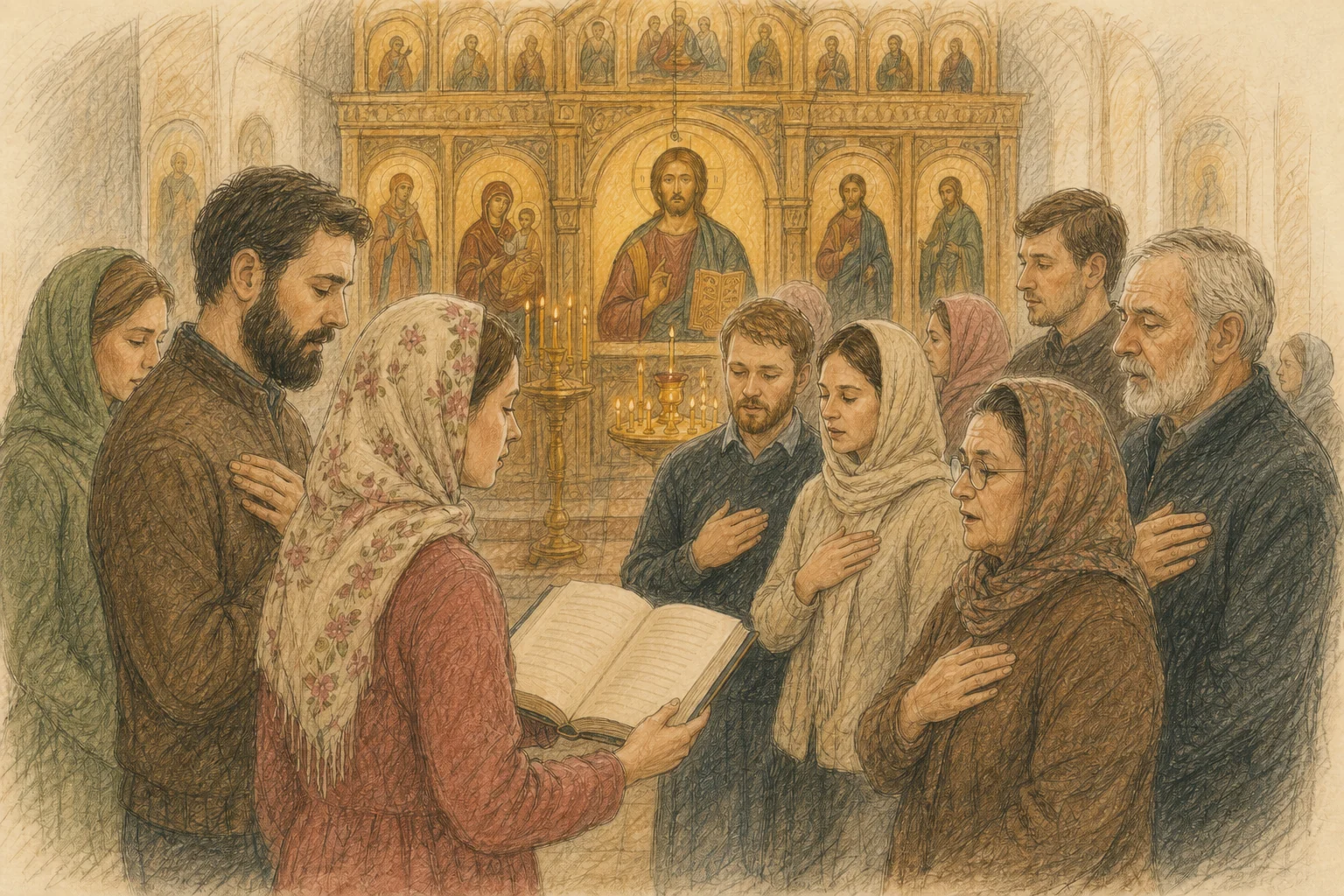
The Creed is a concise confession of the central truths of Orthodox Christianity: the Holy Trinity, the Incarnation, Cross and Resurrection of Christ, the Church, Baptism, the resurrection of the dead, and the life of the age to come. Its text has twelve principal clauses and begins, “I believe in one God, the Father Almighty…”
It is neither a magical prayer nor a list of remote formulas. When the Creed is said at the Divine Liturgy or before Baptism, a person confesses to Whom life is entrusted and into which faith he or she is entering.
Why it is called a Creed or Symbol of Faith
The ancient expression “symbol” means a sign, a gathering, and an authoritative summary by which Christians recognize their shared apostolic faith. It does not mean “merely symbolic” in the modern sense of something optional or unreal.
“I believe” is singular even when the whole assembly speaks. Each person receives the Church’s faith personally rather than inventing a private version of Christianity.
When and why the text was composed
The main portion was adopted by the fathers of the First Ecumenical Council at Nicaea in AD 325. Teaching about the Holy Spirit and the concluding clauses received their completed expression at the Second Ecumenical Council in Constantinople in 381. It is therefore known as the Nicene-Constantinopolitan Creed.
The councils answered controversies that distorted faith in Christ and the Holy Spirit. Precise words protected not an abstract philosophy but Christian hope: only true God, who truly became man, can unite humanity with God and defeat death.
Clause one: one God, the Father and Creator
“I believe in one God, the Father Almighty, Maker of heaven and earth…” confesses the one God as source of everything that exists. “Almighty” does not describe a capricious despot. The world is sustained by divine power and providence, and God reveals Himself as Father.
The visible and invisible creation comes from God and is not an accidental rival to its Creator. Matter is not evil in itself. Christianity therefore takes the body, nature, work, and responsibility for creation seriously.
Clause two: who Jesus Christ is
The Son of God is called only-begotten, begotten of the Father before all ages, “Light of Light, true God of true God.” He did not begin as the highest creature and later become divine.
“Begotten, not made, of one essence with the Father” means that the Son eternally possesses the one divine nature with the Father. “By whom all things were made” confesses that all creation received being through Him.
Clause three: Incarnation and Nativity
For us and for our salvation, the Son of God came down from heaven, was incarnate of the Holy Spirit and the Virgin Mary, and became man. He did not merely appear human. He assumed a real human nature while remaining God.
The Incarnation reveals the value of the human body and of history. Salvation is not escape from humanity but its healing and union with God in Christ.
Clause four: the Cross and burial
The mention of Pontius Pilate places the event within history. Christ was truly crucified, suffered, and was buried. The Church does not teach that His suffering was an appearance.
The Cross reveals God’s love entering human death and the tragedy of sin without committing sin. It is neither approval of violence nor a command to seek pain; it is the victory of love through voluntary self-offering.
Clause five: Resurrection on the third day
Christ rose not merely in the disciples’ memory or as an inspiring idea. Orthodox faith confesses a real Resurrection, the beginning of victory over death. “According to the Scriptures” identifies fulfillment of God’s saving purpose revealed in Scripture.
Sunday consequently stands at the heart of each Church week, and Pascha at the heart of the year. Christian hope does not end at the grave.
Clause six: Ascension
The risen Christ ascended into heaven and “sits at the right hand of the Father.” This is not a geographical description of a chair on God’s right but biblical language for glory, royal authority, and the Son’s unity with the Father.
Human nature in Christ has been brought into glory. The Ascension does not mean that Christ abandoned His disciples; He remains with the Church and sends the Holy Spirit.
Clause seven: the Second Coming and judgment
Christ will come again in glory to judge the living and the dead, and His Kingdom will have no end. The Church expects not an endless repetition of history but its fulfillment and the final victory of truth.
Christians are not commissioned to calculate the date or find secret codes in headlines. Expectation of judgment calls us today to repent, reconcile, defend the vulnerable, and live truthfully.
Clause eight: the Holy Spirit
The Holy Spirit is confessed as the Lord and Giver of Life, who proceeds from the Father and is worshiped and glorified together with the Father and the Son. He is neither impersonal energy nor a secondary force but a divine Person of the Holy Trinity.
“Who spoke by the prophets” says that the Spirit acted in salvation history and spoke through the prophets. The Orthodox text preserves “who proceeds from the Father” without the later Western addition known as the Filioque.
Clause nine: one, holy, catholic, and apostolic Church
The Church is one because she has one Head, Christ; holy because God sanctifies her, even while her members need repentance; catholic because she holds the fullness of faith and is sent to the whole world; apostolic because she preserves apostolic teaching and succession.
“Catholic” here does not simply name a modern denomination, an administrative gathering, or a collection of countries. It points to wholeness and universality in Christ. The sins of Christians do not cancel the holiness of God’s gift, but they demand truth, correction, and accountability.
Clause ten: one Baptism
“I acknowledge one Baptism for the remission of sins” means that Baptism unites a person with Christ’s death and Resurrection, grants forgiveness, and incorporates the person into the Church. It is not repeated as a method of starting over after every fall.
A life of repentance continues after Baptism. Godparents especially need to understand the confession they make; our guide explains what godparents should know.
Clause eleven: the resurrection of the dead
The expression “I look for” means that Christians await with hope. Christianity expects the resurrection of the human person, not merely the immortality of a separated soul. God saves the whole person.
This is neither a return to the same corrupted life nor reincarnation. The future exceeds present experience, but its foundation is the Resurrection of Christ.
Clause twelve: the life of the age to come
The Kingdom of God has no end. “The life of the age to come” is fullness of communion with God, a life whose path already begins through faith, the sacraments, and love.
The concluding “Amen” means: truly, let it be so, I receive this confession. It does not end thought; it confirms faithfulness.
Why the Creed is said at the Divine Liturgy
It is proclaimed before the Eucharistic anaphora, after the call to peace and love. The assembly is about to give thanks and participate in the Mystery in unity of faith, not as a random group holding incompatible ideas about Christ.
The entire church normally sings or recites it. If you do not yet know it from memory, follow a prayer book and speak attentively. Find the next Liturgy on the schedule page.
Why it is said before Baptism
In the baptismal rite, the Creed is spoken by an adult candidate or by the sponsor of a child. It is a public answer to the question of what the person believes and to Whom he or she is being united.
Preparation must not be reduced to mechanical memorization. Catechesis allows the meaning to become understood so that Christian life does not end with a photograph beside the font.
Why the Orthodox Creed has no Filioque
The Ecumenical Council’s text says that the Holy Spirit “proceeds from the Father,” following the Gospel wording. The phrase “and the Son” was added later in the Latin West without an Ecumenical Council and is not included in the Orthodox Creed.
This is not a minor pronunciation preference. It concerns how the Church speaks faithfully about the eternal relations of the divine Persons while distinguishing that eternal procession from the Spirit’s mission in history.
How to memorize the Creed
Divide the text into twelve clauses and learn one or two at a time while understanding each meaning. Hear it at the Liturgy, copy it by hand, and repeat without haste. Explain unfamiliar words before memorizing them.
Memory serves participation, but a mistaken ending does not make a person’s faith invalid. Keep the text visible until it can be spoken freely.
Frequently asked questions
Is the Creed a prayer?
It is primarily a confession of faith made before God and the community. Proclaiming it within worship is also a prayerful act.
Why does it not use the word “love”?
The text answers particular disputes about God, Christ, the Spirit, and salvation. The events it confesses reveal God’s love, and life according to the Creed requires love.
May it be read in a modern language?
An accurate modern translation is useful for understanding. In worship, follow the text received by the parish while gradually learning its language.
What does “of one essence” mean?
The Son possesses the same one divine nature as the Father. He is true God, not a created superior being.
Must a godparent know it by heart?
Practical requirements are clarified during parish preparation. A godparent must in any case understand the faith being confessed rather than merely pronounce unfamiliar words.
How to begin understanding it today
Read the Creed slowly and divide it into twelve units. Mark one unfamiliar word, find an Orthodox explanation, and hear the text at the Divine Liturgy.
Questions can be sent through the parish contact page. The goal is not to pass a formula but to know the faith of the Church and live from it.