
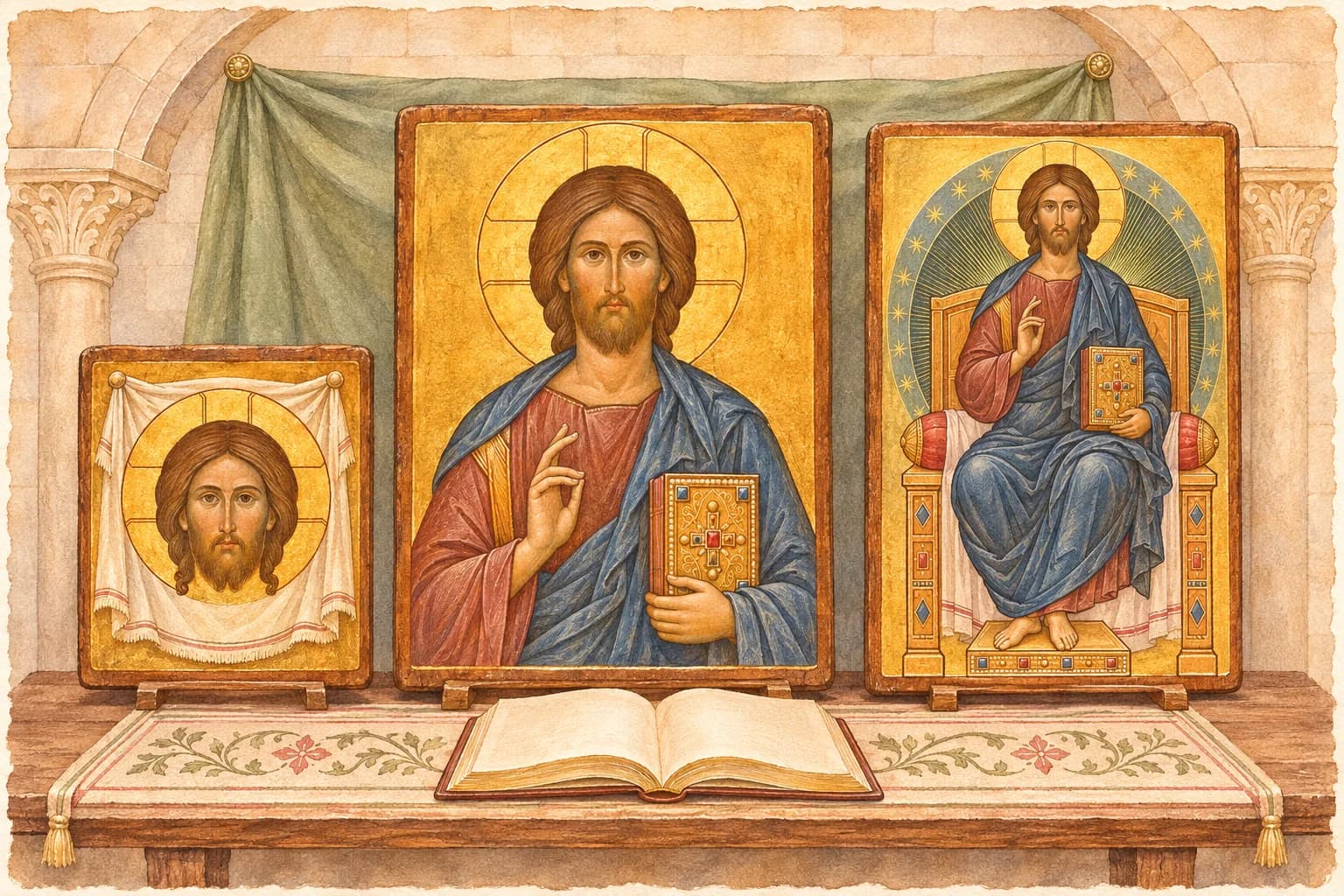
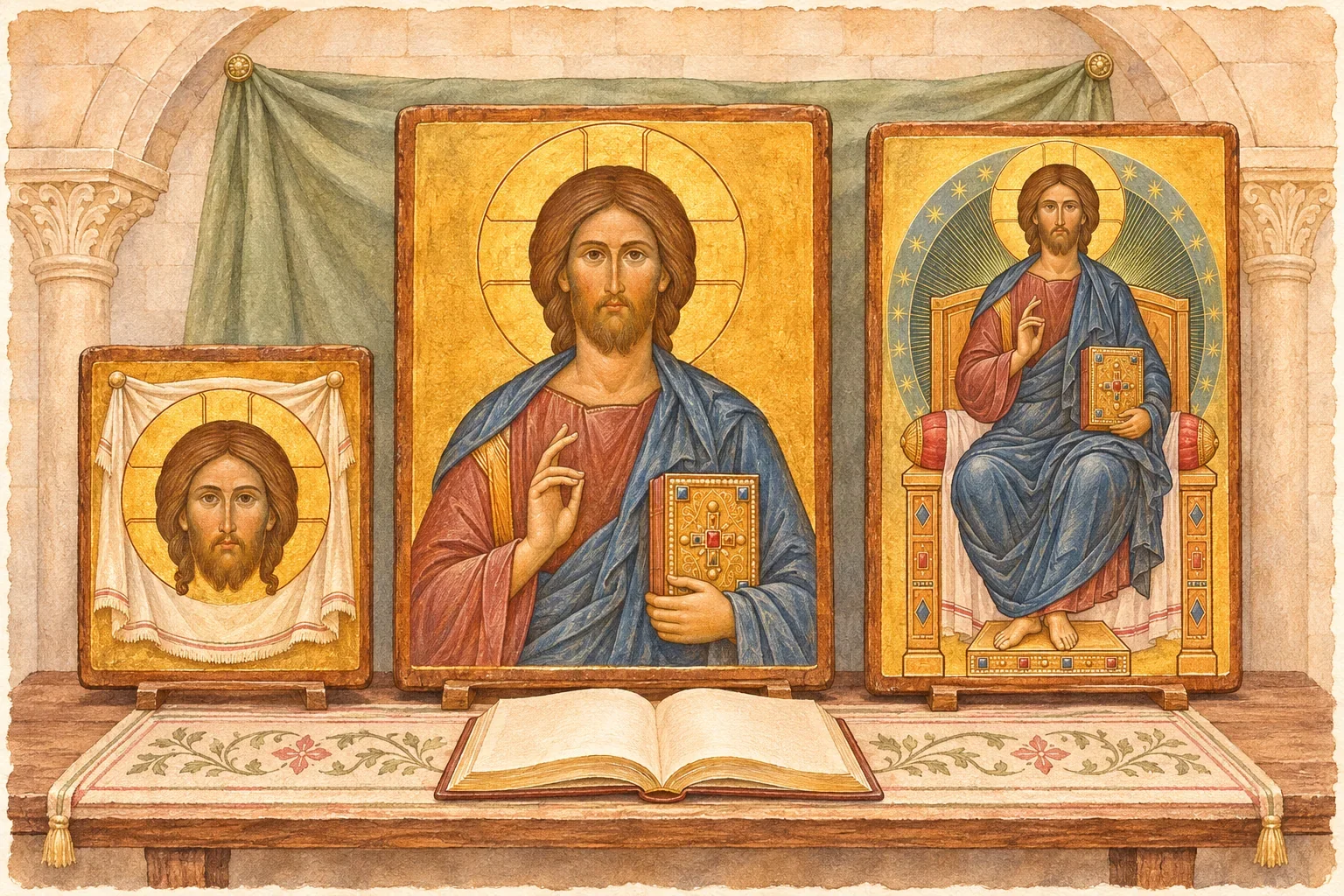
Icons of Christ may show his face, a half-length figure holding the Gospel, an enthroned figure or a Gospel event. These express one faith in the Saviour through different compositions. Their names help understanding, not the selection of a more powerful Christ.
In the Pantocrator image, blessing, the Gospel and confession of Christ as Lord are central. Inscriptions and the halo aid interpretation. Colours and details vary with period and school; every difference cannot be declared a theological error without investigation.
Not every realistic portrait with a religious label is a church icon. Ask a knowledgeable person when uncertain. An artist should not be credited with guaranteed knowledge of Christ’s appearance: iconography does not operate like modern photography.
Choose a recognisable image with a clear inscription for home prayer. If the Gospel text is visible, examine what it says. This provides a meaningful reason to read Scripture rather than endlessly compare the beauty of reproductions.
Pantocrator: the blessing hand and the Gospel
Pantocrator expresses the confession that Christ is sovereign over all creation. In the familiar half-length image, he blesses with one hand and holds a book with the other. This is not a portrait of an earthly ruler with religious decoration added: the book and gesture connect kingship with the Gospel and Christ’s address to humanity. A particularly solemn expression in one work does not depict a different or less merciful Christ.
The book may be closed or open. Where text is visible, read it and locate the Gospel passage: looking at the icon can then lead to hearing the Saviour’s teaching itself. Do not assume that every image contains the same sentence. Inscriptions may be abbreviated or written in Church Slavonic or Greek. If the lettering is unclear, consult a description of the work rather than guessing its meaning from a few recognisable characters.
The Holy Face, the enthroned Christ and Gospel scenes
The image called Not Made by Hands concentrates on Christ’s face, often shown on a cloth. Its name belongs to the church tradition of the Holy Face, not to the manufacturing process of every modern copy. An enthroned image expresses the Saviour’s kingship through a different composition. When the Mother of God and John the Baptist appear beside him in intercession, the arrangement is associated with the Deesis.
Icons of the Nativity, Baptism, Transfiguration or Crucifixion portray events in the history of salvation rather than merely variations of a face. Their details are read in relation to Scripture and the feast’s worship. Asking which icon of Jesus is correct therefore cannot be answered by choosing one accepted composition against all others. Different recognised forms express aspects of the same confession of faith and can occupy different places in a church.
Halos, inscriptions and the limits of symbolism
The cross within Christ’s halo is an important identifying feature. An abbreviated form of the name Jesus Christ usually accompanies the image, while Greek letters in the halo may express the divine name associated with being. These signs do more than identify a figure: they express the Church’s confession that the man depicted is the Son of God. A beginner can understand that central connection without treating every icon as an examination in ancient languages.
Interpret colour with care. Popular explanations sometimes promise a universal chart in which each shade always has one fixed meaning. In practice, period, artistic school, available pigments, restoration and the particular composition also matter. Basic theological markers must be distinguished from suggestions about individual artistic choices. A specialist description of the actual work is generally more reliable than a collection of symbolic meanings copied from unrelated posts.
Choosing an image for home and explaining it to a child
When choosing an icon, consider a clear image, legible inscriptions and a suitable size. A small, well-made reproduction may be more useful than a large object for which there is no safe location. Establish whom and what the image depicts, especially if its composition is unfamiliar. Do not clean an old darkened panel yourself with water or household products: the paint layer and inscriptions may be damaged.
For a child, begin with simple observations: Christ blesses, holds the Gospel and faces those praying before him. Then read an appropriate short Gospel passage and explain its meaning in your own words, clearly distinguishing explanation from an exact quotation. There is no need to claim that the painted eyes physically watch every mistake. The icon supports turning towards Christ; it is not intended to frighten children or function as a household device for controlling their behaviour.
Why Christ is sometimes depicted as a child or youth
The title Christ Emmanuel is associated with an image of Christ as a child or youth. It does not mean there is another Saviour or a different God more accessible to children. Through a particular iconographic form it expresses the Incarnation and God’s presence with humanity. Images of infancy, teaching and suffering concern the same Person.
Age and facial expression should not become a scale of stern and kind icons. A particular image may feel personally approachable without making other recognised images less holy. Clarifying its name and compositional meaning is more useful than selecting it on the promise of a special power.
A question for reflection
What meaning do the gesture and book convey in the image you have chosen?