
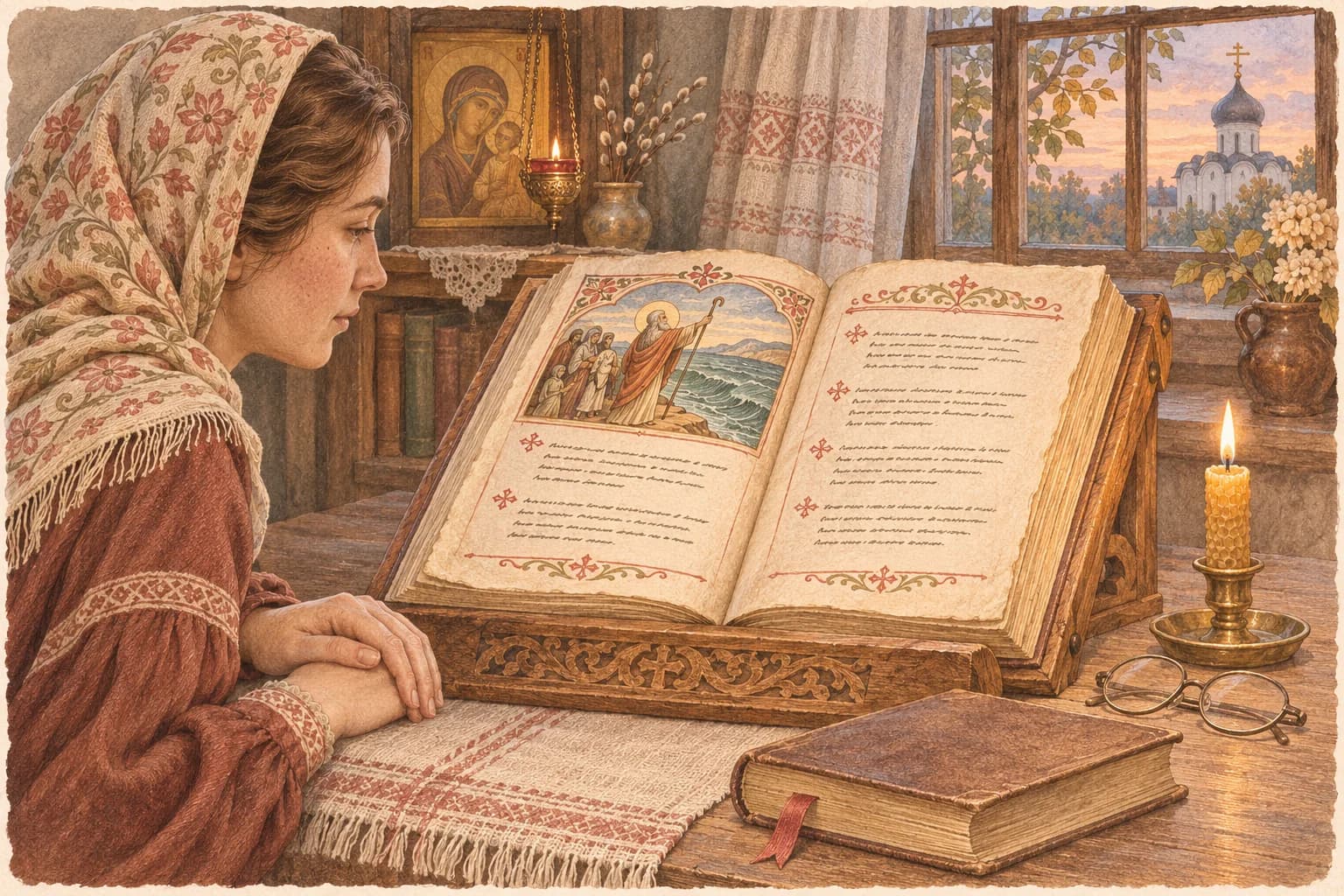

An irmos is the opening hymn of an ode in a canon. It connects the following troparia with the ode’s biblical and liturgical content and provides a model for its performance. In a book, irmos identifies a kind of text, not a saint or a separate prayer book.
A canon consists of odes, each with several elements. The repeated label irmos usually marks a new ode. To find your way through the text, look first at the structure of the whole canon and then examine unfamiliar individual terms.
Irmos and troparion are not merely two names for the same paragraph. A heading is also no reason to rearrange a home prayer rule independently. Editions may present instructions differently: compare the complete service rather than an isolated fragment.
A beginner can start by locating the ode, its irmos and the troparia that follow. For home use, choose a church edition and ask a priest or knowledgeable reader about unclear directions. Understanding the structure supports attention rather than a competition over how much is read.
An irmos belongs within a canon
A canon is an extended liturgical poetic form divided into odes. In ordinary practice, eight of the nine odes are commonly encountered: the second is usually omitted, although there are particular occasions when it is used. Numbering may therefore move from Ode One to Ode Three without a printing error. Each ode has a biblical foundation and contains several stanzas.
The irmos normally opens an ode and connects its content with that biblical foundation. In traditional hymnography and singing, it also supplies a pattern for the following troparia. When a prayer book prints Irmos, the reader is seeing the name of a type of text. It is not an additional invocation to pronounce as part of the prayer. The heading explains the canon’s structure and where the next passage belongs.
What the connection with biblical canticles means
Biblical canticles underlie the sequence of a canon. The first ode, for example, is connected with Moses’ song after the crossing of the sea. Images of deliverance, thanksgiving and divine help may therefore appear in its irmos even when the canon as a whole concerns another feast or a saint. That movement can surprise an unfamiliar reader until the shared biblical framework becomes apparent.
The irmos does more than add an attractive comparison to the main subject. It places the feast’s commemoration within the broader story of salvation. Read it as a connected passage rather than a puzzle made from isolated archaic words. First identify the biblical event being invoked, then consider how it illuminates the canon’s subject. This sequence makes the text considerably easier to understand.
Distinguishing the irmos from the following troparia
The irmos may be followed by refrains and the ode’s troparia. These develop the particular subject more fully: repentance, a festal event or the commemoration of a saint. A refrain belongs to the order of performance and is repeated before the appropriate stanzas. Headings, ode numbers and tone indications organise the text, but they are not all words to be spoken aloud.
If the printed directions seem confusing, examine one complete ode. Identify its number and irmos, then the following troparia and concluding indications. Do not try immediately to memorise the combined order of several canons at a service. A home prayer book often provides a simpler arrangement than a choir book. Follow its own explanations rather than mixing unrelated directions from another edition.
What a katavasia is and why an irmos may recur
During a service, a katavasia may be heard after the troparia of an ode. Under the appropriate order, an irmos serves in this position: sometimes the same one and sometimes one selected for the liturgical season. A familiar text can therefore occur somewhere different from its position in a home prayer canon. The repetition belongs to the structure of the service and does not necessarily mean the singers accidentally returned to the beginning.
The choice of katavasias and combination of canons follow liturgical rules. Someone seeking to pray attentively can begin simply by distinguishing the kind of text from its place in performance. Detailed rules are best learned gradually with a reliable guide and help from an experienced director or minister. Recognising every katavasia in advance is not a requirement for participating in Matins.
Reading at home when you do not know the melody
Not knowing the melody does not prevent you from reading a canon at home from a prayer book. Read calmly and attend to complete phrases rather than trying to imitate unfamiliar singing by ear. If the rule seems too complicated or lengthy, discuss a sustainable arrangement with your priest. There is no need to keep adding canons merely because one recorded hymn appealed to you.
For study, choose a short passage. Read its irmos, use a reliable glossary for unfamiliar words and identify the biblical reference. Then return to the text as a whole; one such reading can make its meaning much clearer. A translation assists understanding but should be distinguished from the Church Slavonic original. Do not present your own paraphrase as an established liturgical text or combine versions without making that clear to the reader.
The Irmologion is not one particular canon
The title Irmologion is encountered in connection with irmoi. It is a liturgical book associated with a collection of irmoi and other chants; contents and format depend on the edition and chant tradition. Finding an irmos there does not supply the complete canon to a particular saint. The relevant troparia and directions are also needed for that sequence. Clarify whether you want the meaning of one stanza, its melody or an entire canon. Those are different tasks, and the most appropriate reliable sources may differ accordingly.
A question for reflection
Can you identify where one ode begins and ends in your prayer book?