
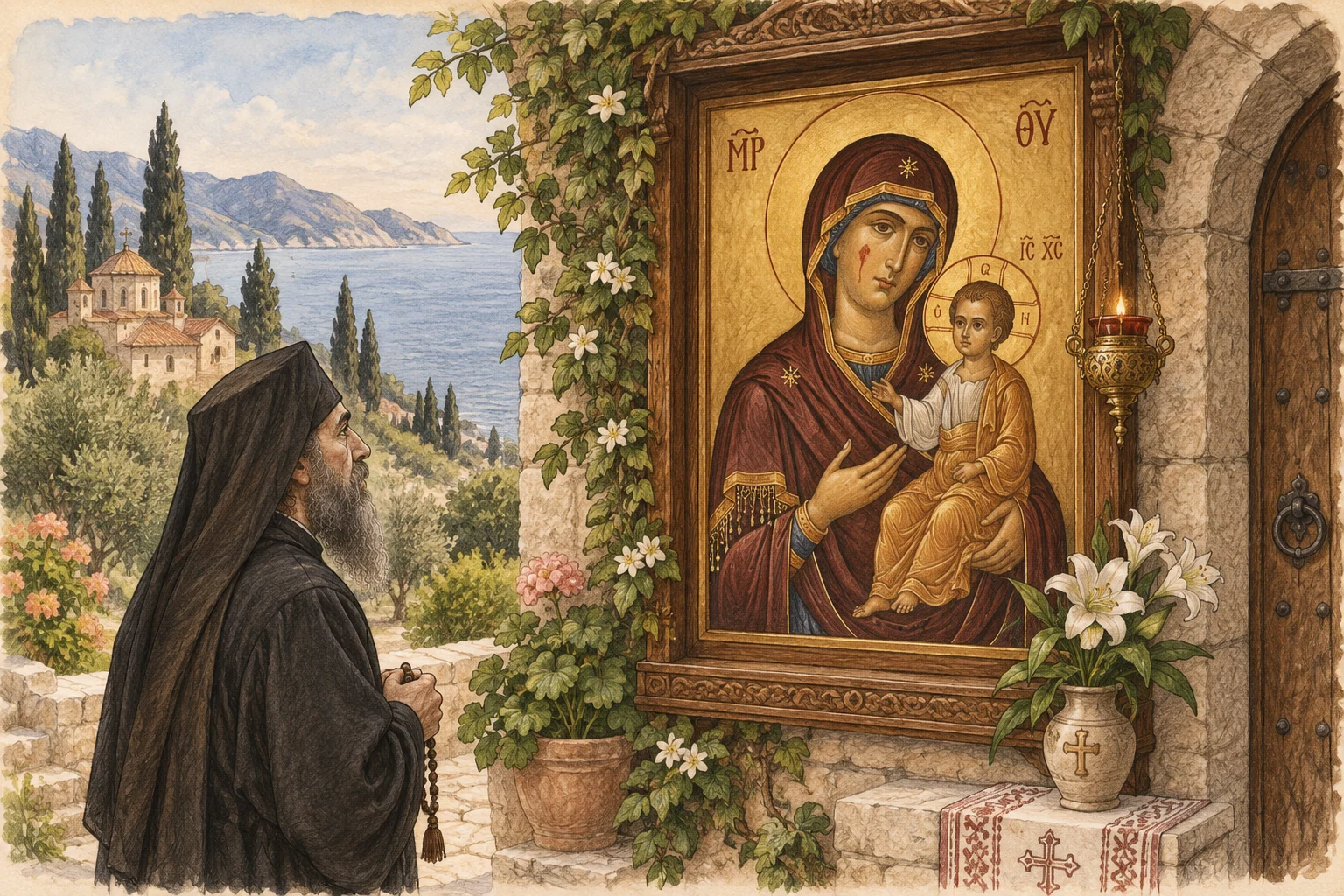
The Iveron icon is associated with Iveron Monastery on Mount Athos. In this context “Iberia” means Georgia, whose people were central to the monastery's early life, not the Iberian Peninsula. Another name, Portaitissa, means Gatekeeper. These names illuminate the image's history; neither turns an icon into a domestic security device.
The Athonite Tradition
The monastery's tradition tells of a widow who saved an icon during iconoclasm by placing it upon the sea. It was subsequently received by monks on Athos, with the monk Gabriel playing a central role. These episodes are transmitted as sacred monastic tradition, not as a chain of events for which an independent contemporary document survives at every stage.
This distinction is not a dismissal of faith. It allows a source to be read honestly according to its genre. A monastic narrative primarily bears witness to the Mother of God's intercession. It does not necessarily answer every modern question about a journey's route, the dating of a wooden panel, or the origin of its pigments.
Why Gatekeeper?
According to the tradition, the icon repeatedly appeared near the monastery gate after being placed inside the church. Its name expresses the point of that story: Mary does not depend upon the monks' protection but intercedes for their community. The subject is trust and prayerful protection, not an object's power operating independently of God.
The popular rule that an icon must hang above an entrance or it will fail to protect a household does not follow from this teaching. At home, place it where prayer is convenient and damage unlikely. Caring for family safety, maintaining locks, and helping someone in need remain ordinary responsibilities; possessing an icon does not suspend them.
The Original and Its Copies
The Athonite image and icons painted after it share a composition but have separate histories. Some copies have additional names identifying a city or a community. An account concerning a particular myrrh-streaming copy cannot automatically be attached to every Iveron icon, just as every reproduction cannot be assigned the same age.
Ask precise questions about a family or parish image: who painted it, where it came from, and what documentation exists. “Copy” is not a disparaging term here. It describes a relationship to a model, not a reduced suitability for prayer. Expensive ornament and simple materials likewise say nothing about how attentively the Mother of God hears a person.
Commemorations and Prayer
Principal Russian observances include February 25 and October 26 in the civil calendar, corresponding to Julian February 12 and October 13, as well as Bright Tuesday. Particular copies may have additional commemorations. Consult the parish calendar for a service rather than assuming that a seller's description provides a complete liturgical schedule.
Begin with a brief introduction to Athos and a reading of the icon's feast-day hymn. When a long prayer is unfamiliar, a simple request for intercession in your own words is possible. There is no need to recreate the sea narrative at home, perform supposedly protective circuits prescribed online, or find a mandatory number of candles. Veneration of the Gatekeeper belongs within faithfulness to Christ and care for living neighbours, not anxious compliance with secret conditions.
When considering pilgrimage, distinguish its spiritual purpose from practical arrangements. Check visitor rules, transport, and access restrictions beforehand. Inability to visit Athos does not prevent prayer before an Iveron image within one's own community.
The Wound on the Face and the Narrative
The Iveron narrative includes an episode in which a soldier strikes the image that a widow has hidden from iconoclasts. The painted wound on Mary's face is associated with this account. It belongs to the image's history of veneration and helps identify it. It is not a reason to search for extraordinary phenomena on an icon at home: the account transmits a sacred tradition, not instructions for an experiment.
If a child notices the detail, explain that the story concerns violence against a sacred image and the faithfulness of a woman trying to preserve it. There is no need to dwell on cruelty or frighten the child about accidentally damaging a paper reproduction. Respectful handling is learned through a calm example, not a threat that every clumsy movement will bring punishment.
Protecting an Object and Trusting the Mother of God
The Gatekeeper narrative reverses an expectation. The monks consider where to keep the icon, while the story speaks of intercession for the community itself. That does not remove their responsibility to care for the image. A domestic icon likewise needs a stable position and protection from accidental damage, but prayer is more than maintaining an object. Someone can polish a covering with great care while failing to notice the person beside them.
Two questions may help personal reflection: what am I trying to preserve, and to whom is my home open? This does not require admitting strangers without caution or abandoning reasonable boundaries. Rather, can you listen to a relative without irritation, notice someone isolated, or offer a guest understandable assistance? Applying the name Gatekeeper in this way is not a new interpretation of a monastic rule. It helps prevent devotion from becoming concerned only with locks, thresholds, and the position of doors.