
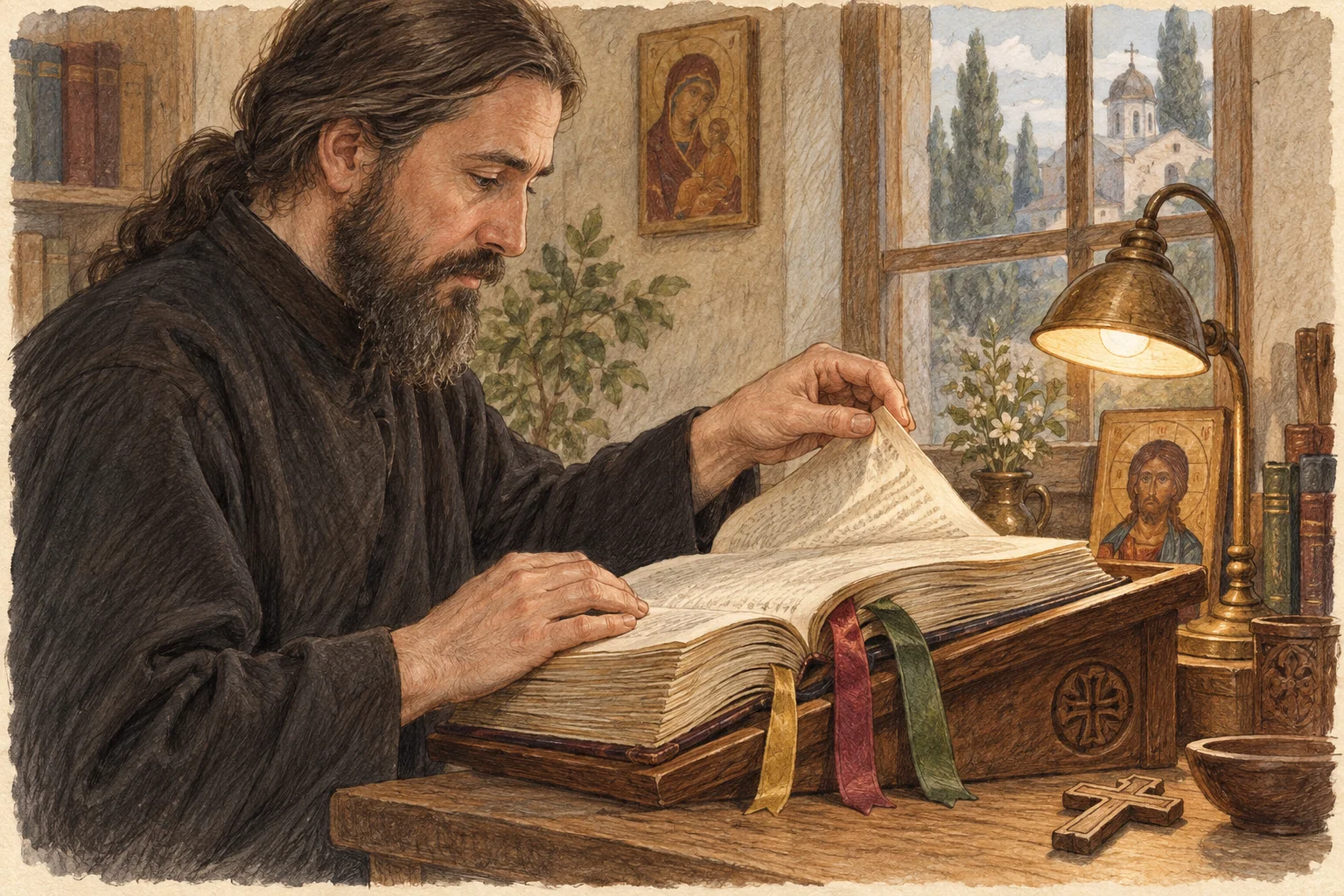
A kathisma is a liturgical division of the Psalter. Its 150 psalms are arranged in twenty kathismas for consecutive reading in the Church. A kathisma is not an individual psalm, a chapter of commentary, or a special prayer for a particular need. The divisions organize a large book for repeated reading within the cycle of worship.
The Structure of a Kathisma
Each kathisma has three sections, called stases. Russian parish usage often calls these “glories,” referring to the doxology between sections. The first kathisma, for example, contains Psalms 1–8 in groups of 1–3, 4–6, and 7–8. An instruction to read one “glory” does not mean saying only the words “Glory to the Father.”
The number of psalms varies between kathismas. The seventeenth contains only the very long Psalm 118 in traditional Orthodox numbering. You therefore cannot estimate reading time from the number of psalms alone. Begin by opening a printed Psalter and identifying a kathisma's actual boundaries.
Names and Numbers
A psalm keeps its own number regardless of its kathisma. If you need Psalm 50, “50” cannot be a kathisma number, because there are only twenty kathismas. Printing that psalm separately in a prayer book does not change its place within the Psalter.
Different biblical editions also use different numbering systems. Traditional Orthodox Psalm 50 corresponds to Psalm 51 in many English Bibles. Simply adding one does not work throughout the entire Psalter, however. Use a comparison table or check the opening words, particularly when moving between translations.
At Church and at Home
Kathismas are appointed at Vespers and Matins according to a liturgical order that varies with the season and feasts. Parish services may use abbreviations. Hearing a few verses therefore does not establish that those verses constitute a complete kathisma in the book.
A home prayer rule need not mechanically reproduce the monastic cycle. When beginning the Psalter, agree on a manageable amount and work toward understanding. A long reading without attention is not automatically better than a shorter one. For shared reading, clarify an assignment in advance: does it mean a complete kathisma, one stasis, or an individual psalm?
Using the Book Carefully
Find the contents page or kathisma index, then locate the required heading, the first stasis, and the doxology markers. Notice where the next kathisma starts. This prevents stopping early or reading further than intended because of unfamiliar typography. Place a bookmark at the text itself rather than only at its entry in a table.
Some editions print additional prayers after kathismas. They do not become part of the biblical psalm simply because they appear beside it. Distinguish Scripture, liturgical directions, and accompanying prayers. Note difficult words or disturbing images for discussion instead of inventing an immediate explanation. Kathisma divisions support attentive reading and prayer; they do not turn the Psalter into twenty independent remedies for particular life problems.
The word kathisma is related to the Greek word for sitting, but its etymology does not establish a universal posture for every situation. Follow the service's order and your physical capacity in church; at home, choose a posture supporting attention. Pain need not be ignored because of a section's number. Terminology should clarify the book, not increase anxiety about bodily limitations.
Finding a psalm within its kathisma
In the Psalter's division table, Psalm 50 is in the seventh kathisma's second stasis, together with Psalm 49, using traditional Orthodox numbering. This distinguishes three different assignments: reading Psalm 50, reading the second stasis of kathisma seven, and reading the entire kathisma. They are not the same amount of text. If an instruction is abbreviated, ask what is intended, particularly when several participants use differently arranged editions.
Find these boundaries in the index and then check them against the headings in the text. A page number supplied by another reader may lead somewhere entirely different in your own book. A shared note can give the kathisma, stasis and, when necessary, psalm numbers. This is ordinary organizational accuracy, not evidence that a more experienced reader has greater spiritual worth. Clear references allow newcomers to take part without repeatedly guessing where to begin or finish.
Consecutive reading and a familiar psalm
A favourite psalm can bring you back to familiar words of thanksgiving or petition. Reading a kathisma consecutively also introduces passages you might not choose yourself. The two approaches need not compete. Understand which you are doing: reading a complete appointed section or returning to an individual prayer. If you accidentally omit a psalm while taking part in an agreed shared reading, it is better to acknowledge it simply than to hide the mistake out of embarrassment.
A difficult image need not interrupt the entire prayer rule for an immediate search through commentaries. Note the verse, finish a manageable passage, and return later with a translation and explanation. If the amount repeatedly proves too demanding, discuss a smaller measure instead of accumulating anxiety every evening over unfinished pages. A kathisma marks a boundary in a text; it does not measure a person's value or promise an outcome in exchange for a precise page count. Its divisions can make a sustained practice easier without turning that practice into a contest.