
In ancient Christian usage, catholic refers to the universality and fullness of the Church. In the Slavonic Creed it corresponds to sobornaya. It should not automatically be read as the modern denominational name Roman Catholic in every historical text.
Meaning depends on context and the period of a text. Catholicity concerns the Church as a whole rather than a closed group with its own doctrine. Translating the word alone does not exhaust the theological meaning of this characteristic.
Conciliarity should not be reduced to majority rule or identical opinions about everyday matters. Unity of faith and shared church life go deeper than matching preferences. Differences in language and local custom do not necessarily break that unity.
When encountering the term, check who is speaking, when and about what. Compare the translation with an explanation of the Creed. This avoids importing a modern denominational controversy into a passage where it does not belong.
Why the word resembles a denominational name
Catholic and the Russian transliteration kafolichesky derive from the same Greek word, although different forms and usages have become established. In an ancient Christian text, the word may describe a characteristic of the whole Church. In a modern news report, Catholic Church commonly functions as a denominational name. Establishing the date and subject of a passage is therefore the first step towards understanding it.
For example, an ancient author’s reference to the catholic Church cannot immediately be read as a contrast between modern Roman Catholicism and modern Orthodoxy. Later divisions do not automatically supply the meaning of every early usage. Conversely, a present-day Roman Catholic document may use the name with a definite institutional meaning. A dictionary translation alone cannot distinguish all these situations.
Universality: the Church is not limited to one people
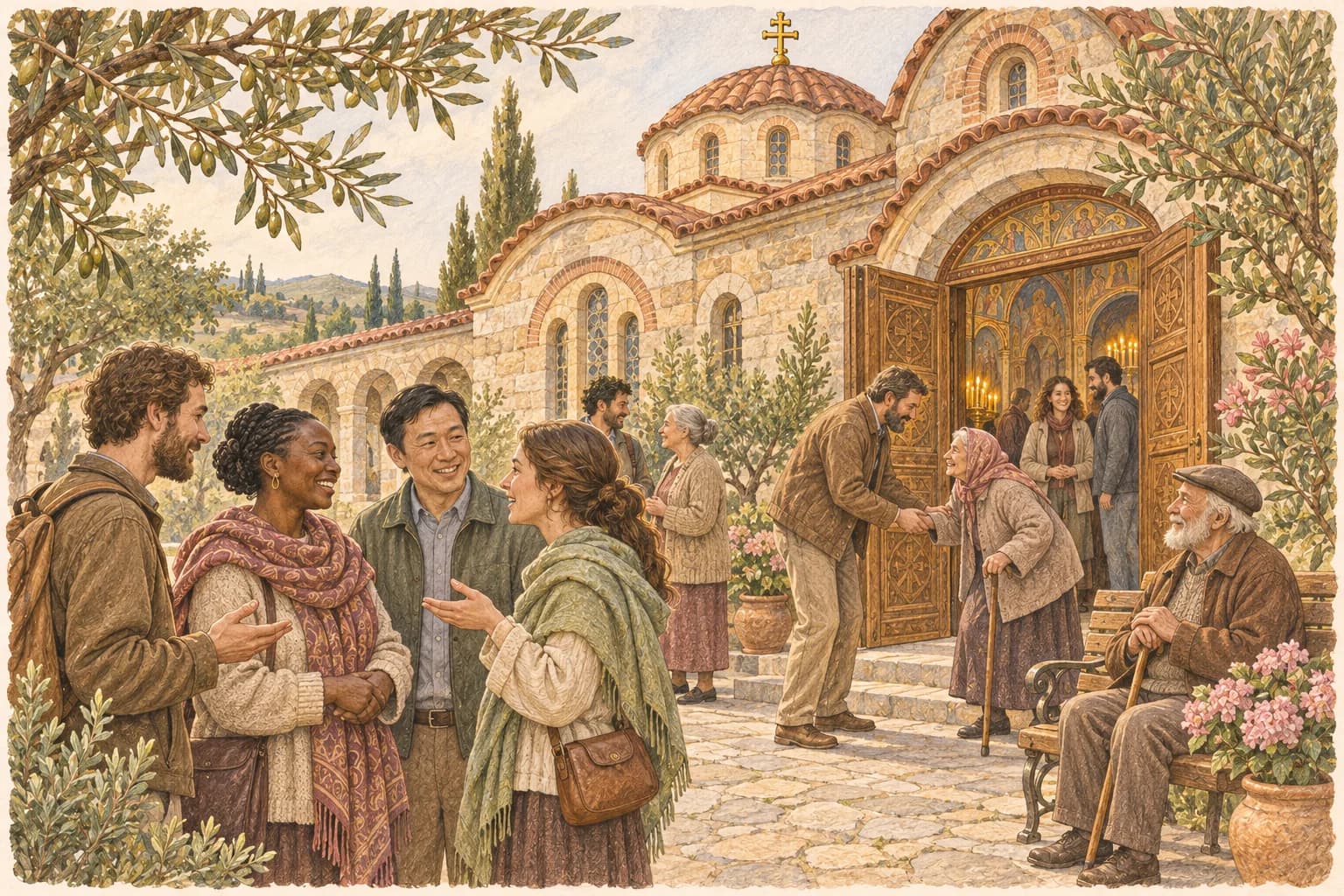
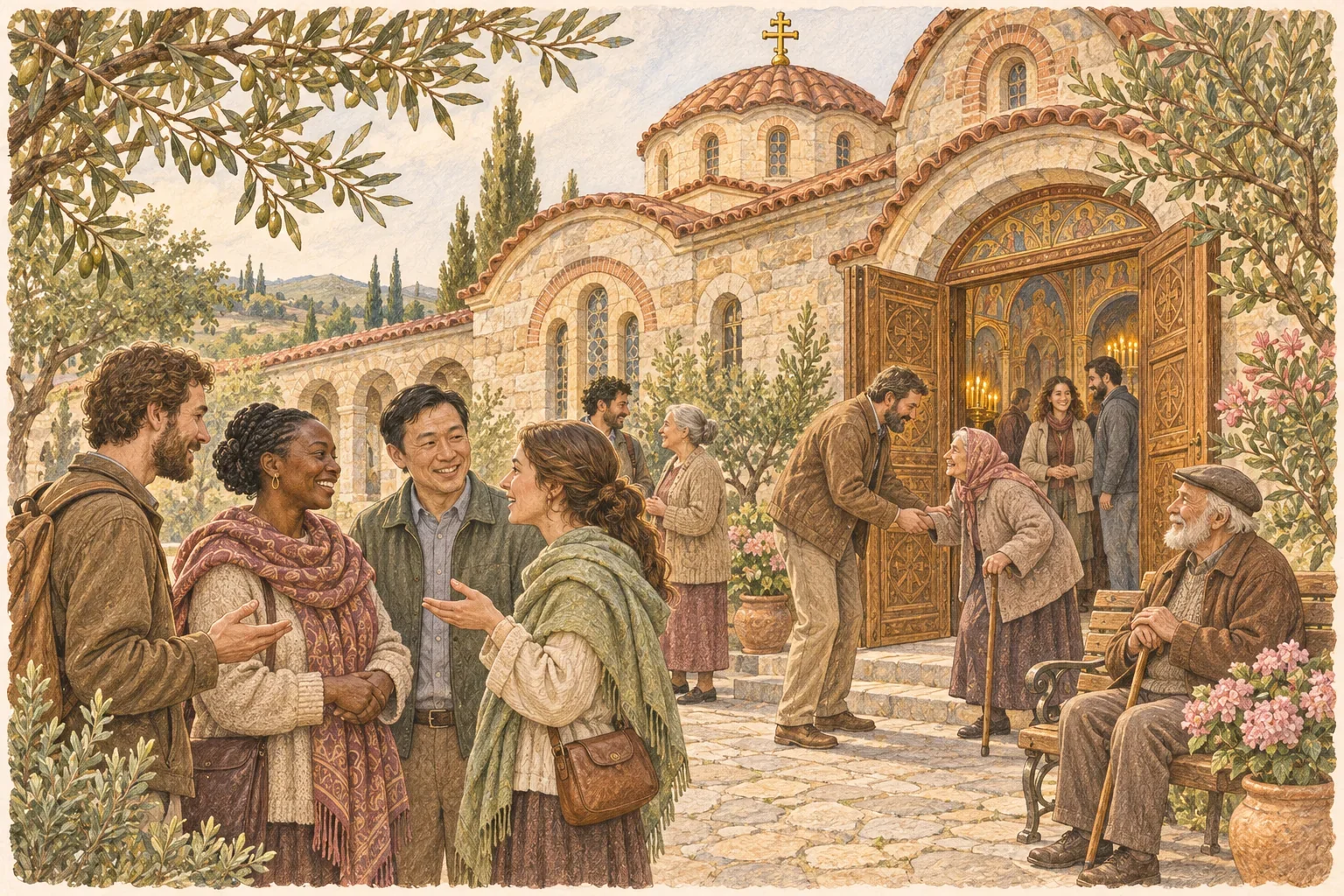
One important aspect of catholicity is that church life is addressed to all people. Membership of a particular nation, social class or language group does not measure a person’s worth before God. The Church is not intended only for the educated, wealthy or those raised in church-going families. Different people are called to the same faith and life in Christ, though their paths towards that life may differ.
This perspective helps assess parish habits. A local language and cultural tradition may be natural and cherished without implying that someone of another background is inherently foreign to Christianity. Universality does not require erasing every distinctive feature. It means that those features cannot become the boundary of the Gospel’s address to human beings.
Fullness: more than geographical spread
Catholicity is not exhausted by placing communities on a world map. A large international organisation may operate everywhere, yet geography alone does not explain this ecclesial characteristic. Orthodox understanding also concerns the fullness of truth and grace needed for salvation. The term therefore relates to the content of faith and sacramental life, not only the number of countries, parishes or members.
A small parish does not receive a smaller portion of Christ because its congregation is modest and its building simple. At the same time, a local community is not a self-contained group inventing doctrine independently of the Church. Fullness of ecclesial life and communion with other communities belong together. Neither an arithmetic total of institutions nor isolation within one favourite parish expresses that relationship adequately.
Conciliarity is not simply counting votes
The Slavonic sobornaya expresses a central characteristic of the Church in the Creed. Later explanations of conciliarity have developed in different ways, and the term should not automatically be reduced to modern political categories. A council may make decisions, but the truth of faith is not created by the number of hands raised. Conciliar deliberation presupposes fidelity to the received apostolic confession.
Nor must all believers assess the weather, architecture or parish refreshments identically. Unity is not uniformity of preferences. Practical disagreements require reasonable conversation and responsible decisions, rather than immediately declaring someone an enemy of conciliarity. Distinguish a question about faith from a discussion of one possible way to organise shared life.
Reading an unfamiliar usage in a book
Write down the complete sentence rather than extracting the word alone. Then identify the author, date and translation being used. If the passage concerns the Creed or an early description of the Church, consult a theological explanation of catholicity. If it is a modern interchurch document, establish which particular communion the author calls the Catholic Church.
Do not try to settle every question of ecclesial division through one term. A shared word’s historical origin does not make contemporary doctrinal positions identical, while different Russian spellings do not prove the absence of a common history. Careful reading preserves both considerations. Its purpose is to understand the passage in front of you rather than force it to confirm a conclusion selected in advance.
A question for reflection
In what historical context is the unfamiliar term being used?