
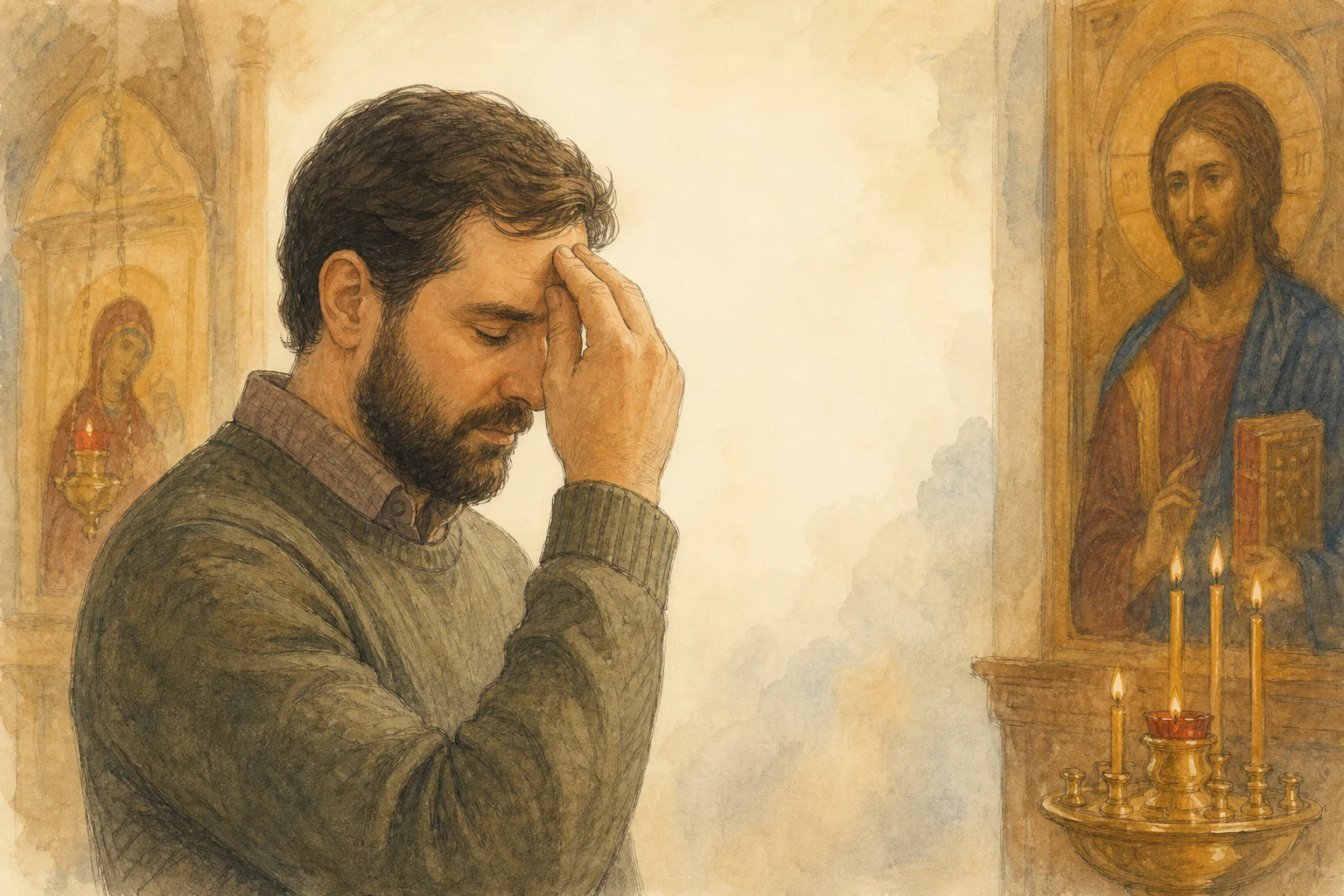
In the Russian Orthodox tradition, the sign of the Cross is made with the right hand: the thumb, index finger, and middle finger are joined, while the ring finger and little finger are folded toward the palm. Touch the forehead, then the abdomen, the right shoulder, and finally the left shoulder. When appropriate, make a bow after completing the sign.
The movement should be calm and deliberate. The sign of the Cross is a brief bodily confession of the Holy Trinity and of the Incarnation of Jesus Christ, not a superstitious gesture for luck.
How to hold the fingers
Bring the tips of the thumb, index finger, and middle finger together. The three joined fingers confess one God—Father, Son, and Holy Spirit. Fold the ring finger and little finger toward the palm as a sign of the two natures of Jesus Christ, divine and human.
There is no need to squeeze the hand painfully or worry about millimeters. The meaning does not depend on perfect motor control, yet the received shape allows the body to confess what the Church believes.
The order of the movement
With the right hand, touch the forehead, move down to the area of the abdomen, then move to the right shoulder and afterward to the left shoulder. The movement traces a vertical and horizontal cross. In Russian Orthodox practice, the shoulders are touched from right to left.
Do not begin the accompanying bow while the hand is still moving from the left shoulder. Complete the Cross first and bow afterward. This keeps the sign clear and the movement attentive.
What words may accompany it
The sign is often accompanied by the words, “In the name of the Father, and of the Son, and of the Holy Spirit. Amen.” Other appointed words may occur at the beginning of prayers, and during worship a person follows the meaning and order of the service.
Do not turn the words into hurried syllables. They may be spoken quietly or inwardly. In public, the sign need not become a performance, but neither is there a need to be ashamed of it.
Why Orthodox Christians touch the right shoulder first
Christian traditions have preserved different directions for the gesture. For a Russian Orthodox Christian, the customary order is the right shoulder followed by the left. This is an inherited Church practice, not a reason to argue or judge another person’s faith by one hand movement.
A person who has come from another tradition, makes a mistake, or is only learning should not be mocked. It is enough to demonstrate the order calmly and explain its meaning.
When to make the sign at home
Orthodox Christians commonly make the sign at the beginning and end of prayer, before reading Holy Scripture, before and after meals, when leaving home, and before an important undertaking. It helps us remember God and offer the action to Him.
Frequency cannot replace attention. Dozens of automatic gestures do not make a decision good if the person knowingly acts with cruelty or dishonesty. The sign should be followed by a choice consistent with the Cross.
When to make the sign in church
Believers cross themselves when entering and leaving the church, before an icon, at the beginning and end of prayers, and at certain points in worship. A newcomer need not copy every movement around him anxiously. Listen to the service and learn its pattern gradually.
Local customs can differ in details. Ask a church attendant or priest after the service rather than worrying during it. Upcoming worship is shown on the schedule page.
Must a bow follow every sign?
The sign of the Cross is often joined to a bow from the waist, but not every moment calls for the same bodily action. There are days and parts of worship when prostrations are not made, and a person’s health must also be considered.
Our separate guide to bows and prostrations in church explains the distinction. When uncertain, make the sign calmly and do not monitor yourself with fear.
May the left hand be used?
The customary hand is the right. If the right hand is injured, absent, or has restricted movement, a person may use the left hand or make the sign as far as the body permits. Illness does not close the way to prayer.
A left-handed person can normally use the right hand for the Church gesture, but the custom must never become a way to humiliate a person with a disability. A priest can advise in a particular situation.
How to teach a child
Stand beside the child and demonstrate slowly: three fingers together, two toward the palm; forehead, abdomen, right shoulder, left shoulder. Explain simply that Christians remember God and the Cross of Christ. Do not demand perfect coordination from a young child.
Do not seize the child’s hand or shame a mistake in front of others. It is better to repeat the movement together at the beginning and end of a brief family prayer. A peaceful example preserves meaning better than constant correction.
Common mistakes
The most visible mistake is a hurried movement in which the hand barely traces a cross. There is also an opposite extreme: becoming so occupied with exactness that the person no longer hears the prayer. Correct the form without fear and continue.
Do not trace a cross in the air toward another person as a means of control, use the sign for fortune-telling, or treat it as a guarantee of safety during a reckless act. The Cross calls us to trust God and act responsibly; it does not cancel common sense.
The sign of the Cross and a priest’s blessing
When a priest blesses with his hand, he uses a different arrangement, traditionally forming the letters of the name of Jesus Christ. A layperson does not need to imitate that priestly gesture when crossing himself or herself. The ordinary three-finger arrangement is used for one’s own sign of the Cross.
When approaching to receive a blessing, people commonly place the open right palm over the left and kiss the priest’s hand after the blessing. A particular liturgical moment may not be the time to approach, so follow the order of the service and the priest’s direction.
What the Cross means in everyday life
The Cross recalls not merely protection but Christ’s love, sacrifice, Resurrection, and the disciple’s calling to bear a cross. Crossing yourself before a difficult conversation therefore means asking for strength to tell the truth without hatred, not receiving permission to defeat the other person.
The gesture gains content when it leads to prayer and action: refusing a lie, helping someone vulnerable, asking forgiveness, or accepting responsibility. Without such fruit, it can shrink into a familiar movement.
The sign is not an amulet
Christians ask for God’s protection, but the sign of the Cross is not an object or motion that mechanically prevents every hardship. A driver must still follow safety rules, a patient must receive care, and a person in danger should seek practical help.
Christian confidence rests in communion with Christ, including through suffering and death, rather than a promise that nothing painful will happen. This distinction protects prayer from superstition.
If you make a mistake or reverse the shoulders
There is no need to restart the whole prayer, become frightened, or expect misfortune. Correct the order calmly the next time. God is not trying to catch someone in a motor error, and the sign is not a code that works only when executed perfectly.
If anxiety forces you to repeat the gesture dozens of times, check the order constantly, or fear punishment, speak with a priest. Compulsive rituals and severe anxiety may also require help from an appropriate health professional.
Frequently asked questions
Should the hand go to the chest or the abdomen?
After the forehead, move the hand down to the area of the abdomen so that the vertical line is clear, and then touch the shoulders.
Must I remove a glove?
An uncovered hand makes the gesture clearer when that is practical, but cold weather, illness, or a work setting does not make a glove an obstacle to prayer.
May I cross myself while sitting?
Yes, during illness, weakness, travel, or whenever standing is unsafe. A healthy person at home or in church will ordinarily do so standing.
Do Orthodox Christians cross themselves before an icon of a saint?
Yes, while addressing prayer to God and asking the saint’s intercession. An icon is not an independent source of magical power.
What if I feel embarrassed in public?
There is no need for a display. Make the sign calmly and naturally, remembering that its purpose is a confession of faith rather than an evaluation of the people around you.
A short reminder
Use the right hand; join three fingers and fold two; touch forehead, abdomen, right shoulder, left shoulder; then bow. Move without haste, understand the meaning, and do not judge those who are still learning.
To ask about parish practice or prepare for a first service, use our contact page. The guide to conduct in an Orthodox church provides other simple points for a newcomer.