
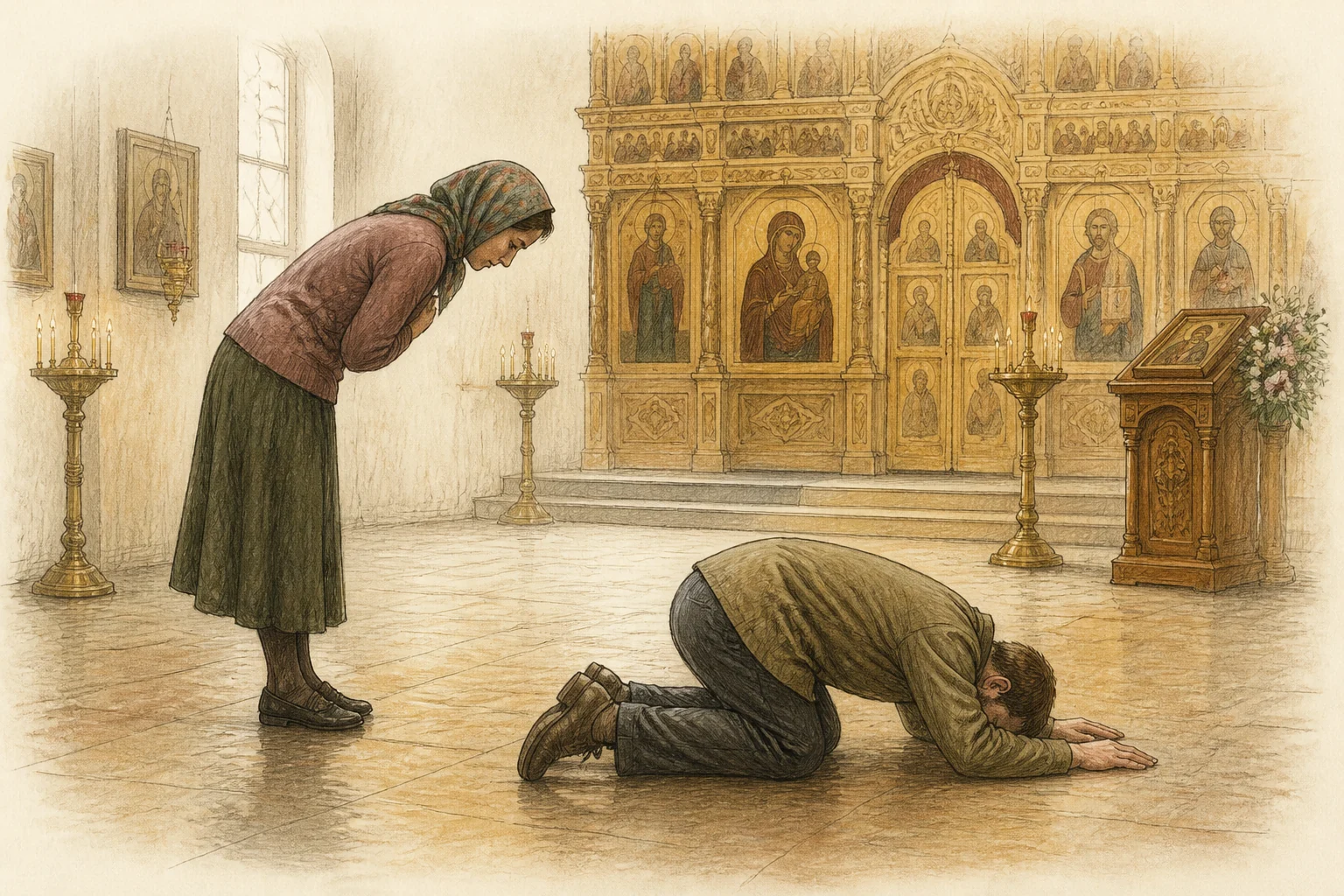
A bow from the waist is an inclination of the upper body, usually made after the sign of the Cross; a full prostration means going down to the knees and hands, lowering the head toward the floor, and then rising. In Orthodox prayer both actions express reverence, repentance, and self-offering to God. They are not made on every day or at every point in a service.
For a newcomer, attentive prayer matters more than anxiously copying every movement nearby. Illness, pregnancy, advanced age, and limited mobility are valid reasons to replace a bow with a small inclination of the head or omit the movement.
What a bow means
A Christian prays not only with the mind. The body also takes part in turning toward God. A bow expresses humility, not as the destruction of human dignity but as an acknowledgment of truth: life and mercy are gifts, and a person needs forgiveness and help.
Rising after a prostration also bears bodily witness to hope and restoration. A bow therefore cannot be reduced to gloomy punishment or religious exercise; its meaning appears within prayer.
How to make a bow from the waist
Normally, complete the sign of the Cross, lower the hand, and then incline the upper body from the waist while directing the eyes downward. The movement should be calm and clear, but its precise angle is not measured. Return upright without haste.
Do not merge the movement across the shoulders with the beginning of the bow. Our separate guide to making the sign of the Cross gives a step-by-step reminder.
How to make a full prostration
After the sign of the Cross, go down onto the knees, place the hands on the floor, and lower the head until it touches or approaches the floor; then rise carefully. Leave enough space so that you do not push another person or lose balance.
Exact mechanics depend on the body and the room. Do not strike the knees sharply or lean on unstable furniture. If the floor is slippery, the church is crowded, or rising is difficult, make a bow from the waist instead.
A prostration and prolonged kneeling are not identical
A prostration is a completed movement downward and back upward. Kneeling may continue for a period during a particular prayer. The gestures are related outwardly, but liturgically they do not always mean exactly the same thing.
A beginner should not assign prolonged kneeling independently. Follow the common order of worship and the direction of the clergy while respecting health limitations.
When bows from the waist are used
Waist bows commonly appear in prayer at home and in church: at certain petitions, before icons, and when entering or leaving a church. The exact order depends on the prayer and local usage.
You need not cross yourself and bow after every person around you. When the moment is unfamiliar, stand peacefully and listen to the words. The structure is learned gradually.
When full prostrations are used
Prostrations are especially associated with the penitential services of Great Lent, including the Prayer of Saint Ephrem the Syrian. They may also be included in a personal rule under pastoral guidance.
Do not apply something seen once to every day of the year. Orthodox practice distinguishes weekdays from Sundays and fasting periods from feasts. Ask a priest about the precise parish order.
Why prostrations are generally not made on Sundays
Sunday celebrates the Resurrection of Christ, and ancient Church tradition emphasizes standing as an image of risen life. As a general norm, full prostrations and prolonged kneeling do not characterize Sunday worship.
The joy of the Resurrection especially shapes the period from Pascha to Pentecost. Particular circumstances and local details call for pastoral explanation, however, not an argument with a neighbor during the service.
Bows during Great Lent
On Lenten weekdays, bodily penitential prayer becomes more prominent. A prostration lets a person not merely speak about repentance but live it with the whole self: bow down, ask for mercy, and rise again.
The number of movements is not a measure of holiness. If many prostrations produce irritability, pride, or injury, the purpose has been lost. Lenten effort should fit the person’s capacity and spiritual guidance.
Should I bow before an icon?
Before an icon, an Orthodox Christian commonly makes the sign of the Cross and a bow, addressing prayer to God and honoring the saint represented. The bow is not directed toward a wooden object as an independent magical power but toward the prototype.
After prayer, a person may reverently venerate the icon when appropriate. Our guide to venerating an icon explains the order and respectful hygienic boundaries.
Knee or back problems
Do not make a full prostration through sharp pain, risk of falling, or a medical restriction. Use a waist bow, a small inclination of the head, or prayer without movement. God sees both the intention and the person’s condition.
When limitations are permanent, there is no need to justify yourself to other worshippers. Choose a place near stable support if useful, without creating a hazard. Medical guidance matters.
Pregnancy, old age, and recovery from surgery
In each of these circumstances, reduce the depth of a bow or omit it temporarily. Do not try to prove zeal at the cost of a fall, bleeding, or a complication. Bodily discipline must serve prayer and life.
A priest can help adapt the rule but does not replace a physician. When uncertain, begin with the safe limitation and ask a clinician about physical load.
How to explain bows to a child
Demonstrate one slow waist bow and explain that the body expresses reverence and a request for help. A young child does not need a large number or perfect synchronization with adults.
Never assign prostrations as punishment for disobedience. That associates a prayerful gesture with fear and humiliation. A child learns through short family prayer and a peaceful example.
Common mistakes
Do not bow before completing the sign of the Cross, make sudden movements in a crowded space, or count the bows of people nearby. Do not use the gesture to display unusual strictness.
The opposite mistake is refusing every bodily action out of embarrassment. Begin with a small waist bow at home, understand the meaning, and gradually join the shared order.
Safety and consideration in a crowded church
Look briefly at the space before going down. Coats, bags, candle stands, children, and people moving behind you can make a full prostration unsafe. A waist bow is not an inferior prayer when the room does not permit more.
Do not expect another worshipper to move immediately or criticize someone for remaining upright. A hidden disability may not be visible. Courtesy toward the neighbor is part of reverence toward God.
What to do when you do not know the service order
Stand where you do not block a passage, listen to the prayers, and observe without panic. You may arrive a little early and ask a church attendant. Services are listed on our schedule page.
If you make a mistake, simply continue praying. A church is not an examination hall; it is a community of people who also once had to learn.
Frequently asked questions
Must the forehead touch the floor?
The spiritual meaning is not measured by exact contact. Make the movement as fully as the body can safely allow.
May I make prostrations at home on Sunday?
The general Sunday pattern emphasizes standing and the joy of the Resurrection. A personal rule and exceptional circumstances are best discussed with a priest.
Must every bow be preceded by the sign of the Cross?
A bow is commonly joined to the sign, but a particular prayer or liturgical moment may prescribe another sequence.
Can a person bow while sitting?
A person who cannot stand may incline the head and upper body while seated. A physical limitation does not prevent prayer.
How many prostrations should be made at home?
A beginner should not assign a large number independently. A small, reasonable amount may be included with pastoral guidance.
The essential distinction
A waist bow inclines the body; a full prostration goes down to the floor and rises. Both should be prayer expressed through the body, not competition, punishment, or a risk to health.
Parish practice can be clarified through our contact page. Begin with the meaning, protect safety, and respect people whose physical measure differs from your own.