
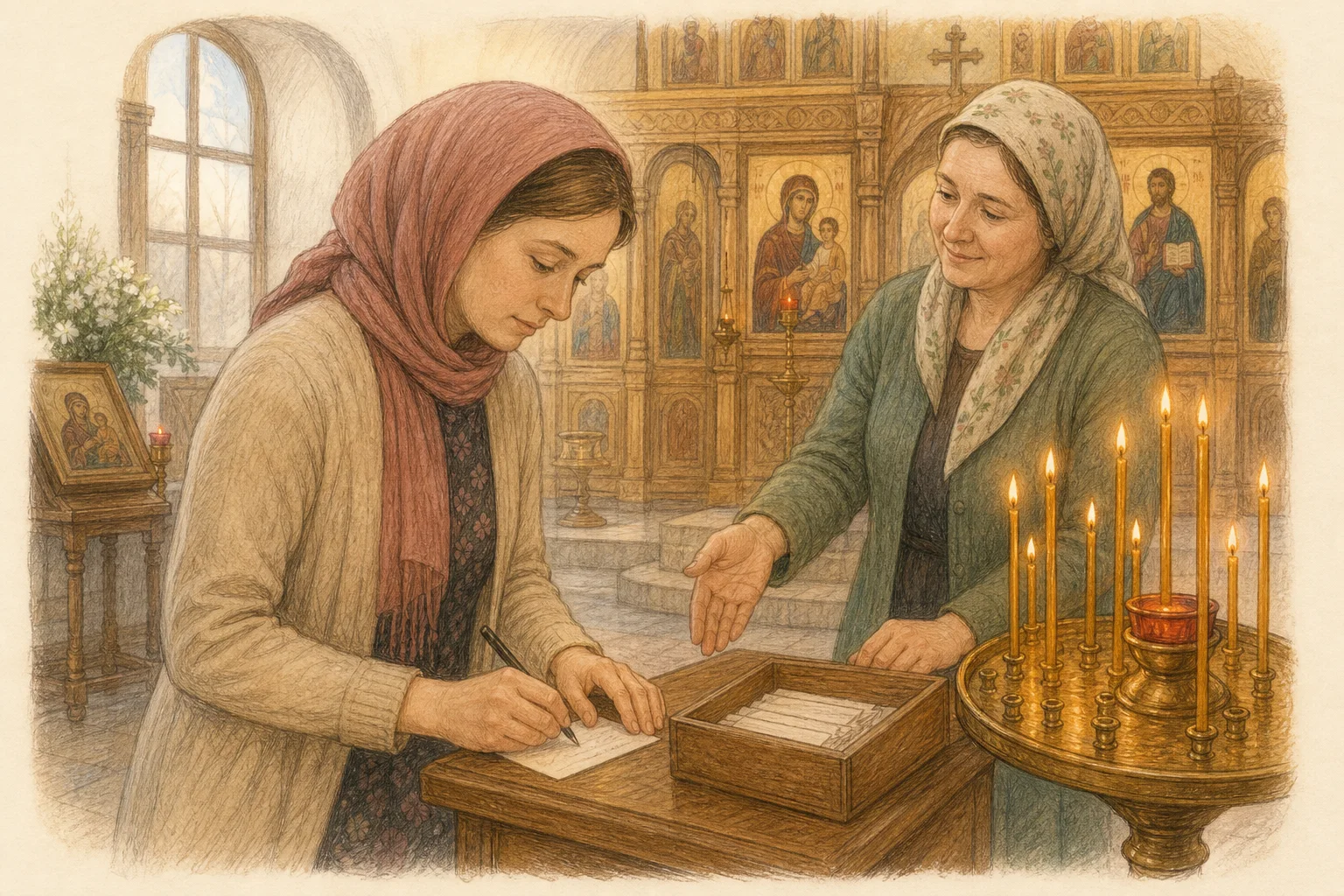
A church prayer note is a request for the Church’s prayer for the living or the departed. What matters is not perfect handwriting or a special formula, but attentive love for the person whose name you bring to prayer.
Practical arrangements may vary slightly between parishes. If you are unsure, simply ask a church worker; this guide is an orientation, not a reason to worry about every letter.
Notes for the living and departed
Normally, “For health” is written for the living and “For repose” for the departed. Health means more than physical wellbeing: it is a prayer for God’s help, peace and salvation. Keep the living and departed on separate notes.
How to write a name
Usually write the full baptismal name in the genitive form: “Alexander”, “Maria”, “Nicholas”. Surnames, patronymics, addresses, titles and long explanations are unnecessary. Use a full name rather than a family diminutive; if a person has a different civil name or you do not know their baptismal name, ask relatives or the parish.
Whom to commemorate
For liturgical commemoration, notes normally contain the names of baptised Orthodox Christians. Do not reach hasty conclusions about a personal situation, an unknown baptism or someone of another faith: speak with a priest. Home prayer and love for a person are not limited to a note.
A note is not an order
A note does not purchase a result or control another person. It asks the Church to pray, and invites us to pray too. Read Proskomedia in plain language for its connection with the Liturgy.
Why names are written in a prayer note
In the Church’s prayer, a person is not reduced to an abstract problem. They are remembered by name, as they were received into the Church at Baptism. A note is not an application form: it does not need a biography, diagnosis, job title or a detailed account of circumstances.
As you write, quietly remember each person and pray in your own words. That small attention is already an act of love and remembrance.
For health is not only for illness
A note “For health” is not only for someone who is ill. It can include a loved one in a difficult time, travelling, beginning an important task or simply dear to you. Health is broader than medical wellbeing: it asks for God’s help, peace, strength and salvation.
A note does not replace calling someone lonely, reconciling with a relative or helping a person in need. Prayer and concrete love belong together.
For repose: memory that does not end
In a note “For repose”, we entrust departed people to God. This is not an attempt to hold the past, but trust that a person remains in God’s love and in the Church’s memory. We may remember relatives, friends, teachers and those to whom we are grateful.
Civil and baptismal names
Sometimes a civil name differs from the name received at Baptism. For a church note, the baptismal name is normally used. If you do not know it, do not guess from an online list: ask the person, relatives or the parish.
How to submit a note calmly
Arrive a little before the service so there is no need to write in a rush. Use the parish form or bring a clear list. If several kinds of commemoration are offered, first say whom you wish to remember; a church worker can explain the present local order.
What not to write
A prayer note is not the place for a requested scenario—selling a flat, winning an argument or forcing a relationship. The Church prays for people, not for an ordered outcome. Bring personal pain into your own prayer and, when needed, speak with a priest.
Questions people ask
Should I write a surname?
No. A full baptismal name is normally enough; follow the guidance on any parish form.
May I write a child’s name, and how is age indicated?
Yes, if the child is baptised. In common Russian Orthodox practice, a child under seven may be marked as an infant (for example, “infant Sergius”); from seven to fourteen, as a youth. These are optional short notes before the full baptismal name. Follow the wording on your parish form or ask a church worker if you are unsure.
What if the grammatical form is wrong?
Do not panic. A small grammatical mistake does not make prayer meaningless.
Next step
Use the parish’s current form or ask a church worker in person. The service schedule and parish contacts are available online.