
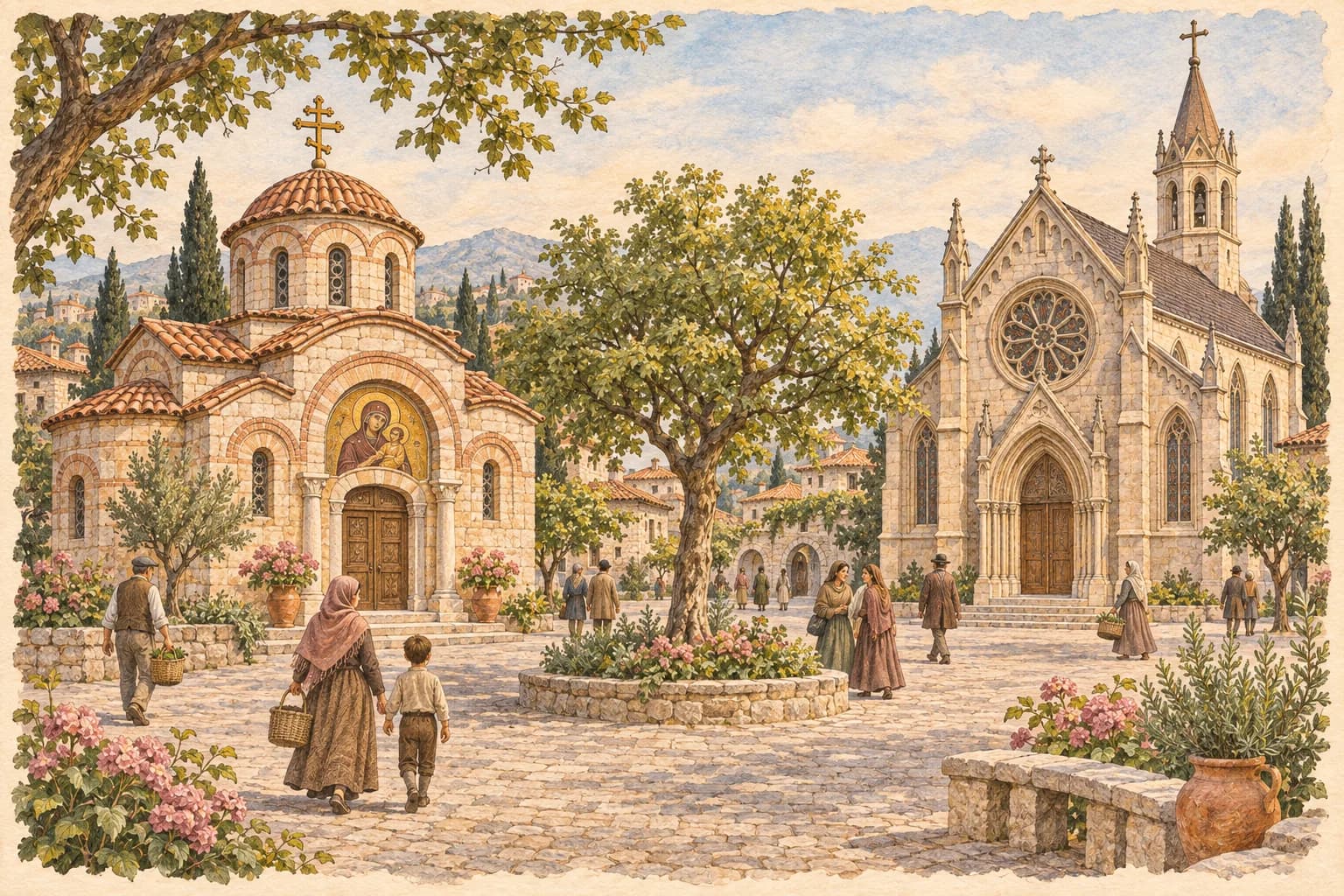
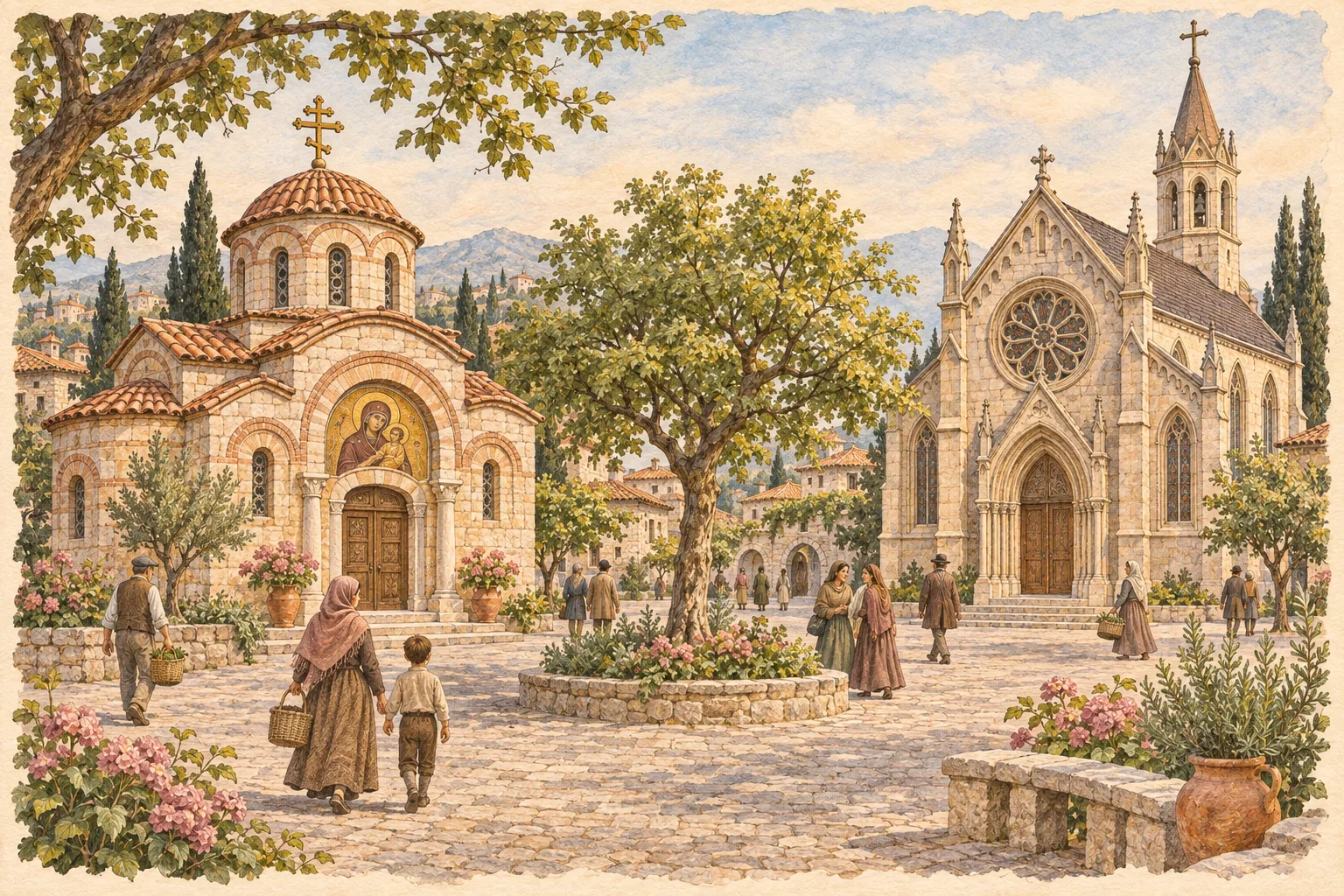
The main differences between Catholicism and Orthodoxy concern church authority and certain doctrines. They extend beyond calendars and church architecture. Both traditions confess Jesus Christ and the Holy Trinity, but they are not in full Eucharistic communion.
Significant issues include papal authority and the addition of the Filioque to the Western text of the Creed. The Orthodox Church does not accept universal papal jurisdiction as understood in Catholic teaching. Accurate comparison requires official formulations rather than second-hand polemics.
The direction of the sign of the cross and fasting practices are visible differences, but do not exhaust the subject. Not all Catholics use the Latin rite: there are Eastern Catholic Churches. Outward resemblance to Orthodox worship does not establish the same ecclesial affiliation.
If your question concerns marriage, baptism or attending a relative’s service, explain the particular situation to your priest. Respect for another tradition does not automatically imply permission to receive Communion there. Theological disagreement does not justify insulting believers.
What the two traditions share
Orthodox and Catholic Christians confess God as the Holy Trinity, recognise Jesus Christ as truly God and truly human, read Holy Scripture and preserve a sacramental understanding of church life. Both traditions venerate the Mother of God and the saints, maintain episcopal ministry and possess rich histories of worship. Listing differences without this common foundation can misleadingly suggest that two entirely unrelated religions are being compared.
Shared convictions do not, however, mean complete agreement on every issue. The separation has a history involving theological, ecclesiastical, political and cultural circumstances. The year 1054 is an important landmark, but it does not describe a single moment when every relationship ceased simultaneously. Relations between East and West developed over centuries, and individual events need to be read in their historical setting.
Papal primacy and conciliar governance
A central question concerns the position of the bishop of Rome. Catholic teaching about the papal office includes universal jurisdiction and a specific understanding of teaching infallibility. The latter does not mean that every everyday opinion expressed by a pope is considered incapable of error: it concerns doctrinal definitions under particular conditions. Exaggerating another tradition’s position makes the actual disagreement harder to understand.
Orthodoxy does not accept those powers in their Catholic sense. The local Orthodox Churches maintain conciliar governance and communion in faith and sacraments; a primacy of honour is not equivalent to universal administrative control. Questions of order and relationships between Churches also arise within Orthodoxy. Compare principles rather than idealising either side as if human conflicts never occurred within it.
The Filioque and other doctrinal questions
The Latin Filioque means “and the Son” and concerns a Western addition to the Creed’s wording about the procession of the Holy Spirit. The disagreement involves not merely translation but theological meaning and authority to alter a text received by the whole Church. A non-specialist can begin by reading the Creed, identifying the passage and then consulting a substantial ecclesiastical explanation.
Other comparative topics include Catholic dogmatic definitions concerning Mary’s Immaculate Conception, post-mortem purification and aspects of the understanding of original sin. Mary’s Immaculate Conception must not be confused with the virgin birth of Christ: these are different claims. A list of technical terms does not itself amount to understanding. Each needs an explanation of what the relevant tradition actually teaches and where the other tradition disagrees.
How differences affect ordinary life
A Catholic Mass in the Latin rite and an Orthodox Liturgy differ visibly in their forms of worship. Yet not all Catholics belong to the Latin rite, and local Orthodox customs also vary. Statements claiming that Catholics always do something in precisely one way need checking: music, calendars, worship language and architecture do not provide a complete definition of a tradition’s faith.
Attending relatives’ worship and participating in a sacrament are different actions. If an Orthodox Christian is invited to become a godparent in a Catholic community, enter an interchurch marriage or receive Communion at a family celebration, a general statement about shared Christianity cannot settle the matter. Clarify the ecclesiastical conditions beforehand. Respect for relatives can be expressed through family involvement, practical help and a calm explanation of religious commitments, without turning every encounter into an argument.
Three common mistakes in brief comparisons
The first mistake is treating a calendar date as the principal doctrinal difference. Orthodox Churches follow different calendar practices, and Catholic life is likewise not exhausted by one liturgical form. Celebrating a feast on the same or a different day does not, by itself, establish ecclesiastical unity. The second mistake is claiming that Catholics have no icons or veneration of saints. Forms of religious art differ, but that sweeping assertion is incorrect.
The third is explaining everything through married versus celibate clergy. Particular disciplinary norms govern Latin Catholic clergy, while Eastern Catholic traditions need separate consideration. Within Orthodoxy, married presbyters and monastic priests also coexist under the Church’s established order. One familiar priest cannot stand as a complete description of a tradition. For a brief explanation to a child, it is better to identify shared faith in Christ and one genuinely significant issue, such as the understanding of ecclesiastical authority, than to list several memorable but inaccurate everyday distinctions.
A question for reflection
Are you comparing doctrines or addressing a particular family situation?