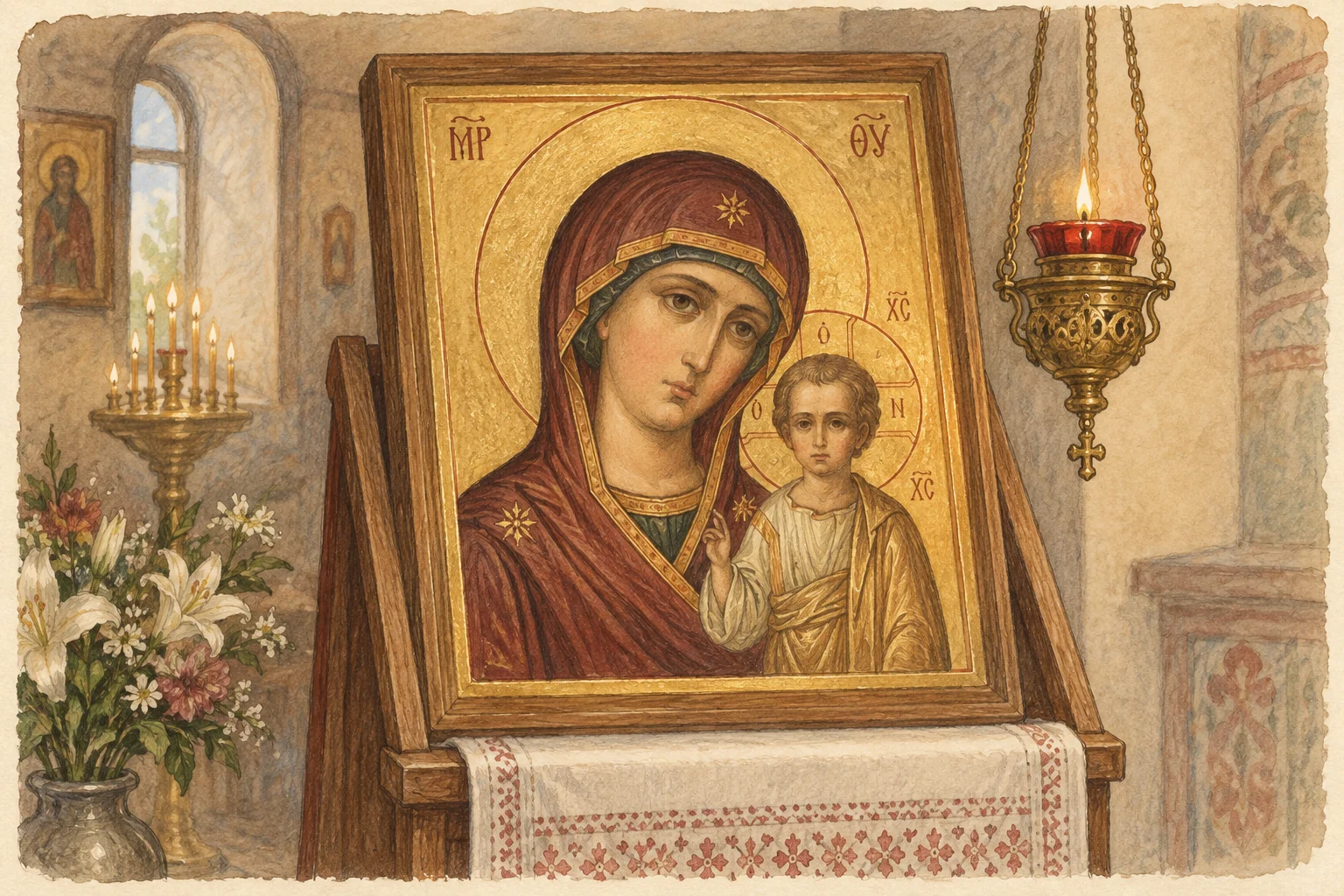
The Kazan icon is familiar even to many people who seldom enter an Orthodox church. Familiarity can obscure its central subject: the Mother of God with Jesus Christ. “Kazan” identifies a history and place of discovery. It does not mean that Mary is a separate local divinity or that only people connected with that city may ask for her prayers.
The Account of Its Discovery
The Church's account places the discovery in Kazan after the fire of 1579. According to the tradition, a girl named Matrona was shown where to look, and the image was found among the ruins. The priest Hermogenes, later Patriarch, participated in these events and subsequently wrote about them. This gives the account an identifiable historical setting rather than leaving it as an anonymous story.
Readers should distinguish the reported event, its interpretation within the Church, and individual testimonies of miracles. A testimony expresses gratitude for help received. It is not a promise that everyone making the same request will experience the same outcome. The history of an icon should not be turned into a technique for obtaining a particular result.
Recognising the Composition
The composition brings the faces of Mary and the blessing Christ Child close to the viewer. It is an intimate, abbreviated image rather than an extended historical scene. The inclination of the Mother's head directs attention towards her Son. Begin by looking at these figures and their relationship, rather than treating a precious metal covering as the image's principal meaning.
The same name is used for the historic icon and for icons painted after its model. Such a copy is not another historical original, but it can genuinely serve the Church's prayer. A label reading “Kazan” does not establish a panel's age, its former presence in a particular cathedral, or its association with a recorded miracle. Those claims require independent evidence.
Two Main Commemorations
In Russian churches following the Julian calendar, the principal civil dates are July 21 and November 4, corresponding to July 8 and October 22 on the church calendar. The summer observance remembers the discovery; the autumn observance is connected with Moscow's deliverance during the Time of Troubles in 1612. These are different occasions for thanksgiving, not celebrations of different mothers of Christ.
Other Orthodox calendars may print the July date without a thirteen-day adjustment. Check the calendar actually used by the parish before arranging a visit. A feast-day entry also does not establish the time of a local service: consult the parish schedule separately.
Remembering and Praying
Appropriate observance may include attending the Liturgy, reading the feast's hymn with an explanation of unfamiliar language, praying for loved ones, and giving thanks. Prayer before this image is not restricted to eyesight, marriage, or domestic concerns. Nor does an expensive icon make someone's prayer more valuable than prayer before a simple reproduction.
If your family has inherited an icon, record what is genuinely known about it: who passed it on, when it appeared, and what relatives remember. An honest modest history is better than an invented ancient pedigree. Do not scrub darkened paint or apply household cleaning products. Questions about preservation belong with a qualified conservator; a clean, convenient place and a reverent attitude are enough to begin praying at home.
A domestic icon need not reproduce a cathedral's elaborate metal covering. A legible image and clear identification matter more than decoration. Show a child Christ's blessing hand and explain that prayer addresses the living God.
A Family Icon and a Blessing
The Church's account of the Kazan icon notes its connection with family devotion and the blessing of couples entering marriage. This helps explain why an image may pass from parents to children. The custom does not make that particular icon a condition of marital happiness or replace the couple's freedom to decide. A family heirloom preserves relationships; it does not give older relatives authority over younger adults' choices.
When giving an inherited icon to a couple, tell them what is actually known: who received it, when it stood in the family home, and who passed it on. A short note can be kept with family records. Do not accompany the gift with a promise that disagreements are now impossible or insist on choosing its exact position in their home. Respect for the new household is itself part of caring for the family.
Distinguishing Icons with the Same Name
Accounts of the Kazan icon mention Kazan, Moscow, and Saint Petersburg. Before combining separate reports into one chronology, establish which image each report describes. A church's name, an icon's title, and a particular copy's history may overlap without being identical. News that a Kazan icon has been brought to a city does not by itself mean that the image described in another article has moved.
For a family album or parish note, an accurate caption is enough: where the photograph was taken, the image's name, and what is known about that copy. If its origin is unknown, do not borrow a famous icon's biography merely to make the story more impressive. Personal prayer can also leave a historical question open. Asking the Mother of Christ for her intercession does not depend on proving an uninterrupted chain of ownership for a wooden panel.