
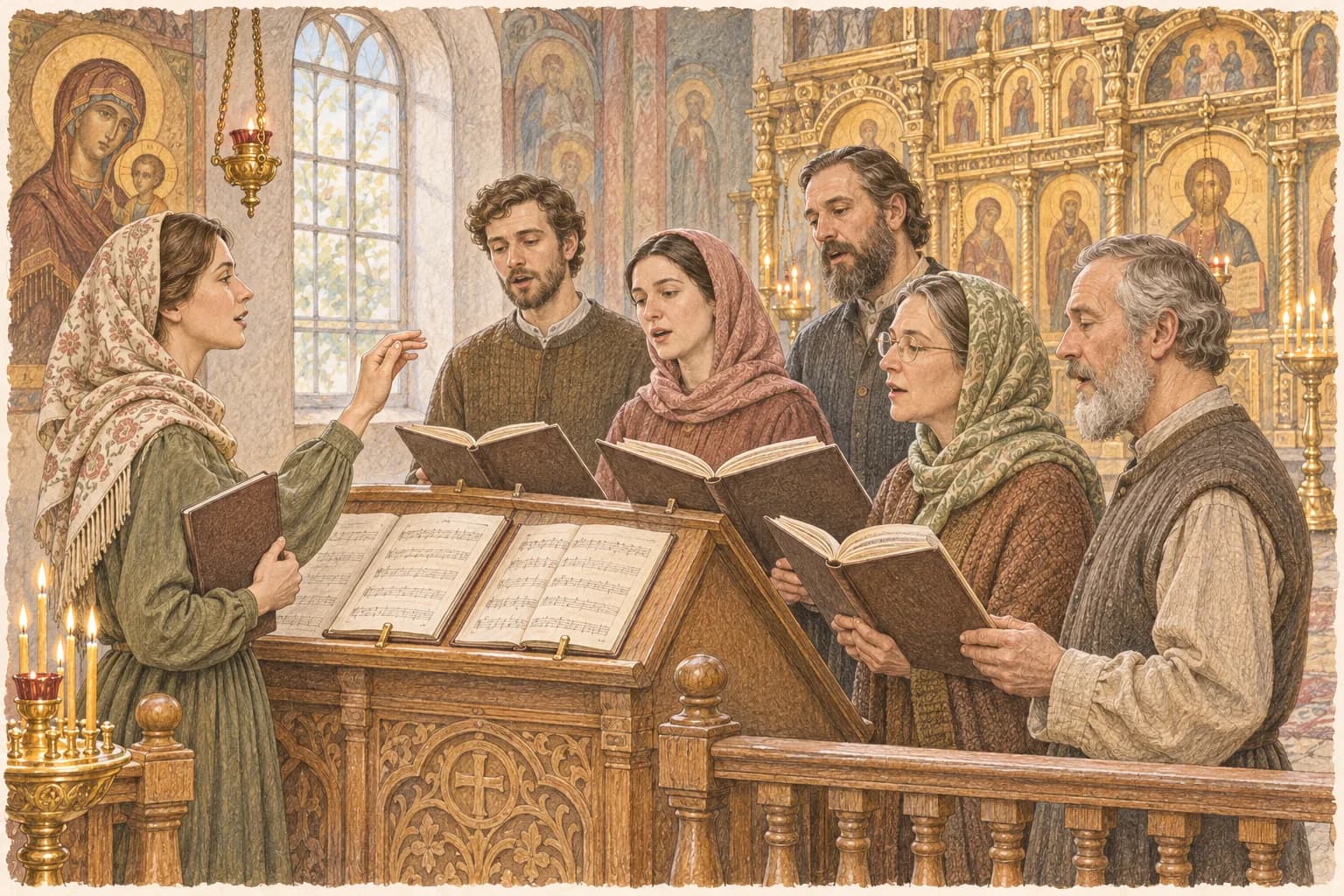
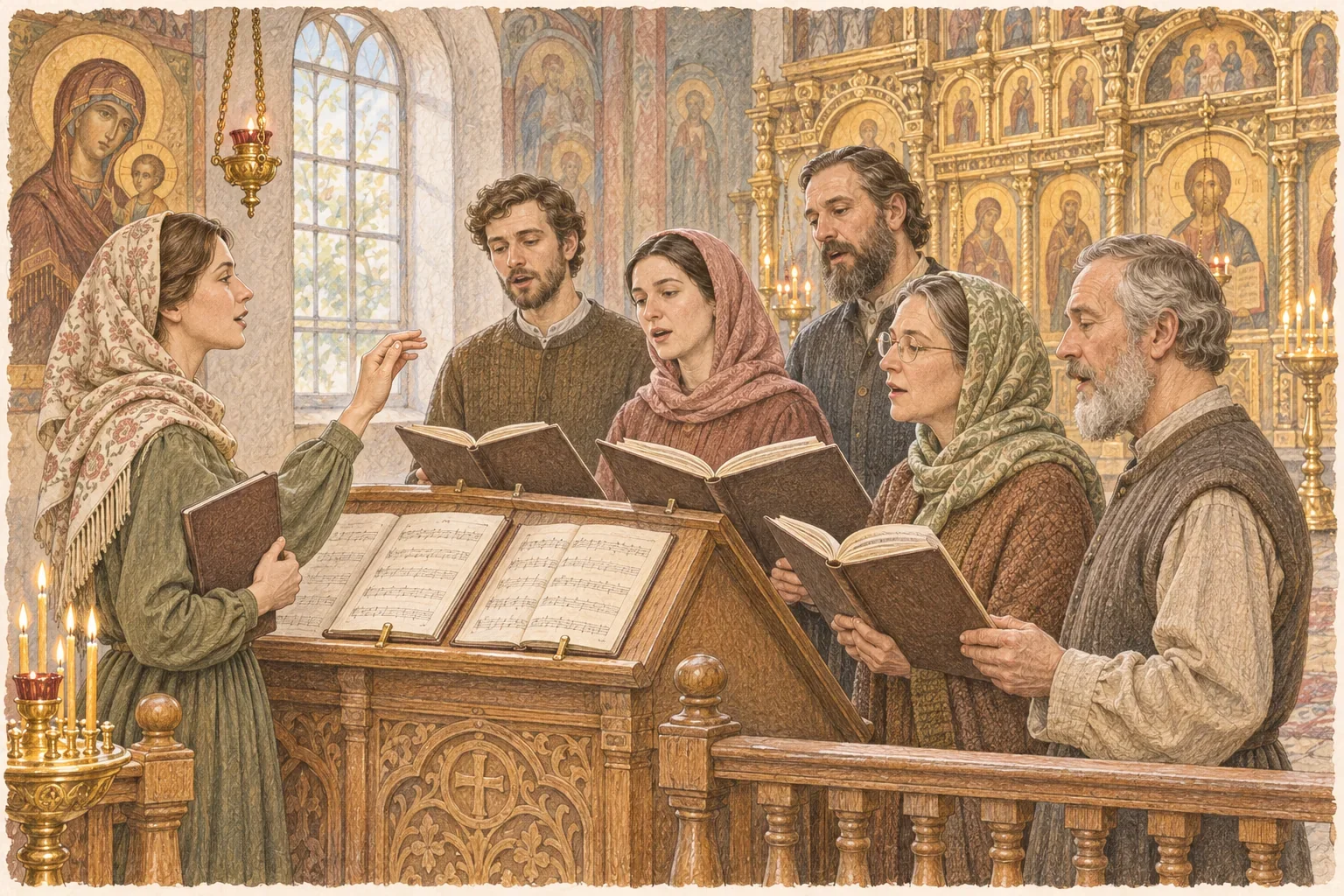
The kliros is the place in a church used by singers and readers; the word may also refer to the singing group. It is commonly near the front of the worship space. Its position depends on the building, so not every church choir stands in an identical location.
Singers respond to the clergy and sing liturgical texts in support of the congregation’s prayer. The work requires attention to the service, musical listening and cooperation. The choir director assigns parts and arranges participation, including preparation for new singers.
Wanting to sing does not give someone permission to take a choir place uninvited or drown out the singers. Equally, a choir need not be a club exclusively for professionals: opportunities to learn depend on the particular parish and cannot be promised on every church’s behalf.
After the service, ask the choir director about vacancies, rehearsals and requirements. Be honest about your experience and availability. Until participation is arranged, follow the parish’s custom for congregational singing rather than treating a service as an audition.
The choir’s place and purpose during worship
Kliros names the place occupied by singers and readers; in everyday speech it can also mean the group singing there. It is usually towards the front of the church, near the sanctuary, though architectural arrangements vary. In one church the choir stands to the side at floor level, while another provides a separate platform. Location alone does not establish the quality or ecclesiastical propriety of the singing.
The choir participates in the shared worship: responding to liturgical exclamations, singing hymns and helping the congregation follow the prayerful movement of the service. Musical beauty serves that purpose. If singing becomes a display of voices and the words cannot be understood, it becomes harder for visitors to pray with the community. Choir work therefore involves musical hearing, attention to language and a sense of proportion together.
What the choir director does
The choir director coordinates the singing: choosing suitable musical settings within the liturgical order, assigning parts, giving entries and keeping the ensemble together. The work takes account of available singers, the building’s acoustics and the particular service. Even a hymn that sounds simple requires a coordinated beginning, clear words, breathing and ending.
The work does not start only when the service begins. Rehearsals allow singers to learn parts, improve pronunciation and identify changes in the text. On the kliros, listening to the director and neighbouring voices matters more than singing a familiar version over everyone else. A strong solo voice does not automatically confer ensemble skills: singers must hold their own part while hearing the combined sound.
Can someone join without formal musical training?
That depends on the choir’s composition and responsibilities. Some communities teach beginners gradually, while others currently need singers who can read music confidently and hold a part independently. Speak with the director first about your experience, range, rehearsal availability and ability to attend regularly. An audition helps establish a starting point; it does not measure a person’s worth before God.
Do not simply step into the choir during a service. An unfamiliar voice can disrupt balance, and someone who does not know the order may miss an entry or begin a different text. Beginners benefit from listening, learning shorter responses and practising at rehearsals. If the main choir has no vacancy, there may be a training group, congregational singing or another way to participate in parish life.
Why singers need books and liturgical knowledge
Worship combines fixed texts with texts that change. A choir cannot learn one collection of tunes and use it identically throughout the year. The weekday, feast, fasting season and service type affect which hymns are sung. Musical literacy therefore goes together with the ability to use liturgical books and follow the prepared order.
For a beginner, this resembles reading a complex work with several guides: knowing the words is not enough without knowing where each passage belongs. First learn the broad sequence of the Liturgy or evening service, then study the notation and headings used by the choir. Questions are best settled at rehearsal. During worship, a brief prompt from an experienced singer is more appropriate than a long conversation on the kliros.
How a parishioner can participate
Where a parish invites everyone to sing particular prayers, join at a moderate volume and follow the shared pace. There is no need to overpower the choir or impose another melody on those nearby. In an unfamiliar church, listen first and observe the local practice. Participation in prayer is not limited to producing one’s own sound: attentive listening is also participation.
Love of church music can begin a serious commitment, but does not require immediately joining the kliros. Regular attendance, punctuality and willingness to learn often matter as much as an attractive voice. Giving advance notice of absence, preparing a difficult passage and accepting correction are concrete ways of caring for shared worship. They make the choir dependable and support the whole congregation.
A question for reflection
Are you ready for regular rehearsal and teamwork, rather than only singing favourite pieces?