
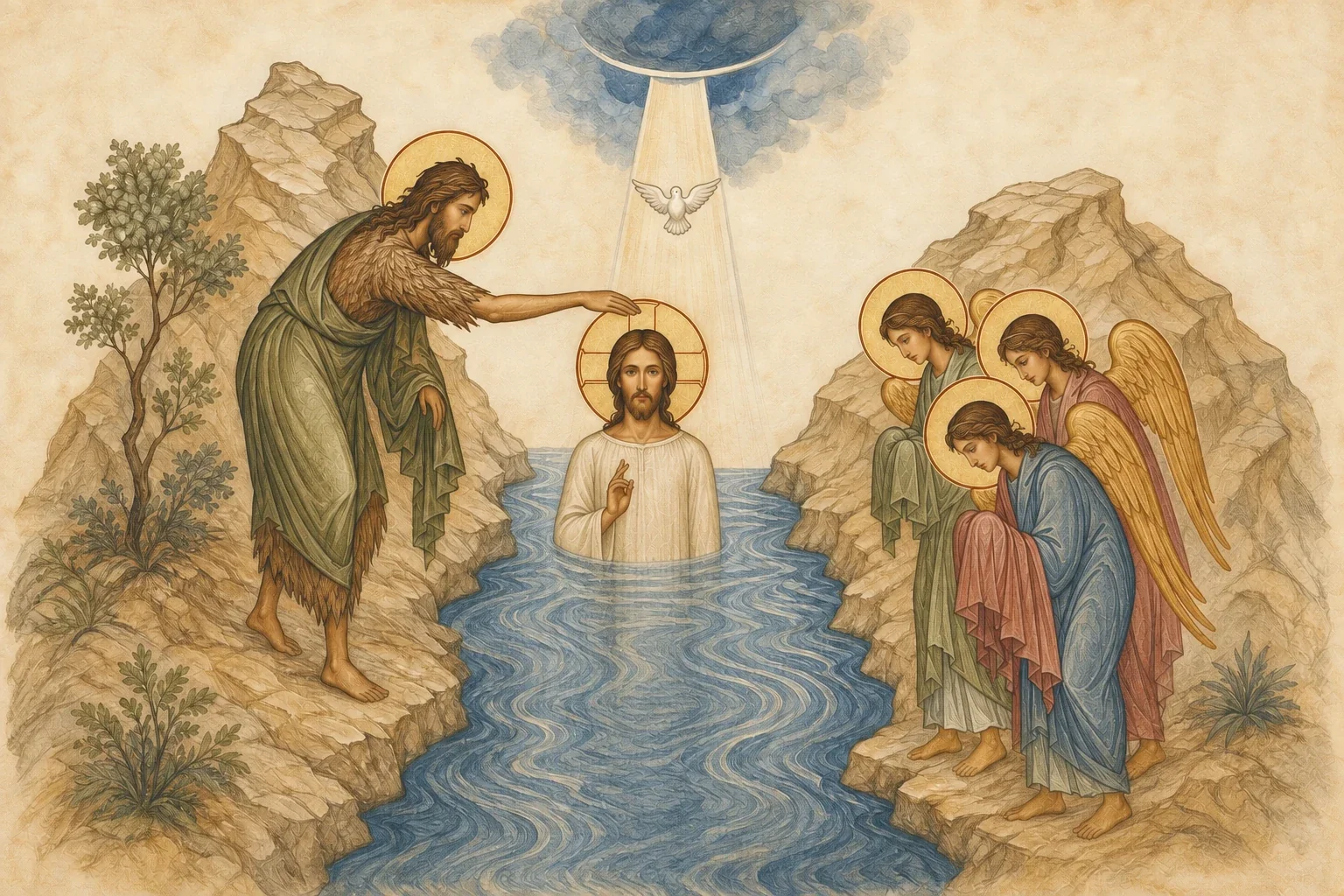
The Baptism of the Lord, or Theophany, is the Great Feast celebrated on January 19 in the Russian Orthodox calendar, remembering Christ’s Baptism by John in the Jordan and the manifestation of the Holy Trinity. The Father’s voice is heard, the Son stands in the water, and the Holy Spirit descends in the form of a dove.
The feast is not centered on winter immersion or storing water for a year. Christ enters the Jordan not because He needs repentance but to fulfill righteousness, sanctify creation, and reveal the path of Christian Baptism.
Why it is called the Baptism of the Lord
John the Forerunner baptized people as a sign of repentance. The sinless Christ stands among sinners and receives baptism not for His own cleansing but at the beginning of His public ministry and humanity’s salvation.
The word baptism is connected with immersion. The Gospel event in the Jordan is not identical to the Christian Mystery of Baptism, but it reveals its meaning and presents water as an image of new life.
Why the feast is also called Theophany
The action of the three Persons of the one God is manifested: the Father bears witness to the Son, the Son receives Baptism, and the Spirit descends. The feast therefore reveals the Church’s faith in the Holy Trinity with particular clarity.
God is not revealed as an abstract idea. Revelation calls people to hear the Son and enter a communion of love rather than merely memorize a theological formula.
What the Gospels describe
All four Gospels bear witness to Christ’s Baptism. John initially hesitates because he understands his own need, but the Lord answers that all righteousness must be fulfilled.
After Christ comes from the water, the heavens open and the Father’s testimony is heard. The event begins the public ministry that leads through temptation, preaching, the Cross, and Resurrection.
Reading the icon of Theophany
Christ stands within the narrow stream of the Jordan as though entering the dark depth of the world. John bends from one bank, angels wait on the other, and a ray from above indicates the action of the Spirit.
Small symbolic figures of the river and sea sometimes appear according to the Psalms. They are poetic images, not water spirits and not an invitation to pagan interpretation.
The date and the Eve of Theophany
The Russian Orthodox Church celebrates Theophany on civil January 19; January 18 is the Eve and an appointed strict fast day.
If the civil date differs in another Orthodox country, the reason is normally the calendar system. Check the jurisdiction instead of accusing another community of celebrating the wrong Baptism.
How the services unfold
The Eve includes special Hours, Vespers, and Liturgy in an order that depends on the weekday. A vigil is celebrated before the feast, followed by the festal Liturgy on January 19.
The Great Blessing of Water follows worship. Consult the parish schedule for the exact distribution time and any local procession.
Why water is blessed on both January 18 and 19
The same rite of the Great Blessing is celebrated on the Eve and on the feast. There is no church foundation for calling one water “Eve water,” the other “Baptism water,” and assigning different powers.
Choose an accessible service without panic. There is no need to collect two magical supplies from the two days.
What is the Great Agiasma?
The Greek-derived word agiasma means a holy thing. It is used for water of the Great Blessing at Theophany. The Church prays for the sanctification of waters and gives thanks for the created world.
Holy water is neither a chemically different substance nor an autonomous medicine. It is received in faith and prayer as a gift directing the person toward God.
How does it differ from other holy water?
The Lesser Blessing of Water may be celebrated through the year, while Theophany uses the Great Blessing. The liturgical rite and place in the calendar differ, but it is mistaken to rank “weak” and “strong” water as grades of magical energy.
Our practical guide explains how to keep and receive holy water at home.
How holy water is received
It is commonly taken in a small amount in the morning before food, with prayer and often with blessed bread. Taking it fasting is a pious custom rather than a prohibition against receiving it at another time during illness or need.
A small amount is not less holy than a full glass. Do not calculate a dosage or expect an automatic solution to a problem.
Storing it at home
Use a clean, closed, labeled container near the icons or in another clean and quiet place. A refrigerator is acceptable when it is convenient and safe.
Do not store it among household chemicals or in direct sunlight. Reverence appears through care, not an expensive vessel.
May holy water be diluted?
A pious custom allows a small amount of blessed water to be added prayerfully to clean ordinary water. This helps a household share it; it is not a laboratory multiplication of power.
Collect a reasonable quantity and return to church when needed rather than storing many liters until they deteriorate.
If the water changes or spoils
Holy water remains material water and may change in odor or appearance when a vessel is contaminated. Do not drink questionable liquid and do not interpret the change as a prediction of disaster.
Pour it into a clean place that is not walked upon, such as beneath a tree, or ask the parish. Wash the container thoroughly.
Is all water on earth blessed?
Liturgical texts speak about the sanctification of the waters and creation, but this does not mean that every household tap has automatically undergone the parish rite at midnight.
The priest blesses water prepared in a particular service. A theological image of renewed creation must not become a household trick tied to the clock.
May a home be sprinkled?
A family may prayerfully sprinkle rooms and ask God’s blessing. This is not a mechanical removal of every problem and does not replace a priest’s blessing of a home when that is desired.
Do not sprinkle people against their will, electronics, or objects that may be damaged. Reverence does not cancel respect and common sense.
Winter immersion is not a sacrament
Immersion in an outdoor ice hole is a popular custom, not a church obligation. It does not wash away sins or replace Baptism, Confession, Liturgy, and a changed life.
Cold water can cause vascular spasm, dangerous heart rhythm, and drowning. Never immerse without medical assessment, sobriety, a supervised location, and rescuers. A child must not be plunged for a photograph or adult pressure.
What truly cleanses sin?
A person receives new life in the Mystery of Baptism and, after Baptism, returns to God through repentance and Confession. Theophany water supports prayer but does not act instead of a free turn of the heart.
If conscience is burdened, do not seek an extreme plunge. Arrange a conversation or Confession through the parish contact page.
Holy Communion on the feast
The summit remains the Divine Liturgy and Eucharist, not the line at a water tap. A communicant prepares through prayer, the Eucharistic fast, repentance, and parish order.
Do not leave immediately after obtaining a bottle when you can remain in prayer. Do not push in the crowd; the holy gift will not disappear because you gave way to an older person.
Explaining Theophany to a child
Offer three simple points: Christ entered the Jordan, the Trinity was manifested, and the water recalls the child’s own Baptism. Look at the icon and identify the Father’s voice, the Son, and the Spirit’s action without trying to depict invisible God literally.
Give the child a small labeled bottle and teach calm reverence. Do not threaten illness over an accidental drop and never force immersion in icy water.
Mercy and care for creation
Blessing water reminds us that nature is a gift rather than an endless resource. Leave no plastic at a spring, do not pollute a river, and take only what will be used.
Help an older neighbor carry a small container or share yours. A line for a holy gift becomes Christian when it makes room for someone weak.
Common questions
Which water is stronger, January 18 or 19?
Neither. The same rite of the Great Blessing is celebrated on both days; ranking the water has no church foundation.
Must it always be taken before food?
That is the usual pious practice. During illness or need, holy water may be received at another time with prayer.
Does ice-hole immersion remove sins?
No. Sin is overcome through repentance and life in Christ, not exposure to cold.
May an unbaptized person receive holy water?
It may be offered with a respectful explanation if the person wishes. Never use it secretly or impose it.
What if holy water spills?
Clean it calmly and, when possible, pour the remainder into a clean place. An accident is not a sign of punishment.
The essential point
Theophany reveals the Holy Trinity and shows Christ entering the waters for the salvation of the world. Blessed water witnesses to God’s sanctification of creation.
Participate in the Liturgy, receive the Great Agiasma prayerfully, reject superstition, and protect health. The feast calls for renewal of the life begun in Baptism, not a record in icy water.