
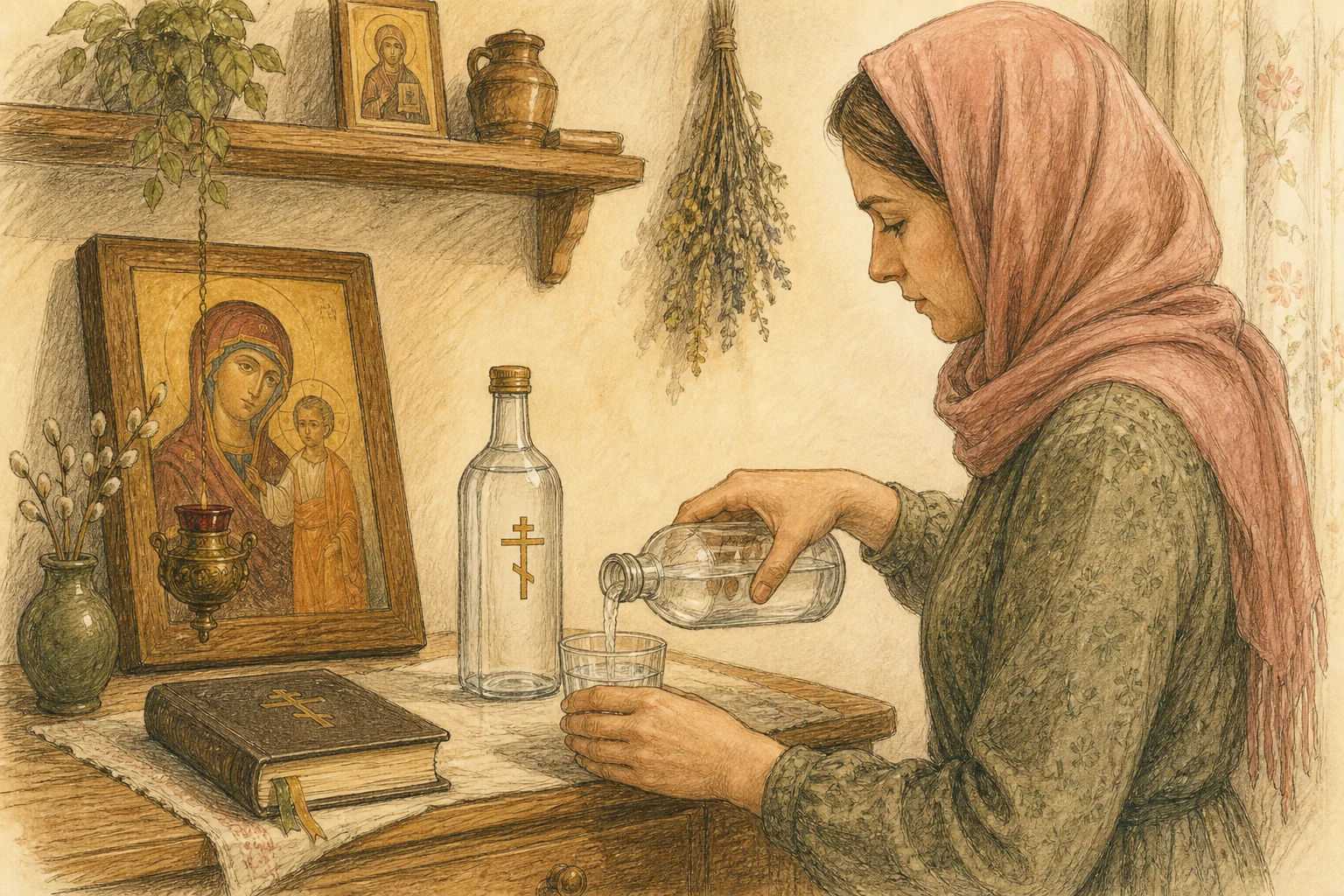
Holy water should be kept in a clean, closed container, commonly near the home icons and away from heat and direct sunlight. It is received with prayer and reverence, often in the morning before food, but illness, necessary medication, and other circumstances do not turn the time into an absolute prohibition. Holy water neither replaces treatment nor works as a magical substance.
There is no need to collect dozens of liters. A small amount used thoughtfully by the household is sufficient.
What the Church calls holy water
It is ordinary water over which the Church has celebrated a rite of blessing and prayed for God’s grace. The Great Blessing of Waters is celebrated at Theophany; a Lesser Blessing may be celebrated at other times of the year.
Divine grace is not a chemical additive that can be measured. The water becomes a holy gift within the life of prayer while retaining the physical properties of water and requiring clean storage.
Theophany water and water from a lesser blessing
The Great and Lesser Blessings have different liturgical rites and places in the Church year. Water blessed in either service is received with faith and reverence. It should not become a competition over which water is “stronger” or which problem each one solves.
If the parish gives particular guidance regarding Theophany water, follow it without condemning another community. The time of a blessing service can be checked on the schedule page.
What container should be used?
A clean glass bottle or good food-grade plastic container with a secure cap is suitable. Wash and rinse it well before filling so that no smell of a previous beverage or detergent remains.
Label the container plainly so that no one accidentally uses it for a household purpose. Avoid a bottle formerly used for alcohol and any vessel that cannot be cleaned thoroughly.
Where to store holy water
A home prayer corner or a clean closed cabinet nearby is convenient. Our guide to arranging icons at home explains how to make such a place without unnecessary complexity.
Avoid a radiator, a bright sunny windowsill, dampness, and access by young children. Refrigeration is acceptable if the home is hot and it preserves the water better; cooling the bottle is not disrespectful.
How to drink holy water
Pour a small amount into a clean glass, make the sign of the Cross, and say a brief prayer. Drink peacefully, remembering that you ask for the sanctification of life, help in resisting sin, and strengthening in faith.
A widespread custom is to receive holy water in the morning before eating. This distinguishes the sacred gift from ordinary consumption, but it should not cause necessary help to be withheld from someone who is ill.
May it be taken after food?
Yes, when there is a real need, such as illness, distress, travel, or another circumstance. Reverence is not determined only by an empty stomach. Do not postpone prayer because you fear violating a household sequence.
For regular practice, follow the order accepted in your family or parish. If a particular case troubles your conscience, ask a priest rather than collecting dozens of contradictory rules online.
Holy water and medicine
Take prescribed medicine according to the clinician’s instructions. A tablet may be taken with ordinary water, and holy water may be received separately with prayer. Never reduce a dose, cancel a medication, or delay medical care in the hope of relying only on a sacred gift.
A Christian asks God to bless treatment, the healthcare team, and the patient’s own efforts. Spiritual and medical care do not compete.
May children drink it?
A child may receive a small amount while being told simply that it is a holy gift associated with the prayer of the Church. Do not force a child to drink or turn the water into a punishment or test of obedience.
For an infant or a child with health needs, follow ordinary medical requirements concerning hydration and cleanliness. The sacred character of the water does not cancel safety.
How to sprinkle the home
A layperson may sprinkle rooms with holy water while praying, especially after cleaning, on a feast, or at the beginning of life in a new home. Do this peacefully, without imagining every drop as a protective barrier.
The full blessing of a home is celebrated by a priest with an appointed rite. Personal sprinkling does not replace it. A visit can be discussed through the parish contact page.
May holy water be added to ordinary drinking water?
Orthodox household custom sometimes adds a small quantity to clean drinking water when necessary. This should not become a formula for endless “multiplication,” followed by careless treatment of what results.
If you intend to use the custom regularly, ask about parish practice. It is simpler to collect a reasonable amount and use it with prayer.
Why holy water can spoil
Water may become cloudy or develop an odor because of a contaminated container, heat, light, or microorganisms. Spoilage does not prove a spiritual disaster and is not automatically evidence that someone has sinned.
Do not drink water with a suspicious smell, sediment, or altered appearance. Wash the vessel and use ordinary clean storage next time.
What to do with spoiled or excess water
Pour it reverently onto a clean place that is not walked upon, such as soil beneath a plant. Avoid pouring it down a household drain with waste when a respectful alternative is available.
A large amount or an unidentified old container can be brought to the parish for advice. Do not keep spoiled water for years out of fear.
If some is spilled accidentally
Wipe it with a clean cloth, put the surface in order, and, where practical, allow the cloth to dry before respectful disposal. There is no need to expect punishment or repeatedly bless the area.
An accident is different from deliberate contempt. Reverence appears in calm care, not panic.
What holy water should never become
Do not use it for fortune-telling, removing a supposed curse, controlling another person, or testing a room for evil. Do not sell it or promise a cure. Never put it secretly into another person’s drink.
Faith cannot be measured by the volume consumed or the number of years a bottle remains unchanged. Holy water directs a person toward repentance, prayer, the Eucharist, and works of love.
Environmental and practical care
Bring a reusable clean bottle rather than many disposable containers. Take only what the household can use. At a crowded distribution, leave room for elderly and disabled people and avoid spilling water on a slippery floor.
Reverence includes care for neighbors and creation. Accumulating more than needed while another person waits is contrary to the meaning of a shared Church gift.
Holy water and participation in Church life
Receiving water at home does not replace worship and the sacraments. A blessing of waters is the common prayer of the Church; the bottle at home recalls that prayer and calls us to continue it in daily life.
When coming to collect water, bring a modest clean container, avoid crowding, and help someone who needs assistance. Reverence is also visible in how we treat the person beside us.
Frequently asked questions
May holy water be boiled?
It is normally unnecessary. When the physical quality is doubtful, it is safer not to drink the water and to pour it out reverently rather than attempting to restore it.
May it be used for cooking?
Holy water is normally received separately in a small amount. There is no need to treat it as an ordinary cooking supply.
Does it have an expiration date?
There is no fixed ecclesiastical expiration date, but assess the water’s actual condition and storage. Do not drink water that has changed.
May I take some for a relative who does not believe?
You may offer it respectfully and explain the meaning, but never administer it secretly or use it to pressure someone into faith.
May I swallow tablets with holy water?
You may do so reverently, though there is no practical requirement. Follow the medical plan and do not attribute automatic effects to the water.
A short reminder
Use a clean closed bottle, keep it cool and away from direct sunlight, receive a small amount with prayer, expect no magic, and never abandon treatment. Do not drink spoiled water; pour it onto a clean place.
If a particular situation remains unclear, use our contact page. A holy gift is given not for fear and accumulation but for a grateful life with God.