

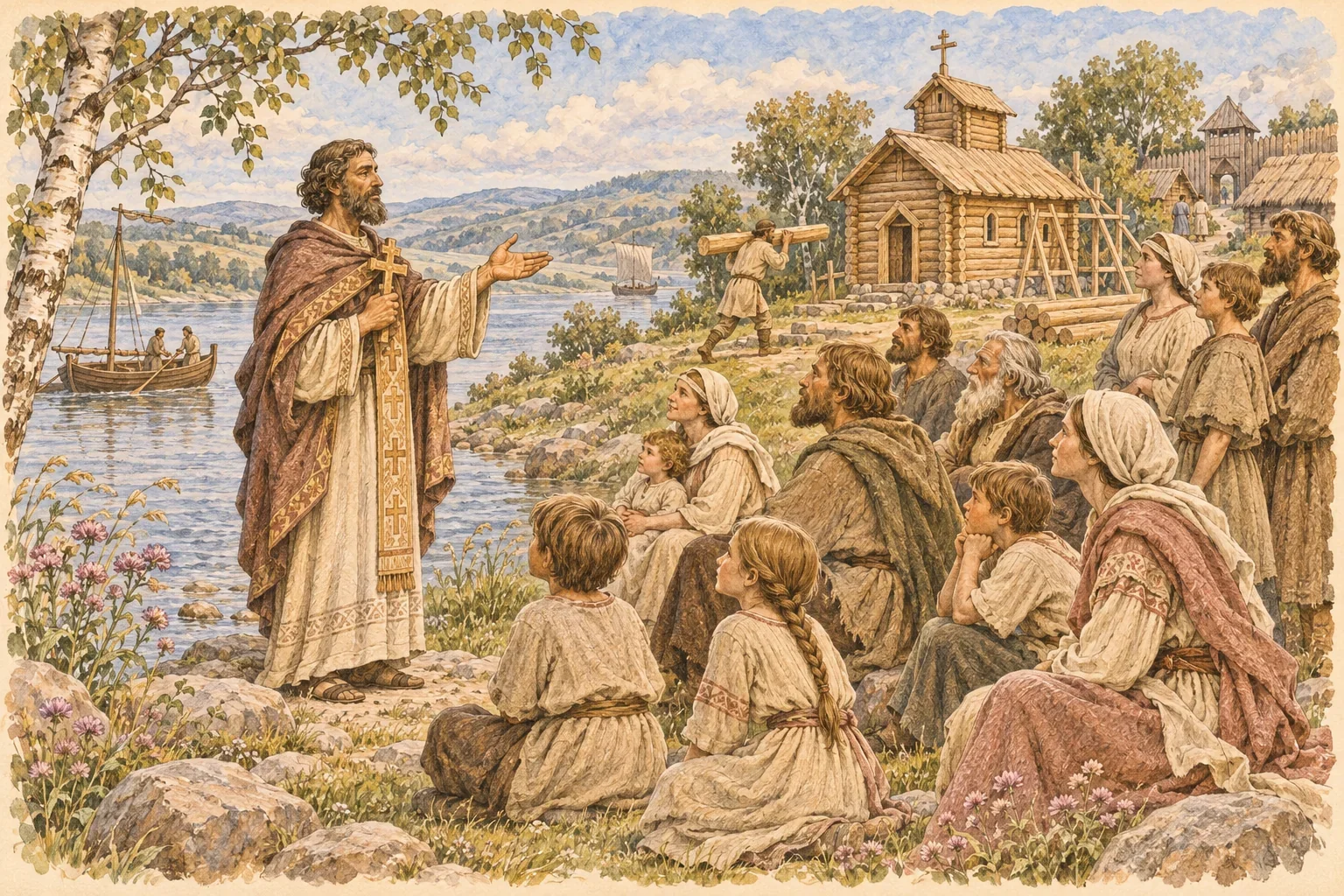
The Baptism of Rus is traditionally associated with Prince Vladimir and 988. This marks a major stage, not Christianity’s first appearance everywhere on a single day. Christians existed beforehand, and church life continued developing afterwards.
Sources recount the princely decision, Baptism and the formation of communities. A chronicle and modern historical investigation have different purposes. Attentive reading considers evidence, provenance and questions that remain unsettled.
Ancient Rus cannot automatically be equated with one modern state. Formal reception of faith also did not instantly erase earlier customs. Christianisation is more complex than a political slogan or a line in a school timeline.
Begin with the sequence and the significance of receiving Christianity, then compare responsible accounts. Distinguish historical knowledge from claims of modern national superiority. A church reader can also ask how faith becomes lived practice.
What the traditional date of 988 signifies
In ecclesiastical and historical memory, 988 is associated with Prince Vladimir and the baptism of the people of Kyiv. It is a conventional landmark in a much larger process, not the date on which every inhabitant of an extensive territory changed religion simultaneously. Christian communities existed in Rus earlier, and different towns and regions adopted the new faith in different circumstances. Saying that there were no Christians at all before 988 is therefore incorrect.
The princely decision had to be followed by churches, clergy, liturgical books and instruction. Habits and inherited ideas did not vanish in a day. Recognising this does not diminish the event; it reveals the scale of the transformation. Political decision, social reception and personal conversion are connected but distinct levels of history, each with its own circumstances and pace.
Princess Olga and Christianity before Vladimir
Princess Olga’s baptism demonstrates a Christian presence in the ruling circle before the broader conversion associated with Vladimir. Commercial and diplomatic contacts with Byzantium also brought encounters with Christianity. However, the personal baptism of a ruler did not immediately mean the baptism of every subject or automatic agreement from the next generation of the princely family.
This background prevents an oversimplified picture of a completely unfamiliar religion arriving through one unexpected decree. At the same time, it does not mean society was already entirely Christian by Vladimir’s time and merely needed a new label. Historians distinguish evidence for individual Christians, communities, diplomatic relationships and governmental support for the Church. These are different kinds of evidence, not interchangeable proofs of one fact.
How to approach the chronicle account
Chronicle accounts of the choice of faith, embassies and events surrounding the baptism preserve important historical memory and theological interpretation. They belong to a particular literary genre and are not modern recordings of negotiations. Extended speeches should therefore not be presented without qualification as word-for-word transcripts. Assessing details requires attention to when a text was composed, its sources and its author’s purpose.
The Church honours Vladimir as Equal-to-the-Apostles because of the spread of Christianity, not because every action before his conversion is declared exemplary. The transformation of life itself matters in the hagiographic narrative. A reader can respect ecclesial memory while distinguishing degrees of historical certainty in particular details. Neither task requires reducing the past to an accusatory slogan or an unconditional idealisation of political power.
Changes associated with the reception of Christianity
Christianisation is associated with the development of ecclesiastical writing, translated literature, church architecture, icon painting and charitable practices. Worship and the calendar shaped public rhythms, while Christian understandings of the person influenced moral and legal discussions. These developments were gradual and did not eliminate conflicts between the proclaimed ideal and everyday reality.
Useful historical questions are concrete: where early churches appeared, how books circulated, who trained clergy and what evidence survives about communities. This produces a more substantial enquiry than arguing over which modern nation can exclusively claim a medieval inheritance. Commemorating the baptism of Rus also invites a personal question: whether baptism remains only a family anniversary or shapes one’s prayer, choices and treatment of other people.
Organising further reading about the event
Begin with a short chronological overview so that Olga, Vladimir and later developments in church life are not conflated. Then read the chronicle account in an edition with explanatory notes. Commentary helps identify people and places, understand the literary manner of presentation and see where scholarly disagreements exist. After that, a focused study of early churches or the circulation of books can deepen the picture.
When comparing texts, notice the task each author is undertaking. Liturgical commemoration celebrates the event’s ecclesial significance, a textbook provides an overview, and historical research discusses sources and arguments. These are different genres and should not all be expected to offer the same form of demonstration. If a popular article says that historians have established something conclusively, look for the documents or studies it names. Missing references do not automatically make a statement false, but a confident tone alone does not make it verified. This reading method is especially helpful in a subject where religious memory often appears alongside present-day political interests.
A question for reflection
What happened around the commemorated date, and what developed gradually afterwards?