
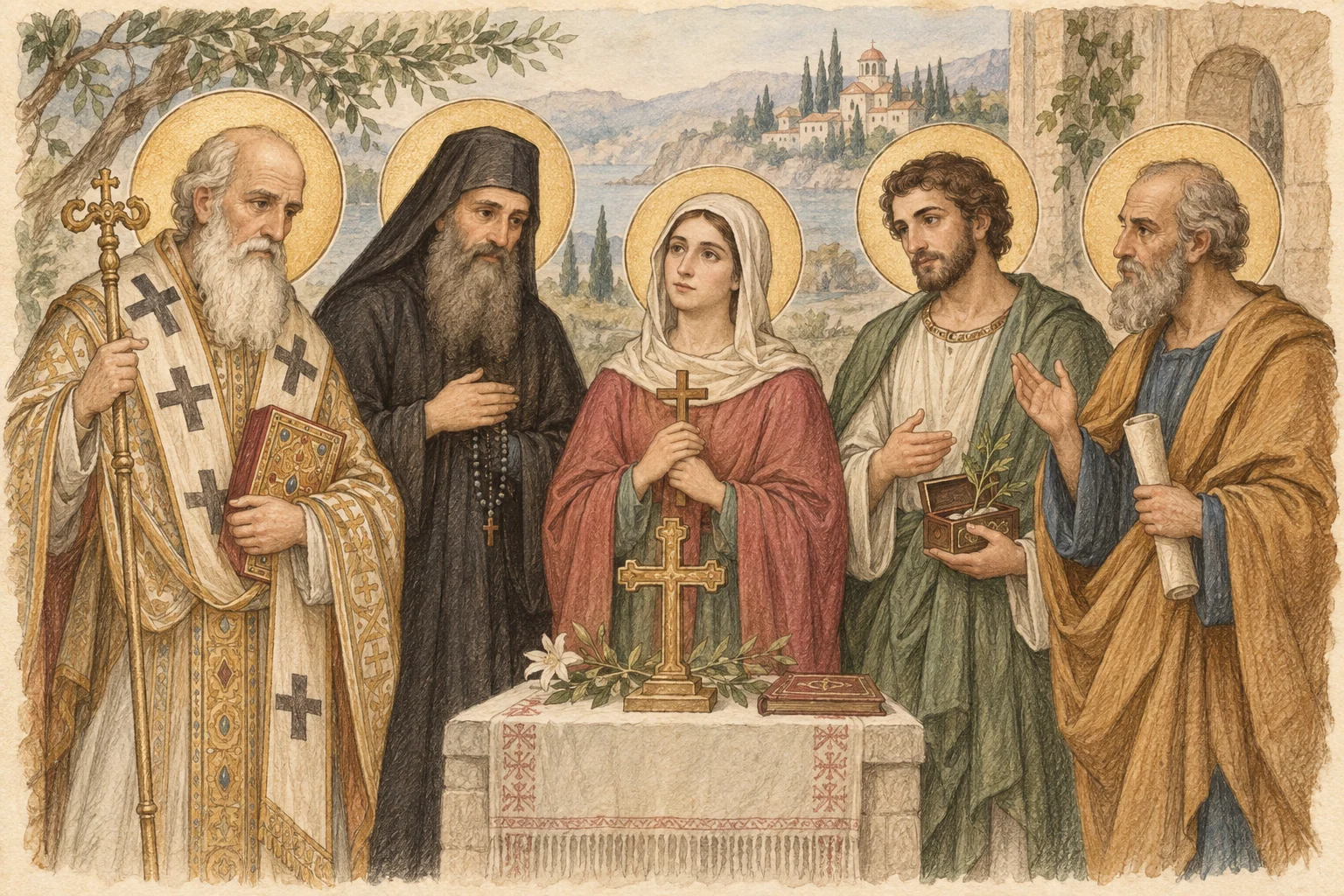
In the Orthodox calendar, All Saints is the Sunday immediately after Pentecost. The Russian liturgical word often translated literally as “week” here means Sunday, not a seven-day period. The feast honours all who have pleased God, both those known by name and those whose holiness is known to God alone. Its date moves with the Paschal cycle.
Why After Pentecost?
Its place in the calendar connects the gift of the Holy Spirit with the transformation of human life. After commemorating the Spirit's descent, the Church remembers people in whom that gift bore fruit. Holiness is therefore more than an unusual natural talent, a particular temperament, or an impeccable social reputation.
Yet a saint does not become an impersonal instrument. Different lives matter: witness may take the form of martyrdom, pastoral responsibility, monastic commitment, or fidelity within a household. A common source does not erase personal identity. Otherwise the saints would become a collection of identical ideal biographies unlike anything encountered in actual history.
Who Is Remembered?
Apostles, prophets, martyrs, hierarchs, monastics, and righteous people are honoured together. These terms describe forms of service, not a ranking of human worth. A hierarch served as a bishop; a monastic saint is recognised through a monastic life. Righteousness is not confined within monastery walls. The common celebration embraces different centuries and peoples.
Remembering unnamed saints also acknowledges the limits of our knowledge. There is no complete biographical archive of everyone faithful to God. This does not authorise an individual to declare any deceased person publicly canonised. Hope in divine mercy and formally established veneration belong to different aspects of the Church's life.
The Following Sunday
Russian practice dedicates the second Sunday after Pentecost to all saints who shone forth in the Russian land. The first Sunday concerns the whole Church without national limitation. These observances do not replace each other. A particular historical memory belongs within the universal one, rather than establishing a separate salvation for a single people.
If another Orthodox parish lists saints of its country or local Church on the following Sunday, that need not be an error. Regional commemorations may have their own dates. Read the day's full title rather than identifying a service solely by the familiar words “all saints.”
A Personal Response
Choose one life to read instead of trying to scan hundreds of names in an evening. Notice concrete choices: whom the person helped, what they relinquished, and how they carried responsibility. There is no need to imitate literally a monastic discipline or circumstances of martyrdom absent from your own life. Imitation requires discernment rather than copying an outward form.
Remember the saint whose name you bear and give thanks for people who introduced you to faith. A quiet act of kindness without an audience can continue the feast meaningfully. Public celebration of the saints does not diminish an unnoticed life. It leaves room for those about whom no book was written, but whose faithfulness is known to God. The invitation concerns faithfulness today, not an ambition to appear flawless at some imagined future moment.
If a saint's life seems remote, look for a recognisable human choice rather than matching occupations or centuries. Care for the vulnerable, honesty, and fidelity to a promise can connect very different circumstances without forcing a comparison.
A Saint's Life, History, and Imitation
When reading a saint's life, first identify the person and the period. A brief calendar entry may not explain every circumstance behind an action. If an episode is puzzling, neither reject the entire account immediately nor turn one sentence into an instruction for your household. Compare a fuller life and bring the difficult question to a parish conversation. A short summary is an introduction, not necessarily an answer to every historical or pastoral question.
Imitation does not require creating artificial danger. An account of steadfastness before persecutors is not advice to provoke conflict, and a story of generosity does not authorise giving away someone else's property. First name the good involved: faithfulness, mercy, or honesty. Then consider how it could take shape in circumstances for which you are responsible. Discernment belongs between admiration and action; copying the outward form is not always the faithful response.
Why Unnamed Lives Matter
The common commemoration helps us avoid measuring a life only by its public recognition. Someone can spend years caring for a relative without leaving a widely known story. This is not a reason to declare the person canonised, but it is a reason not to mistake obscurity for fruitlessness. A family can give thanks for particular kindness received without assembling an immaculate portrait of someone who has died.
Nor must an ordinary life be treated as an obstacle to faithfulness. Raising a child, working honestly, and keeping a promise are not less real because they do not resemble the pages of a heroic account. Familiar work, however, does not automatically make every way of doing it good. The question of how we treat people remains. Both romanticising distant lives and dismissing our own responsibilities can distract from that question.
One Example to Consider During the Week
After reading, choose a quality rather than an impressive feat. If it is mercy, identify someone who needs help you can actually offer. If it is truthfulness, identify a conversation in which you need to stop evading an answer. A few days later, assess the action rather than your supposed level of holiness: was the call made, the error corrected, or the promise kept? This modest reflection does not replace life in the Church. It gives what you read a chance to become more than a beautiful impression that fades as soon as the book is closed.