
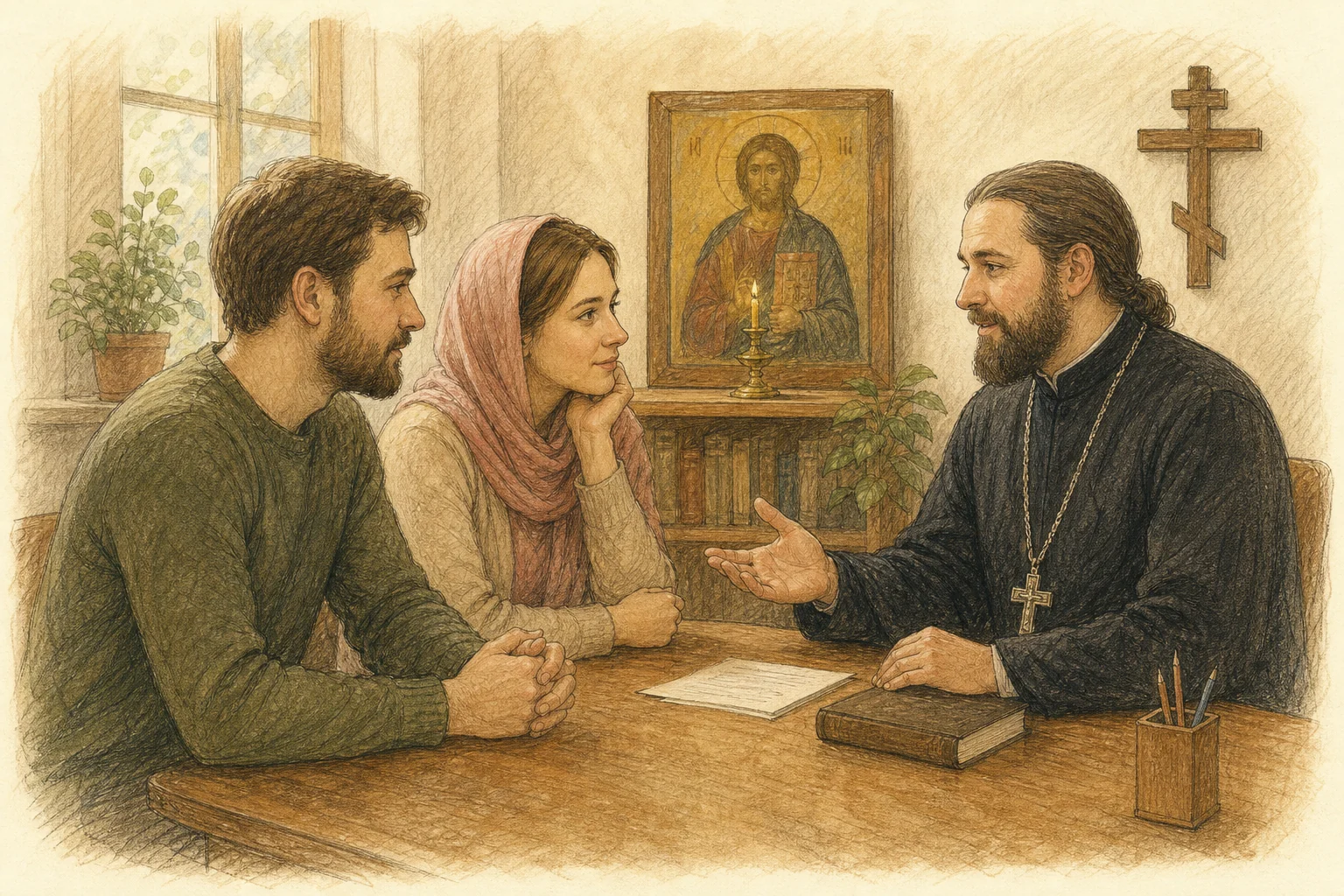
In the Orthodox Church, a man and a woman may be crowned in marriage when they freely and knowingly enter a lawful union, have no canonical impediment, and intend to live in faithfulness, faith, and mutual responsibility. Normally both are Orthodox Christians. Particular cases involving a Christian of another confession are handled according to church rules with the priest and, when required, the diocesan bishop.
A desire for a beautiful ceremony is not enough. Before setting a date, the parish must clarify civil registration, Baptism, previous marriages, kinship, and other circumstances. The right first step is therefore a pastoral conversation, not ordering candles or booking a reception.
What the Church means by marriage
Church marriage is not a decorative addition to a wedding and not spiritual insurance for a relationship. A man and a woman publicly give free consent and ask God to bless their union as a life of fidelity, service, shared prayer, and Christian responsibility.
Crowning does not replace daily work: speaking truthfully, protecting one another, raising children, repairing conflict, and seeking help during a crisis. The sacrament gives grace, but it does not cancel human freedom.
Is civil registration required?
In Russia and in other places where a church ceremony has no civil legal effect, Crowning normally follows state registration of the marriage. The civil certificate confirms the spouses’ legal responsibilities and protects their rights and the rights of children. A promise to register at some future date is not sufficient in an ordinary case.
Crowning before registration is possible only in exceptional circumstances through the proper church decision, such as a documented danger to life when timely civil registration is impossible. It is not a shortcut for a couple that simply prefers to avoid legal responsibility.
Must both people be Orthodox?
The normal order is the marriage of two baptized Orthodox Christians who do not reject the faith and who understand the sacrament. No one has to pretend to possess perfect church experience, but both must be honest about Christian belief and willing to build a shared life in the Church.
If one person has been absent from church for years, this calls for preparation rather than an automatic rejection. Conversation, Confession, prayer, and a return to parish life help distinguish a free decision from pressure imposed by relatives.
Marriage to a Christian of another confession
In certain circumstances, the marriage of an Orthodox Christian to a baptized non-Orthodox Christian may be permitted by pastoral economy and the diocesan procedure. Questions normally include the future religious life of the family and the Orthodox Baptism and upbringing of children.
Do not promise another person’s consent. Tell the priest the exact confession, whether Baptism took place, and what each person actually believes. The priest will explain whether the bishop’s blessing and additional documents are required.
Marriage to an unbaptized person or an unbeliever
The sacrament cannot be performed for a person who is not baptized or who consciously rejects the foundational Christian faith. Receiving Baptism only to obtain wedding photographs, without faith or preparation, turns both sacraments into a formality.
The Church nevertheless recognizes a lawful civil marriage and does not instruct an Orthodox spouse to destroy a family because Crowning cannot take place. The Christian may pray, remain faithful, and continue a respectful conversation without coercion.
Free consent is indispensable
No one may be crowned under threat, blackmail, family coercion, or in a condition that prevents understanding. Pregnancy, parental expectations, an already paid reception, or fear of public embarrassment cannot replace a free yes.
If the relationship includes violence, financial control, threats, stalking, or isolation, do not use a church ceremony as an attempt to repair danger. Establish safety first and seek appropriate professional and pastoral help.
Age and capacity to consent
The future spouses must meet the legal marriage age and be capable of making a free, responsible decision. Minority, a legal finding of incapacity, or a severe condition that prevents informed consent requires separate legal and ecclesiastical review.
A large age difference does not provide a universal answer by itself, but the pastor may appropriately explore dependency, pressure, and whether the decision is realistic and free.
Kinship as an impediment
Close blood relationship prevents church marriage. Certain degrees of affinity, adoption, and spiritual kinship are also considered, including relationships established through sponsorship at Baptism.
Do not try to settle a complicated family tree using an anonymous internet chart. Draw a clear diagram and show it to the priest. Some cases are obvious; others require a canonical determination.
Previous marriage and divorce
A divorce does not mean that church life is permanently closed, but a new Crowning is not scheduled automatically. The parish must know whether the former union was crowned, why it ended, how many marriages have occurred, and whether a church decision concerning the earlier marriage already exists.
Bring the documents and describe the history honestly without placing every fault on an absent former spouse. A second or third marriage may require diocesan authorization. Fourth and subsequent marriages are not permitted by the relevant norms of the Russian Orthodox Church.
When a spouse has died
Widowhood ends the earthly marital union, and the surviving person may enter another marriage. The Church honors the deceased while not forbidding the living person to build a family.
The timing is personal. There is no magical period after which grief must disappear. It is wise to discuss readiness honestly with those affected and with a priest.
Holy Orders and monastic vows
A person who has made monastic vows does not enter marriage. An already ordained clergyman may not marry after ordination. If a candidate for priesthood chooses married life, the marriage takes place before ordination.
These are specific canonical circumstances and cannot be resolved by an ordinary request for a service. They belong to the competent church authority.
Pregnancy and children
Pregnancy is not an impediment to Crowning. Having a child together, or children from previous relationships, does not by itself prohibit the sacrament. What matters is the lawful union, the canonical conditions, and responsible care for every child involved.
Do not delay medical care or civil registration for the sake of a ceremony. The length and practical arrangements can be discussed in light of the pregnant woman’s health.
May a long-married couple be crowned?
Yes. Spouses may come to the sacrament after years or decades of lawful family life when both freely desire it and no impediment exists. Their previous years do not become unreal or morally worthless.
Preparation is still necessary. Each person’s faith, the meaning of the promise, and unresolved family difficulties do not disappear merely because the marriage is old.
Days when Crowning is not performed
The church calendar limits the days on which marriages are crowned. The service is generally not held during the longer fasting seasons, on the eve of fast days and major feasts, and during certain festal periods. Exact dates change with each year’s calendar and local order.
Do not reserve an expensive reception before speaking with the parish. Ask about an available day through the contact page and consult the general service schedule.
What to bring to the first meeting
Prepare identification, information about civil registration, Baptismal certificates when available, and documents concerning previous marriages. Write down each person’s confession, parish connection, and any potentially relevant kinship.
If a Baptismal certificate has been lost, do not buy a false paper or seek a second Baptism “just in case.” The parish will explain how the fact may be verified and what investigation is appropriate.
A practical sequence
Contact the parish and attend the first meeting together. Clarify impediments and documents, complete the required preparation, agree on a date, and only then finalize the external arrangements.
Our fuller article on pre-marital talks before Crowning explains which subjects should be addressed before making solemn promises.
Common questions
May a couple be crowned if one spouse objects?
No. The free consent of both is essential. Conversation must remain respectful; pressure, secret scheduling, and manipulation are incompatible with the sacrament.
Should an unbaptized person be baptized for the wedding?
An unbaptized person needs a genuine path toward faith and an informed Baptism, not a technical certificate. The decision cannot be made solely for the ceremony.
Can Crowning take place without witnesses?
The practical role and qualifications of attendants should be confirmed with the parish. Their presence or absence does not resolve civil registration, faith, or canonical impediments.
Is a second church marriage possible?
It may be possible after the circumstances are reviewed and the required authorization is received. Permission is not automatic.
Can we reserve a date by telephone?
You may ask provisionally, but a final decision follows the pastoral meeting and examination of documents.
The essential point
Crowning is not available merely to anyone who books it. It is for a man and a woman who freely enter a lawful union, accept the Christian meaning of marriage, and have no canonical impediment. A complicated circumstance should not be hidden; it should be discussed early and calmly.
The Russian Orthodox Church’s official document On the Canonical Aspects of Church Marriage states the governing principles. A personal parish conversation applies them responsibly to your actual history.