
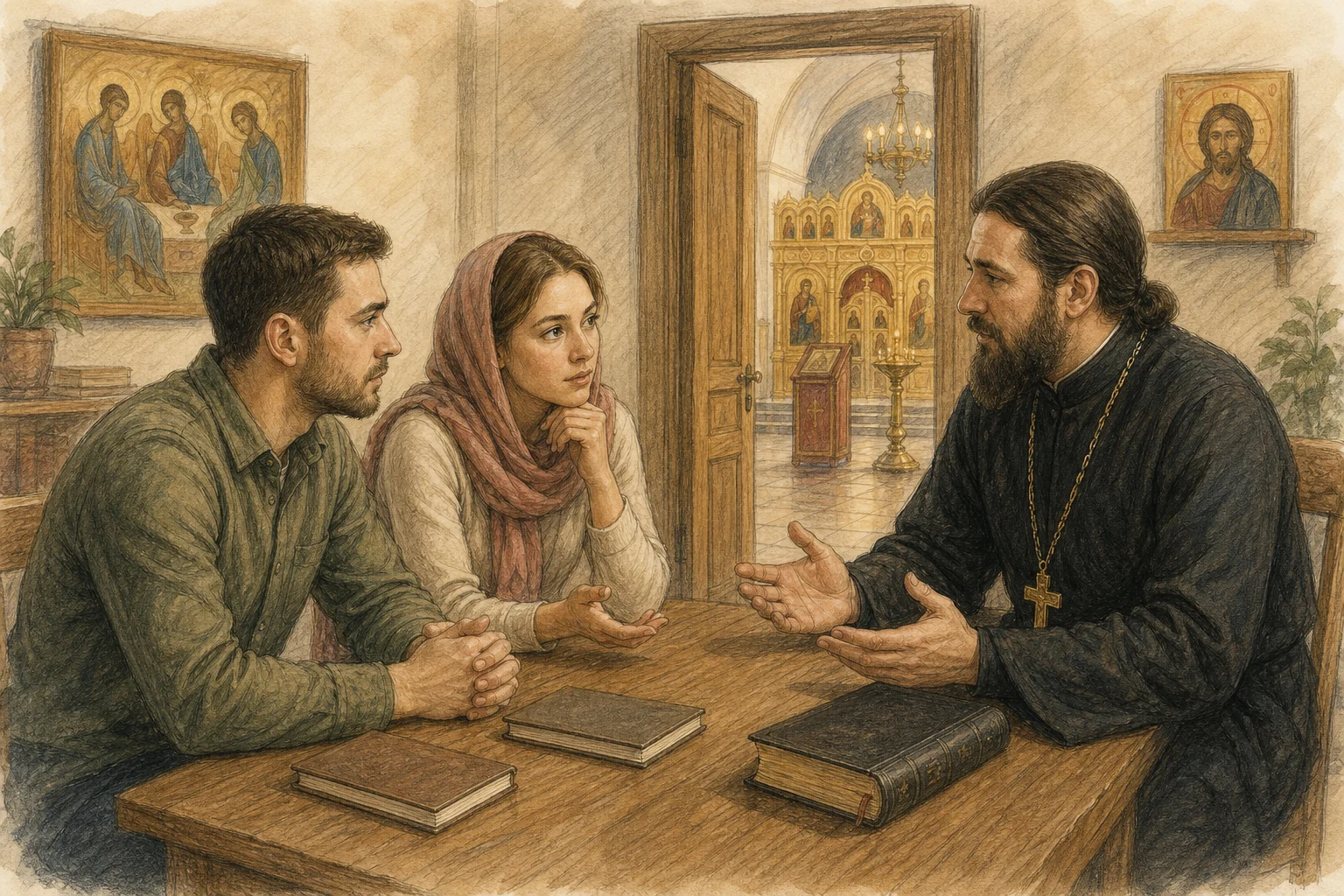
Pre-marital talks before Orthodox Crowning help a couple understand church marriage, verify that no impediment exists, and discuss faith, fidelity, children, money, conflict, and shared life before making solemn promises. They are neither an examination of perfection nor a ceremonial lecture required only for a certificate.
The Russian Orthodox Church’s official document on canonical aspects of marriage explicitly calls for preparatory instruction. The number, format, and timetable of meetings are set by the diocese and parish, so couples should ask early.
Why reserving a date is not enough
External arrangements easily consume all attention: clothing, guests, photography, transportation, and the reception. Crowning, however, contains a promise concerning the whole of life. The Church must know that both people understand it and come freely.
A meeting creates room for a difficult subject that should not first appear on the day of the service: a previous marriage, different religious commitments, parental pressure, undisclosed debt, addiction, or fear of one’s partner. Early truth prevents later harm.
Is this an examination or a conversation?
Good preparation combines teaching with dialogue. A catechist or priest explains the sacrament; the couple asks questions and describes its real circumstances. The aim is not to catch someone who cannot recite a prayer.
The conversation nevertheless has consequences. If an impediment, abuse, lack of free consent, or conscious rejection of the faith appears, the ceremony may be postponed or may not take place.
How many meetings are required?
There is no universal number for every parish. Some provide one extended meeting, while others use a series of classes followed by a personal conversation with the priest. A complicated history naturally requires more time than a straightforward situation.
Do not leave preparation until the final week. Clergy schedules, documents, and a possible diocesan request all take time.
The first question: why do we want Crowning?
“It is customary” or “our parents insist” suggests that the meaning has not yet become personal. Each person should be able to say what Christian marriage means, what he or she asks from God, and what responsibility is being accepted.
The answers may not be identical, but hiding them is dangerous. Crowning must not become a condition for reconciliation, a tool for trapping a reluctant partner, or a beautiful addition to the reception.
What is discussed about faith?
The conversation includes Baptism, foundational Christian belief, prayer, participation in the Divine Liturgy, and a willingness to build family life around more than material goals. Honesty matters more than a performance of ideal church behavior.
If the Creed remains unclear, read our plain-language explanation of the Creed and bring questions. Lack of knowledge can be addressed; pretended agreement corrodes trust.
Documents and canonical impediments
The parish clarifies civil registration, Baptism, legal age, kinship, and previous unions. A mixed marriage, divorce, or missing record may require an additional diocesan process.
Our guide to who may marry in the Orthodox Church explains the main conditions. Bring the facts at the beginning rather than hoping a difficulty will remain unnoticed until the service.
Free consent and personal safety
The priest may speak with each person separately to exclude coercion. Pregnancy, financial dependence, family pressure, or an already purchased celebration does not automatically make consent free.
When there are blows, threats, surveillance, sexual coercion, or control of money and documents, a religious ceremony is not a cure. Safety, specialist support, and individual pastoral care must come first. A victim must never be ordered to endure danger for the sake of a crown.
Fidelity and boundaries
The couple should discuss exclusivity, flirting, pornography, private messages, former partners, and digital privacy. It is better to name boundaries before promises than to discover opposing assumptions afterward.
Fidelity is not total control of another person’s telephone. Trust joins honesty, respect, and a willingness to acknowledge a violation.
How do you handle conflict?
The question is not whether disagreements exist, but what happens during them. Insults, prolonged punitive silence, threats of divorce, and destruction of property cannot be dismissed as temperament.
Agree on safe pauses, a return to the conversation, rules that exclude humiliation, and the point at which professional counseling will be sought. A priest addresses spiritual life but cannot replace every kind of specialist.
Money, debt, and work
Before Crowning, disclose loans, support obligations, major liabilities, and expectations about common and personal funds. Secret debt becomes a moral problem as well as a financial one.
Discuss housing, employment, care of relatives, generosity, and the process for large purchases. Christian marriage does not require equal salaries; it requires truth and justice.
Children and parenthood
The couple speaks about openness to children, their Baptism and formation, infertility, adoption, and medical care. No one should promise another person’s agreement when it does not exist.
If either person already has children, discuss their safety, place in the new household, relationship with the other parent, and financial responsibilities. A new marriage does not erase earlier duties.
Marital intimacy and respect
Within Christian marriage, bodily intimacy belongs to faithful love; it is not a right to use another person. Consent, tenderness, health, and the ability to discuss boundaries remain important after the wedding.
Preparation does not require public disclosure of intimate detail. A serious matter may be raised privately with the priest and, when appropriate, with a physician or therapist.
Parents and the boundaries of the new family
Honoring parents does not give them authority over every marital decision. Discuss visits, practical help, apartment keys, financial participation, and ways to stop demeaning interference.
The couple becomes a family without abandoning love for relatives. The task is to establish adult boundaries without revenge or contempt.
Prayer and parish life together
Decide what Sunday, prayer at home, and participation in the sacraments may realistically look like. Do not design a two-hour daily rule when neither person currently prays.
Begin modestly: a brief morning or evening prayer, a few Gospel verses together, and the Liturgy as circumstances allow. Current services appear in the schedule.
Confession and Communion before Crowning
Future spouses are normally encouraged to confess and receive Holy Communion. This is not a magical stamp, and it never gives one fiancé the right to demand the contents of the other’s Confession.
Agree on preparation with the priest in light of health and actual church experience. Each person’s Confession remains personal.
Questions to ask the priest
Ask about calendar restrictions, documents, the length of the service, attendants, rings, icons, photography, clothing, and accessibility for a person with a disability. Confirm what the parish provides and what the couple brings.
Practical questions are not less worthy than theological ones. Clarity reduces commotion and makes prayer easier on the day itself.
When a serious disagreement appears
Do not treat a postponed date as disgrace. It is better to stop before promises and understand the issue than to expect the sacrament to change another person’s convictions or character automatically.
Sometimes more conversation is enough; sometimes professional couples counseling is needed; sometimes declining the marriage is the honest decision. The Church does not require an unsafe plan to continue because a celebration has been paid for.
Preparing for the first meeting
Each person can write three expectations, three concerns, and several questions about faith. Gather records, recall previous marriages, and map any potentially relevant kinship. Attend together and reserve unhurried time.
Use the parish contact page to ask about registration. Do not send sensitive details through an open messaging channel; simply request a private conversation.
Common questions
May we attend talks at another parish?
Sometimes another parish’s confirmation is accepted, but the church where Crowning will occur decides. Obtain agreement before starting the course.
What if one person knows much less about faith?
Different levels of knowledge do not prevent dialogue. Honesty, willingness to learn, and the absence of conscious rejection of foundational faith are what matter.
Must we tell the priest about every argument?
No. Identify persistent or dangerous patterns rather than giving a transcript of the relationship. Personal Confession must not become a joint interrogation.
Can the priest postpone the wedding?
Yes, when preparation is incomplete, records are missing, an impediment is discovered, or free consent is doubtful.
Do the talks guarantee a happy marriage?
No. They reveal meaning and risk, but faithful family life still requires the daily free work of both spouses.
The essential point
Pre-marital talks exist for truth, not bureaucracy. The couple examines readiness for Christian marriage, personal safety, canonical conditions, and its ability to speak honestly about difficult things.
Good preparation does not remove joy from the celebration. It frees the day from pretense and helps two people make their promises with open eyes.