
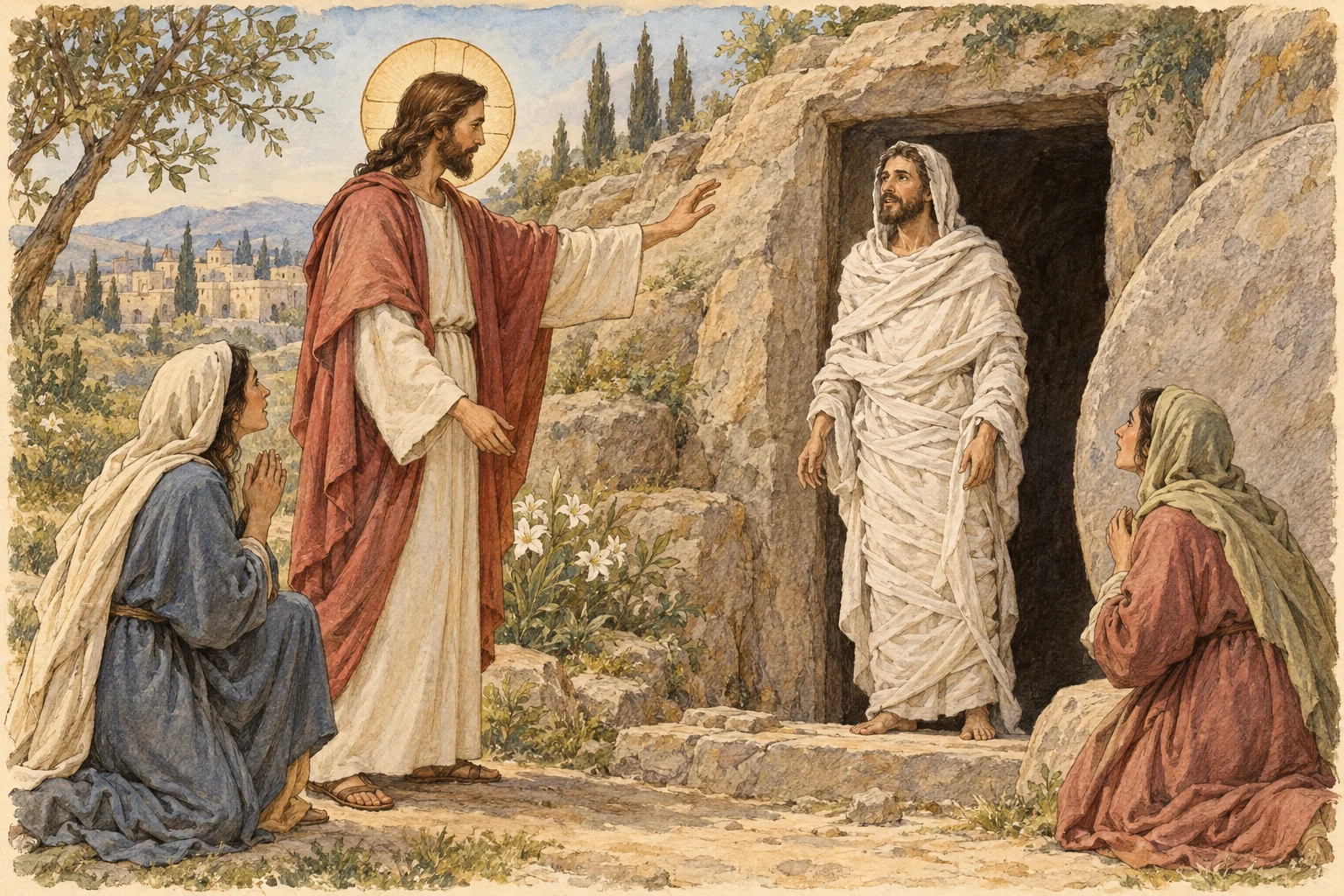
Lazarus Saturday comes immediately before Palm Sunday and brings the Church to the threshold of Holy Week. It commemorates the raising of Lazarus at Bethany in John 11. This Lazarus is Christ's friend, the brother of Martha and Mary, not the poor man in the parable of the rich man and Lazarus. Confusing those narratives obscures the feast.
What Happened at Bethany
When Jesus arrived, Lazarus had been in the tomb for four days. John describes the sisters' grief, Martha's conversation with Christ, and the Saviour's own tears. Christ then orders the stone removed and calls the dead man out. The four days emphasise the reality of death rather than suggesting an ordinary awakening.
The centre of the conversation with Martha is not a miraculous technique but Christ himself as resurrection and life. Do not skip the dialogue in order to reach the dramatic conclusion. Martha's faith is expressed amid pain, questions, and incomplete understanding, not in the calm of someone who already knows how everything will end.
Christ's Tears
His tears do not contradict his authority over death. Another person's loss is not treated as an abstract problem. The feast therefore cannot properly be used to shame someone grieving by insisting that a believer should never cry. Christian hope does not demand pretending that separation causes no pain.
When accompanying someone bereaved, remaining present, helping with ordinary responsibilities, and listening may matter more than immediately explaining the theology of resurrection. The promise of life does not authorise anyone to set a deadline for grief. The Gospel allows love, tears, and hope to occupy the same human experience.
Why Before Palm Sunday?
The liturgical sequence connects this revelation of Christ's authority over death with his entry into Jerusalem and voluntary journey towards suffering. Lazarus Saturday nevertheless has its own hymns and subject. It is not merely an early preparation for obtaining blessed branches, and should not disappear beneath the practical arrangements for Palm Sunday.
The raising of Lazarus is also not identical with Christ's Pascha. Lazarus returns to earthly life; the Saviour's Resurrection reveals victory over death in a definitive sense. The Saturday celebration points forward and strengthens hope without replacing the entire meaning of the Paschal feast.
Observing the Day
Read John 11:1–45 in order. Divide it, if helpful, into the news of illness, the encounters with the sisters, and the event at the tomb. This can work well in a family: each scene offers a separate question to discuss instead of presenting a child with a long summary that is difficult to follow.
If attending worship, check specifically for the Saturday Liturgy, not only the evening service for Palm Sunday. Any dietary relaxation belongs within Church practice and personal circumstances; it is not the day's central subject. Someone unable to attend church can still remember departed loved ones in prayer, support a grieving person, and prepare to follow the services of Holy Week attentively. Emotional excitement is not required. The feast teaches trust in Christ precisely where human strength and the ability to explain suffering reach their limits.
When discussing the miracle with a child, do not promise that a deceased relative will return home like Lazarus. Distinguish this particular Gospel event from the hope of the universal resurrection, answering questions about an actual loss honestly.
Martha and Mary: Hearing Both Encounters
In John 11, the sisters do not meet Jesus together. Martha goes out to him, and Mary subsequently leaves the house; the narrative makes room for each. Do not turn the reading into a contest between correct and incorrect grief. Notice how each addresses Christ, what she says, and how he responds. Their questions remain within the story rather than being removed as obstacles to belief.
This can guide a household after a loss. One person wants to talk, another prefers quiet, and another concentrates on necessary arrangements. Outward behaviour does not accurately measure love for the person who died. Ask whether a relative would welcome conversation, a walk, or help with dinner instead of making them conform to your idea of appropriate sorrow. Their answer may also change from one day to the next.
A Miracle Is Not a Method for Controlling God
Christ's command at the tomb is not a formula that produces a chosen result whenever someone repeats it. The account does not describe a human skill for bringing back the dead. Offers to reproduce the miracle for a payment, through an object, or by secret recitation should therefore not become an extension of the feast. Lazarus Saturday directs attention to Christ, not to finding a provider of extraordinary services.
We may pray honestly about what matters most without setting contractual deadlines for God's answer. If someone bereaved keeps asking why their request was not fulfilled, do not accuse them of insufficient faith. Sometimes the honest response is to admit that you do not know and remain willing to hear their pain. Quiet presence cannot explain the mystery of death, but it can prevent an additional burden of abandonment. You need not invent an answer in order to be helpful.
Approaching Holy Week
When planning the coming days, distinguish time for Lazarus Saturday from shopping and preparations for Pascha. You might read the chapter in the morning and choose one service you can attend attentively. If responsibilities are heavy, avoid a schedule that only works by sacrificing sleep or care for dependants. Agree beforehand who will remain with a child or an ill relative. Attention to the Gospel then has a practical consequence: there is still room for a living person beside you, not only for completing holiday preparations. A modest, workable plan can keep the reading from becoming just another item hurried through on a crowded list.
Sources
- John, chapter 11, Russian Synodal translation
- OCA: Lazarus Saturday liturgical outline
- OCA: Paschal message on the raising of Lazarus