
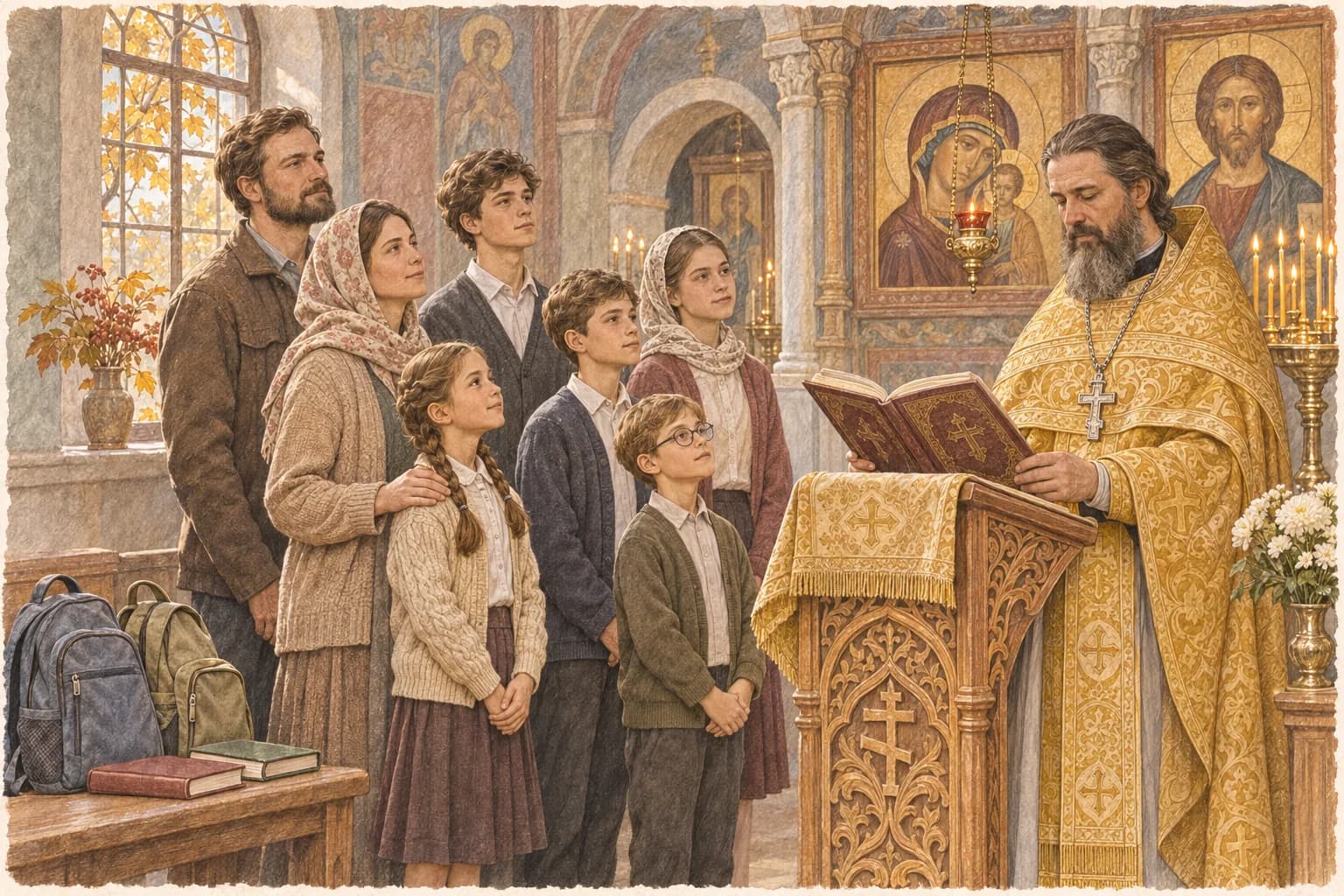
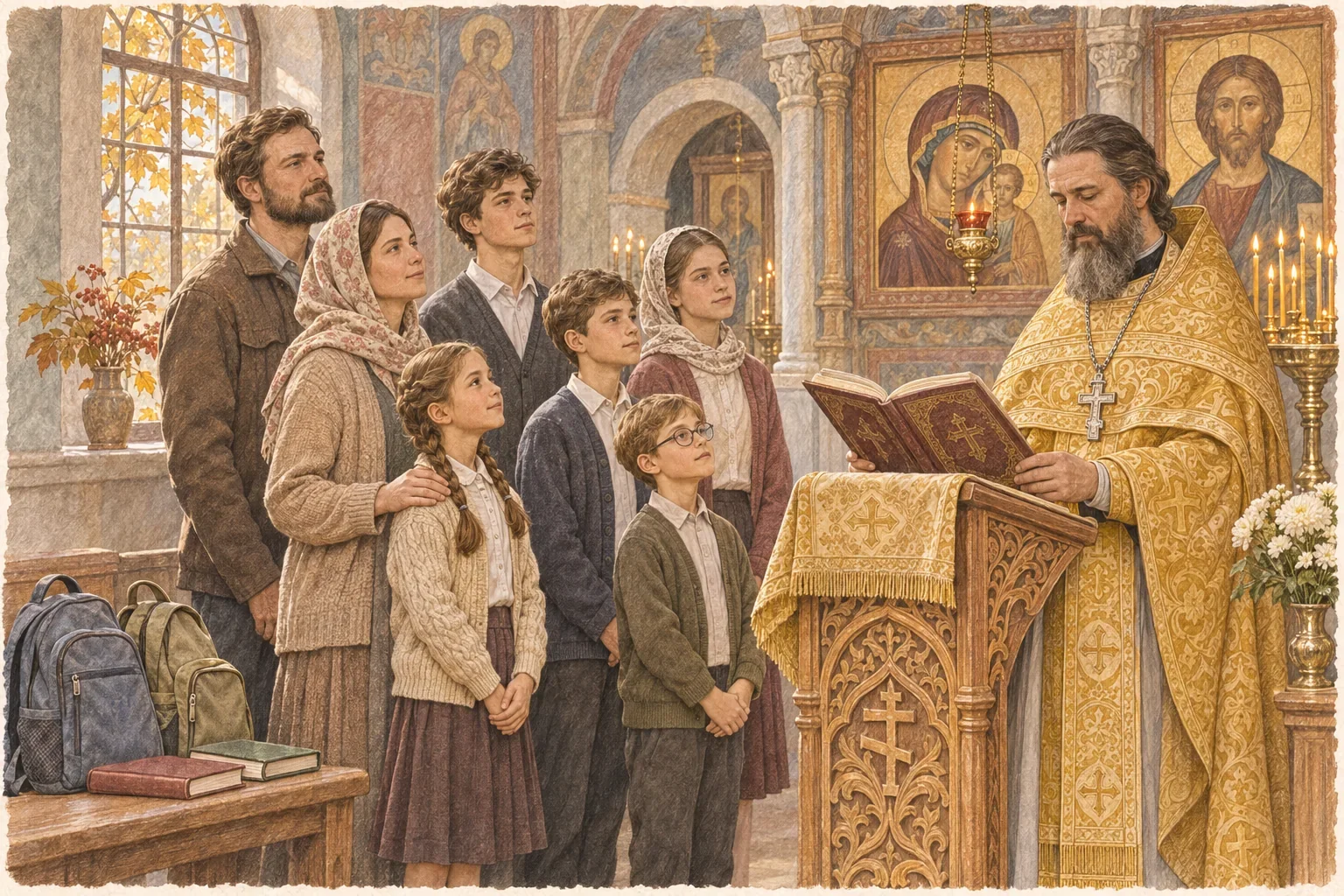
Prayer before the school year asks God’s help for students and teachers together. It does not promise high marks without effort. Its purpose is to begin learning with prayer, care for others and responsibility for one’s own work.
Explain beforehand where you are going and approximately how long the visit will last. Ask organisers about the duration. The parish announcement should clarify the service and whether names need to be submitted in advance.
Do not make attendance a condition of parental love or a method of forcing excellent grades. Prayer does not abolish learning difficulties, tiredness or the need for support. Specialist help, when needed, is not replaced by attending a service.
Afterwards, discuss one practical step: sleep, homework time or asking a teacher for clarification. Adults should also decide how to offer support without constant comparison with other children. This gives the prayerful beginning a practical continuation.
What pupils, parents and teachers pray for
A new school year involves more than mastering subjects. A child needs to listen to others, ask questions, acknowledge mistakes and live alongside classmates. Teachers need patience, clarity and fairness; parents need the ability to support a learner without taking over their work. Prayer at the beginning of education concerns this whole human undertaking, rather than just the final mark recorded in a school report.
It is therefore appropriate to ask for diligence, understanding and kindness towards one another. Wanting good results is natural, but attendance must not be presented as a guarantee of winning a competition or avoiding every correction. Learning involves gradually understanding difficult material. A mistake may be part of education, rather than evidence that prayer has failed to work.
Explaining the visit to a child
Use language appropriate to the child’s age: you are going to pray together, give thanks for the opportunity to learn and ask for help. Explain that there may be other children, prayers and a blessing, while the particular arrangements depend on the parish. Do not promise activities that have not been announced, such as gifts, an individual conversation for everyone or a compulsory tour afterwards.
For a first visit, identify a comfortable place to stand and explain whom to ask if help is needed. Let the child know that unfamiliar words can be discussed after the service. Constant comparisons with how supposedly good religious children behave rarely improve attention. An adult’s calm manner can show that prayer is an encounter with God rather than a public examination of discipline.
What to check with the parish
Check the date, time and connection with other services. An announcement saying after the Liturgy does not imply the same starting hour in every church. Ask whether attending only the supplication service is possible, how names are submitted and whether arrangements include learners of different ages. University students and adults starting studies may also seek a prayerful beginning, although local organisation may not accommodate every group in the same event.
If a child struggles with noisy crowds, needs step-free access or may need to sit, explain this beforehand. It helps make participation manageable. A family’s faith cannot be measured by a child’s ability to stand for a long time. During illness, recovering and discussing another way to participate is more sensible than bringing a feverish child merely to meet a single calendar date.
How prayer can shape attitudes to learning
A prayerful beginning invites people to see learning as part of human development, not merely a competition. Knowledge can support future work, understanding of the world and care for other people. This has an ethical dimension: cheating, bullying a struggling pupil and humiliating someone for an error do not become acceptable ways to improve a class ranking.
Parents can ask whether they praise genuine effort or a child’s position compared with someone else’s son or daughter. Teachers can distinguish demanding work from judging a person’s worth. A pupil can choose a small goal, such as asking when something is unclear or returning regularly to a difficult topic. That is more understandable than being expected to become a perfect student immediately after attending a service.
When the school year begins with anxiety
Changing schools, approaching examinations or a previous experience of bullying can cause serious anxiety. Do not answer simply by saying that you have prayed and the child must now stop being afraid. Listen to the particular concern and identify what adults can do. A conversation with a teacher, a change in daily demands or professional support may be needed. Prayer can accompany those steps rather than cancel them.
After the service, agree on one manageable change for the first week: preparing belongings in advance, protecting time for sleep or learning how to ask for assistance. Avoid making twenty new commitments in a moment of enthusiasm. A modest promise is easier to keep and review. The church visit can then begin a more attentive relationship rather than become an isolated event followed by the same old pressure.
A question for reflection
What support does the child need during the coming school week?