
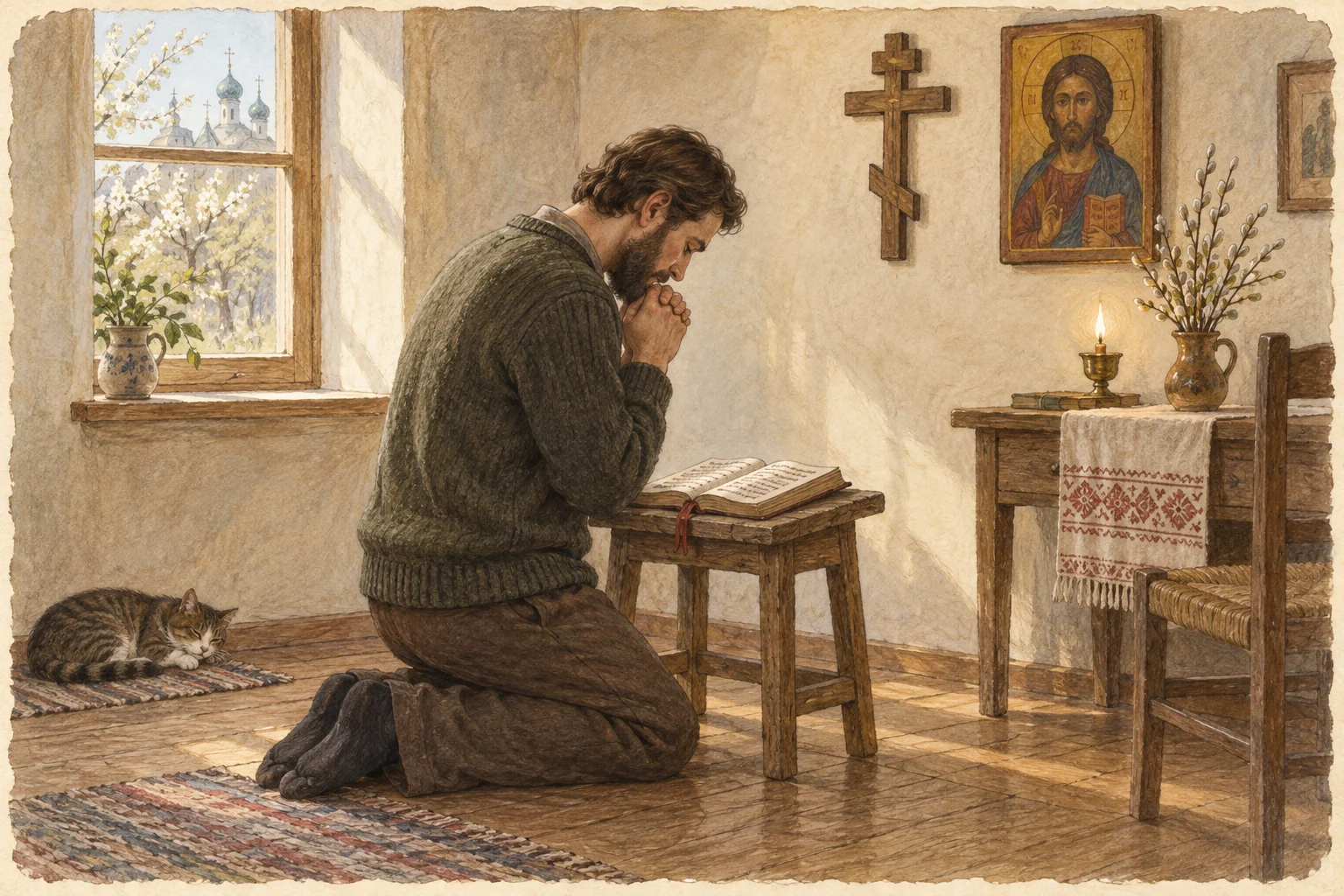
Saint Ephrem’s prayer sets out an inner programme for fasting: what we seek freedom from and what we ask God to give us instead. It ends not with judging other people but with asking to recognise our own sins.
The complete prayer
O Lord and Master of my life, do not let idleness, despondency, love of power and empty talk rule me.
Rather, grant me, Your servant, chastity, humility, patience and love.
Yes, Lord and King, grant me to see my own sins and not to condemn my brother, for You are blessed for ever and ever. Amen.
This is an explanatory English rendering of the traditional prayer, not an official English liturgical edition. Use your parish’s prayer book when praying together.
Understanding the petitions
Idleness is not the same as necessary rest. Love of power is the urge to dominate other people. Empty talk reminds us that speech can waste time and injure others.
Chastity includes integrity of the whole person as well as purity in relationships. Humility challenges self-importance. Patience and love are practised among actual, imperfect people, not only in an imagined ideal community.
The request does not suggest that God creates sin. We ask not to be abandoned to it. Spiritual despondency should not simply be equated with a medical diagnosis of depression.
When it is used
The prayer is particularly associated with weekday Lenten services. Its use depends on the day and service; it should not be inserted automatically into every service throughout the year. A prayer book with seasonal directions is helpful for home use. Ask a priest about uncertain cases.
Bows and prostrations
In the familiar full order, each of the three petitions is followed by a prostration. “O God, cleanse me, a sinner” is then said twelve times with bows. The complete prayer is repeated once, followed by one prostration. Some liturgical uses have a shorter order.
A bodily gesture expresses prayer; it is not an endurance test. Illness, injury, pregnancy or limited mobility may require adaptation. Do not cause yourself pain in order to reproduce someone else’s practice.
Not condemning does not mean accepting harm
It remains possible to identify cruelty, end an unsafe conversation and protect a child. The prayer turns us away from claiming final judgement over another person’s soul. A concrete beginning might be refusing to pass on gossip, admitting a mistake or apologising for an injury we caused.
What we leave and what we ask to receive
The prayer does not end with a list of things to avoid. Its second part names qualities without which reclaimed time and restrained speech could remain empty. You might stop recounting another person's mistakes while continuing to despise them inwardly. Asking for patience and love moves beyond outward silence. During study, ask not only what you are stopping, but what you are learning instead. This is not a compulsory one-to-one scheme pairing every fault with a virtue; it is a way of recognizing the movement of the whole prayer.
Idleness and necessary rest
An exhausted person may hear a prohibition against stopping. Rest after work, sleep, and recovery should not be labelled spiritual failure. The question concerns how we use the life available to us, not a demand to be continuously occupied. Someone can rush about all day while avoiding one responsible conversation. Another may rest quietly in order to fulfil duties later without taking exhaustion out on the family. Distinguishing these situations honestly is more helpful than counting every inactive minute as a fault.
Love of power without an official position
The wish to dominate is not confined to management. It can appear in a family, friendship, or shared charitable task when help is offered only on our terms. One example is insisting that a relative not merely hear advice but immediately act on it. Asking freedom from this passion allows care to remain without taking ownership of another person's responsibility. Directing a task entrusted to you and seeking personal control over someone are not the same thing. Clear responsibilities can support cooperation without humiliation.
Empty talk in messages
The prayer also concerns words we type. Before forwarding someone's story, check whether it is reliable, whether you are entitled to disclose its details, and whom it will actually help. Avoiding empty speech does not prohibit friendly conversation, humour, or comfort. It challenges words used without responsibility for their consequences. A private question to the person concerned may be more constructive than discussing their life in a group chat. Silence is not always the answer, but care with speech is part of the request.
Seeing your own faults without endless self-examination
The final petition returns attention to your responsibility. It does not require suspecting a hidden sin in every neutral thought. After praying, notice a particular error, name it, and identify a possible repair. If reflection becomes another accusation against everyone else, return to your own conduct. Other people's harm nevertheless remains harm: admitting that you spoke sharply does not make you responsible for someone else's violence. The prayer should not erase that distinction.
Bodily bows and attention to meaning need not compete. Someone unable to make the customary movement can still ask for patience and love. Do not correct a nearby worshipper without knowing their circumstances. At home, choose a clear, safe space beforehand so movement does not become a hurried effort between pieces of furniture. Care for the actual body is more appropriate than trying to demonstrate zeal through pain. The physical expression should support the prayer, not replace its purpose.