
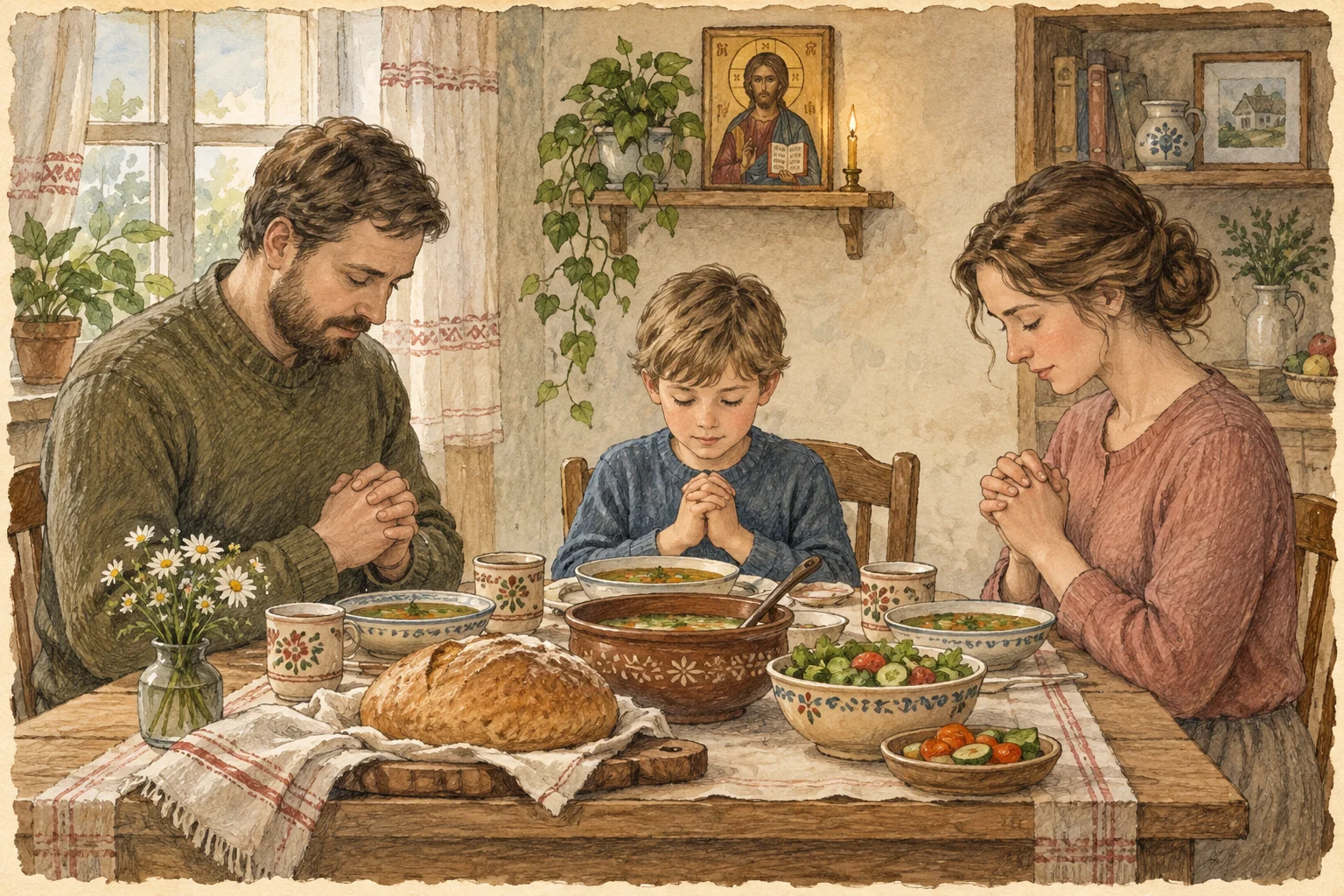
Prayer at a meal begins with gratitude. Food reaches us through work, care and gifts we do not create by ourselves. We ask God to bless the meal and give thanks afterwards. Prayer does not make unsafe food harmless.
Before eating
The Lord’s Prayer can be said before a meal. Orthodox prayer books also contain a short blessing. The following is an explanatory English rendering:
Lord Jesus Christ, our God, bless our food and drink through the prayers of Your most pure Mother and all Your saints, for You are blessed for ever and ever. Amen.
If you are beginning to pray, read a short chosen prayer attentively instead of trying to accumulate every available text. A priest can help you establish a suitable home practice.
After eating
We thank You, Christ our God, for satisfying us with Your earthly gifts. Do not deprive us of Your heavenly Kingdom; but as You came among Your disciples, Saviour, giving them peace, come to us and save us.
This explanatory translation follows the traditional thanksgiving. It connects an ordinary meal with the disciples’ encounter with Christ and hope in His Kingdom. For shared worship, use the wording in your community’s prayer book.
Praying as a family
One person can read while the others listen. Explain to children whom we thank and why, rather than demanding faultless pronunciation. Prayer at a shared table should not become an occasion to embarrass someone who does not yet believe or know the words.
At work or as a guest
Silent prayer is possible. You do not have to stop everyone else’s meal or draw attention to yourself. An invitation to pray together should leave other people free to respond.
If you remember only after starting to eat, give thanks then. Missing a formula has not spoiled the food and does not make punishment inevitable.
Gratitude and practical care
A blessing does not remove allergies, dietary restrictions or ordinary food-safety requirements. Nor does it replace thanking the people who cooked, brought groceries or welcomed you. Sharing with someone in need gives practical expression to gratitude.
Does every snack require a special formula?
There is no need to search for a different text for tea, every dish or every family member. A modest and consistent practice is more useful than anxious checking that every word was correct. Prayer is an address to God, not a test of ritual precision.
Why give thanks before and after?
Before the meal, attention turns toward what we are about to receive; afterwards, toward what has been given. These are not two inspections of whether the food has been made ritually correct. A brief pause notices an ordinary gift easily taken for granted. Simple soup is as much an occasion for gratitude as a festive table. The price of ingredients does not determine the importance of prayer, and modest food does not mean someone has received less of God's attention.
The movement of the thanksgiving
The text names earthly gifts, then the heavenly Kingdom and Christ's peace. This does not set eating against spiritual life. It recalls that being fed does not exhaust human need: people around a table also need peace and consideration. A harsh command or mockery of someone's habits can therefore be particularly noticeable immediately after prayer. You do not need to wait for a perfect household before praying, but it helps to keep thanksgiving connected to your own tone of voice.
A practicable order for different days
A family can agree on a brief common prayer without assuming everybody always eats at the same time. A schoolchild, a shift worker, and someone caring for an infant have different schedules. Discuss a simple arrangement for separate meals instead of repeatedly accusing an absent person of disrespect. A shared practice supports remembrance of God; it should not turn the dining table into a record of infractions. On a difficult day, brief and attentive gratitude serves better than an argument about who must wait for everyone else.
Children participating without embarrassment
A child can read a familiar short part or listen to an adult. If they stumble, do not make them repeatedly start again in front of guests. Explain one unfamiliar word after eating. Show gratitude through action too: clear the dishes together, thank the person who cooked, and take care with remaining food. This connects prayer with relationships rather than only a demand for silence before the first mouthful. Participation can grow without making a child's performance the centre of the meal.
Hospitality and freedom
When welcoming guests, explain your custom calmly and leave them free not to say unfamiliar words. Silent respect need not be tested by questioning their faith at the table. As a guest yourself, brief inward prayer can preserve your practice without unexpectedly taking charge of someone else's meal. Discuss the meaning of thanksgiving when there is genuine interest, rather than using an invitation to eat as an opportunity for compulsory instruction. Consideration for a guest belongs with, not against, prayer.
Care rather than anxious control
Gratitude can take the form of thoughtful shopping, recognition of another person's work, and manageable help for someone lacking necessities. It does not require finishing everything at any cost or forcing another person to eat. Appetites, health, and suitable foods differ. Do not comment on someone's plate as evidence of their spiritual condition. Prayer does not remove their right to explain calmly what they can eat, and never justifies concealing ingredients to overcome what someone dismisses as fussiness. Care for food and respect for the person receiving it belong together.