
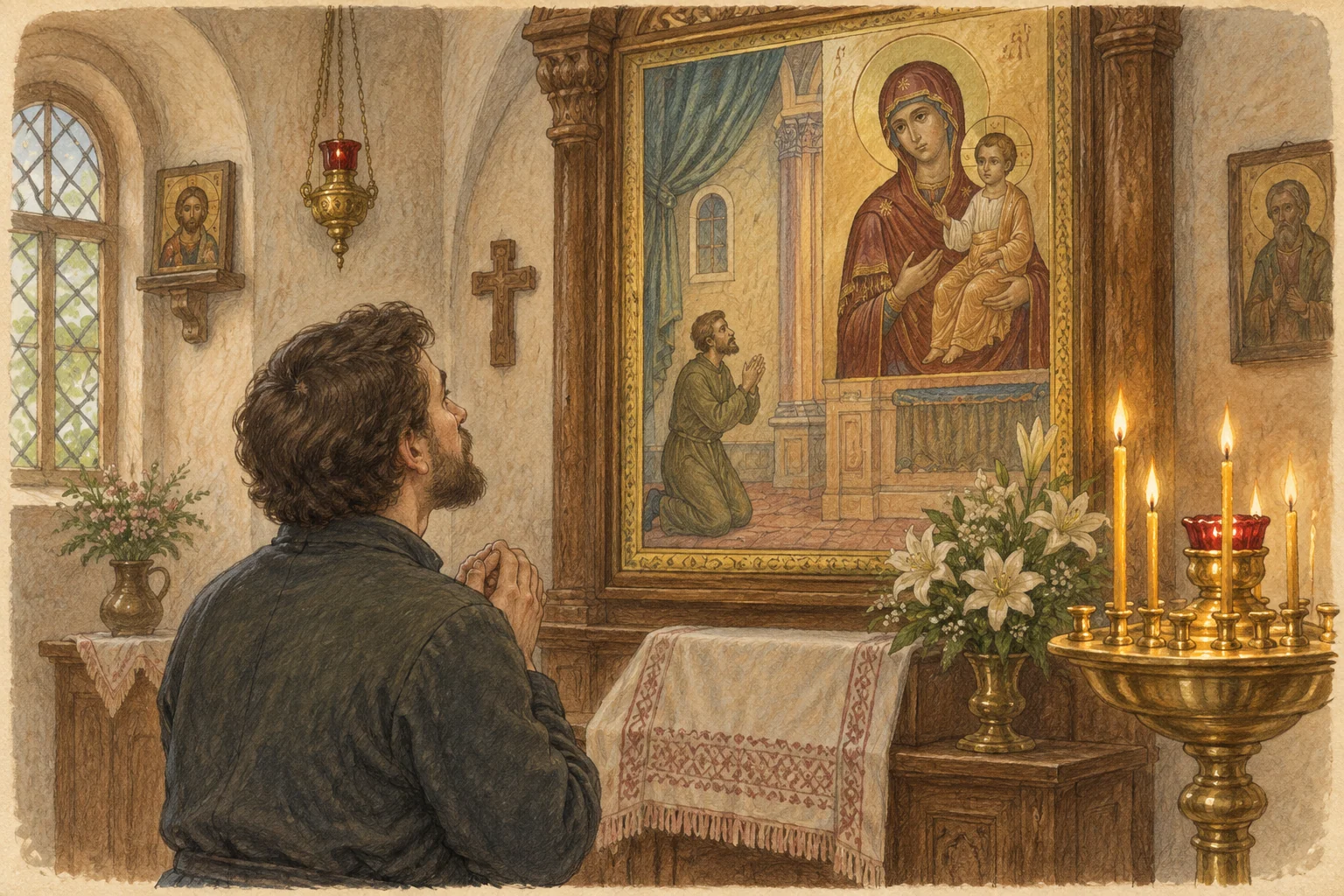
Unexpected Joy means a joy that was not anticipated, perhaps one a person no longer dared to hope for. The icon's title concerns forgiveness and the possibility of changing one's life. Reducing it to a promise of sudden good fortune loses the narrative: this is not an illustration of a lucky break but of a sinner encountering divine mercy.
The Narrative Behind the Image
The composition is associated with a story in Saint Dimitry of Rostov's work known in Russian as The Dewed Fleece. A man continued to pray to Mary while intending to sin. In the narrative he saw wounds upon the depicted Child, recognised the gravity of his conduct, and begged forgiveness. Pardon became his unexpected joy.
This is an instructive religious narrative, not an additional Gospel episode about Jesus' childhood. It exposes the contradiction between prayerful language and deliberately chosen wrongdoing. Its challenge concerns self-justification, not people troubled by intrusive thoughts who are already frightened of doing wrong.
An Icon Within an Icon
The composition shows a person standing or kneeling before an image of Mary and the Child. Viewers therefore see both the sacred figures and a human response to them. In some versions inscriptions help explain the dialogue. These details may vary while the central movement towards repentance remains recognisable.
Attention should rest on the change in the person's direction, not merely on the dramatic sight of wounds. He stops treating devotion as a cover for his conduct. This distinction also protects a careful reading from becoming an invitation to fear every passing thought. An unwanted anxious image is not the same as a considered intention to harm.
What Forgiveness Means
Repentance is not a method for making God yield after enough repetitions. Mercy cannot be bought with a lengthy prayer rule or a large donation. What matters is ceasing to excuse a wrong and becoming willing to repair its consequences where possible. That may mean returning property, acknowledging a lie, ending bullying, or making an apology.
A person who has been hurt is not required to restore trust immediately because an offender declares repentance. Forgiveness and the resumption of a former relationship are not identical. Real change allows time for its credibility to be tested and respects another person's boundaries. The icon must never become an argument for forcing someone back into danger.
Prayer Without Bargaining
Begin by naming a concrete difficulty honestly: “Help me stop excusing my lies,” or “Teach me to ask forgiveness.” These are examples of personal words, not an authorised liturgical formula. Afterwards, identify one feasible action. When preparing for confession, consider actual conduct rather than constructing a speech which condemns your entire identity.
The icon's title does not forbid asking for ordinary happiness, health, or peace at home. Its meaning is preserved when the petitioner leaves the answer to God instead of setting a deadline for a miracle. During profound sadness, the absence of a joyful feeling is not evidence of divine rejection. Prayer can be brief and quiet. Support from trusted people and a conversation with a priest may be more fitting than attempting a long akathist when exhausted. The narrative ultimately invites truthful hope, not another anxious performance.
When reading with a child, distinguish acknowledging a wrong action from labelling the child bad. Repentance includes the possibility of change. Constant personal humiliation works against the hope expressed by the icon's name.
Three Movements Within One Story
The Unexpected Joy narrative can be read in three movements: a familiar act of devotion, an interruption by the truth about an action, and a request for mercy. In the Church's account, the man initially fails to acknowledge the contradiction between praying and intending to sin. Change begins when his usual excuse can no longer stand, not when he acquires a special object. The praying figure therefore matters to the composition as much as its title.
Look at the direction in which the figures turn and how the conversation is indicated. Versions do not all contain the same inscriptions, and a small reproduction may make the lettering unreadable. Do not guess its words and then attribute that guess to Saint Dimitry. Read the basic narrative separately and discuss differences between images as features of particular versions.
Making Amends Without Demanding Immediate Trust
Consider someone who circulated a false story about an acquaintance and now regrets it. Repair involves more than acknowledging it in private prayer. They can stop forwarding it, tell the same people that the information was wrong, and stop attributing their conduct entirely to provocation. They should not impose a meeting on the person harmed or demand confirmation that forgiveness has already occurred. The way of making amends must respect that person's safety and willingness to communicate.
Another example is a broken promise. Instead of a dramatic vow that it will never happen again, name a realistic action and a time you can meet. If the original promise cannot be fulfilled, say so honestly. The joy of forgiveness does not require pretending that consequences vanished instantly. Hope and responsibility remain together: a person can begin to change without claiming the right to decide when everyone else must forget what happened. That distinction keeps the story's invitation to repentance from becoming another demand placed on those who were hurt.